Super puzzle from Puck, though a couple of the answers went in from wordplay without any clear idea of the definition. For the blog Wikipedia came to my rescue. Thank you Puck.
In bell ringing changes are mathematical patterns for ringing the bells. A plain course is a subset of the overall pattern for one of the bells. A “bob” is an instruction from the conductor to a ringer to move his or her bell on in the pattern. A triple indicates that 7 bells are being used. A plain bob triple is the name of a particular ringing pattern that contains 5040 rings before geting back to the beginning. From what I understand the pattern contains each of the ways that 7 bells can be rung in sequence, the number of such sequences being 7x6x5x4x3x2x1=5040.
The first record of a completed plain bob triple is at St Peter Mancroft Church in Norwich, the event being recorded on the church wall in 1715, 300 years ago. The event took 3 hours and 17 minutes.
Gervase @24 points out that triple only indicates that 7 bells are changing order, 8 bells might be used in total, the eighth bell remaining unchanged in the pattern.
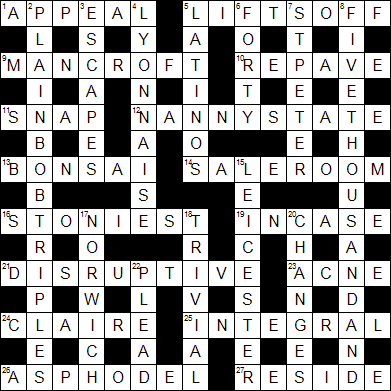
| Across | ||
| 1 | APPEAL |
How’s that possibly a parish’s first set of 20? (6)
A Parish (first letter of) PEAL (set of changes in bell ringing) – an appeal to the umpire in cricket |
| 5 | LIFTS OFF |
Launches takeaway illegally, so gets fines (5,3)
LIFT (steal, take away illegally) SO with F F (fine, two of) – takeaway needs to be separated into two words, not otherwise indicated in the clue |
| 9 | MANCROFT |
Working farm not occupied by Cornwall’s first Conservative peer (8)
(FARM NOT)* anagram=working containing (occupied by) Cornwall (first letter of) – Lord Benjamin Mancroft, Conservative politician |
| 10 | REPAVE |
Traveller greeting flag again (6)
REP (travelling salesman) and AVE (greeting) |
| 11 | SNAP |
Article used in party game (4)
A (indefinite article) inside SNP (Scotttish National Party) |
| 12 | NANNY STATE |
How Singapore is described by some kid’s mother, say (5,5)
NANNY (a female goat, kid’s mother) then STATE (say) |
| 13 | BONSAI |
Sloth shown by partners after trimming box tree (6)
AI (the maned sloth) following (shown by) N and S (partners, in bridge) following (after) BOx (trimmed) |
| 14 | SALEROOM |
Abandoned Romeo after girl? Lots here, perhaps (8)
ROMEO* anagram=abandoned after SAL (a girl) – lots are items at an auction |
| 16 | STONIEST |
Most impoverished characters in Boston, ie students (8)
found inside (characters in) boSTON IE STudents |
| 19 | IN CASE |
Packed as a precautionary provision (2,4)
double definition |
| 21 | DISRUPTIVE |
Ex-PM’s 50% vituperation, 50% outrageously obstreperous (10)
DISRaeli (ex-PM, 50% of) and VITUPeration* (50% of) anagram=outrageously |
| 23 | ACNE |
Spots gas bill first (4)
NE (neon, a gas) with AC (account, bill) first |
| 24 | CLAIRE |
Girl writing paper in college (6)
I (i, concise newspaper from the publishers of the Independent) in (written inside) CLARE (a Cambridge college) |
| 25 | INTEGRAL |
Playing triangle for function (8)
TRIANGLE* anagram=playing – mathematical function |
| 26 | ASPHODEL |
One blooming peal’s wrong, including flipping first note (8)
PEALS* anagram=wrong containing DOH (first note) reversed (flipping) – a flower |
| 27 | RESIDE |
Sit in chair, topless (6)
pRESIDE (chair, as a verb) missing top |
| Down | ||
| 2 | PLAIN BOB TRIPLES |
Set of 20 in flat — result of scout doing two more jobs? (5,3,7)
PLAIN (flat) BOB TRIPLES (result of scout doing two more jobs) – a bell ringing pattern. When I was young scouts used to have “bob-a-job week” where they raised money by doing tasks for a shilling each. I think it is called “Scout Community Week” now, catchy. |
| 3 | ESCAPES |
Key copies for jailbreaks, say (7)
ESC (key, on computer) APES (copies) |
| 4 | LYONNAISE |
Your starter: one snail, freshly cooked with onions (9)
anagram (freshly) of You (stater, first letter of) ONE SNAIL |
| 5 | LATINOS |
Upstanding person, Italian, housing Mexicans in New Mexico? (7)
found reversed (upstanding) inside (housed by) perSON ITALian |
| 6 |
See 8
|
|
| 7 | ST PETER |
One allegedly met after death of first pet, Ermintrude (2,5)
found inside (of, part of) firST PET ERmintrude |
| 8,6 | FIVE THOUSAND AND FORTY |
Vegetarian starter mix, all oddly used for number of 20 in 7 9 17’s celebrated 2 (4,8,3,5)
Vegetarian (starter, first letter of) with MiX aLl (every other letter, oddly used) gives the Roman numeral VMXL (or 5,040) – the number of changes in St Peter Mancroft Norwich’s celebrated plain bob triple, 300 years ago in 1715 – but see Biggles A @2 and R P Hiscocks @30 for some more on Roman numerals, VMXL is not a valid expression of 5,040 as a Roman numeral. Update – The clue is is a variant on a charade: the words of the answer “Five Thousand and Forty” convert individually to V M and XL which are then indicated by “Vegetarian starter mix…” in a conventional cryptic manner. |
| 15 | LEICESTER |
Queen’s favourite city (9)
double definition – Robert Dudley, 1st Earl of Leicester, was a close friend and favourite of Queen Elizabeth I |
| 17 | NORWICH |
City choir now disheartened, sadly (7)
anagram (sadly) of CHOIR and NoW (missing heart) |
| 18 | TRIVIAL |
Getting 6 in test’s not worth mentioning (7)
VI (six, Roman numerals) in TRIAL (test) |
| 20 | CHANGES |
Puts clean nappy on small child by river leaving French city (7)
CH (child) by ANGErS (French city) missing R (river) |
| 22 | PLEAD |
Series of 20 after moving left up to daughter to offer in excuse (5)
PEAL (series of changes, bell ringing) with L (left) moving closer to the beginning (up) with (to) D (daughter) |
definitions are underlined
Thanks Peedee. Brilliant stuff from Puck. Once I got St. Peter, changes and Norwich google helped with the theme clues. Other clues were great with smooth surfaces. Liked 14a and 21a. Thanks, Puck.
A very lovely theme of the peculiar mathematical techniques of change ringing, and very satisfying to complete that sentence in 8,6 Down, “number of changes in St Peter Mancroft Norwich celebrated plain bob triples”, despite knowing nothing about this subject, being gently guided into it. The Wikipedia was, of course, a Godsend, also to get MANCROFT as opposed to ASHCROFT, who is slightly more famous!
Thanks PeeDee. I got there eventually but only with the help of Google and furthered my education again. But 5040 in Roman numerals is not VMXL, it’s VXL with a bar over the V. Wikipedia reveals 5040 is a factorial (7!), a superior highly composite number, a colossally abundant number, and the number of permutations of 4 items out of 10 choices (10 × 9 × 8 × 7 = 5040)!
Thanks PeeDee. This made me gnash my teeth when, having got all but the last two without aids, I googled the church and found the answer to 2D, which was too recondite for words.
Thanks Puck and PeeDee. I got most of it quite quickly but struggled with 9A and couldn’t parse 8D which (unlike Biggles @3) I think is fair, if you take V for Five and then MXL for Thousand and Forty.
I do remember doing Bob-A-Job week but that was before we realised that sending young boys in shorts to knock on strangers’ doors wasn’t always a good idea.
Just a little typo in 18d. VI is six; IV is four.
Thanks Puck and Peedee. I needed the blog today, since Google was helpful with bell ringing but not forthcoming on scouts tripling bobs.
I thought 3d was a bit unsporting, using an abbreviation of Escape to clue ESCAPES. I was similarly not fond of LEICESTER. My favourite was the simplest one, the double definition at 19a.
Clever, but a crossword that relies so much on Google for solving is hardly satisfactory.
I fully concur with muffin @8. Rarely has so much useless information been required to complete a crossword – almost all of it never to be used again. A pity since, as usual with Puck, there were some gems here.
An entertaining puzzle from Puck.
Never heard of PLAIN BOB TRIPLES but the wordplay obviously indicated BOB and the CHANGES answer led me to look up the answer.
Luckily the wordplay gave me MANCROFT (never heard of him!) and then I got NORWICH . ST PETER, CHANGES etc. From there it was a simple to look up the indicated number as I could’nt see how the wordplay got me there.
Apparently Puck expected us to use reference materials as he can’t possibly expect this to be general knowledge and the wordplay was obvious enough to lead us to the answer in Google. I personally have no problem with this, especially with a “Prize”. However the “no aids” brigade may have been a little nonplussed!
A nice prize puzzle.
Thanks to PeeDee and Puck.
I loved this puzzle, and learnt a lot from it as well!
Thanks to Puck and peedee.
I struggled with parsing some of the answers, so the blog was definitely helpful.
All of the ” thematic” answers (2D, 6D, the church in Norwich) are to be found in a single paragraph near the end of the Wikipedia article on bell ringing, so if you found it quickly, that made a big difference.
I struggled with the girl’s name for 24A, Claire was one of my candidates, but I just couldn’t make the leap from writing paper to ‘i’!
As an expert on bells and Norwich I found this far too easy for a prize puzzle.
Very enjoyable! Thanks to Puck and PeeDee. I’d missed that LATINOS was a hidden reversal, separately parsing SON as the “person” and ITAL as the abbreviation for Italian. My only excuse is that my mind was befuddled by struggling with adapting to Windows 8.1, having just had to replace my dead laptop.
I first came across the language of change ringing many years ago through Dorothy L. Sayers’ “The Nine Tailors”, but since then I’ve been interested in the mathematics of it. I didn’t know the history referenced in this puzzle, though, so I did need to use Google and Wikipedia. That didn’t bother me, as I like learning new information from puzzles, but I can see that solvers who like to do their crosswords on paper while travelling or sitting in the garden might find it frustrating.
Very enjoyable, but am I the only person who got ELOISE for 24a? Letter of Intent (LOI) is a paper and the European School of Economics (ESE – OK, I had to Google that) is a college.
So on the basis that The Damned’s ‘Eloise’ is a massively superior song to Gilbert O’Sullivans’s ‘Claire’ I am going to claim the prize on this one!
[Fiery Jack @ 15 Wasn’t it Paul and Barry Ryan who sang Eloise?
R_c_a_d @13 🙂
]
So last Saturday afternoon, we rang the bells for the bride to enter the church and then I sat down with the Guardian crossword. I solved 1a and then a couple of other clues and said to my fellow ringers “this is about bellringing”. I finished solving the very enjoyable crossword and then we rang the newly married couple back out again.
Thanks to Puck for a most entertaining and relevant crossword and to PeeDee for the blog.
muffin @ 16: Damn, you are right. However, I am too young to remember that so for me a Damned song it is. Thank you for giving a 52 year old the opportunity to write that sentence though!
Fiery Jack @18
You are welcome. (I don’t think I heard The Damned’s version – too old!)
I knew the required meaning of CHANGES but my knowledge of bellringing isn’t deep, so the fact that I was able to finish this puzzle without recourse to aids is a testament to Puck’s setting, IMHO. I thought the puzzle was a gem, especially after researching the theme post-solve. From what I recall CLAIRE was my LOI.
The only word in an answer that I thought may have caused a problem to solvers who like to complete a puzzle without recourse to aids, especially those from overseas, was the BOB in 2dn because only the middle letter was checked, and if a solver didn’t know anything about either bellringing or Bob-a-Job then it was hard to guess. Fortunately I knew the latter.
I did this on Saturday morning in Cheltenham while waiting for the jazz to start and,despite having to use Google, I thought this an excellent puzzle. Too many favourites to list and I certainly learned something about chronology.
Thanks Puck
Thanks Puck and PeeDee,
Absolutely fascinating. I love the sound of bells being rung (from a distance – just been listening to St Peter’s Norwich on my granddaughter’s computer; I don’t know how to lower the sound and now my ears are ringing).
On Friday I read the Church Times:
http://www.churchtimes.co.uk/articles/2015/1-may/features/features/the-day-that-maths-was-turned-into-music
and on Saturday I did Puck’s crossword. I also used to be a bellringer for a few years in my early 20s (many years ago) so once CHANGES went in, I was away.
However, I think my favourite clues were the non-themed REPAVE, LYONNAISE and LATINOS.
Thanks, PeeDee.
I enjoyed this a lot.
Fortunately I didn’t have recourse to Wikipedia, except to check that I had the right answer for the name of the Norfolk church. Like jennyk @14, it was Dorothy Sayers’s ‘The Nine Tailors’ which first introduced me to the maths of campanology. PeeDee isn’t quite right to say that TRIPLES are rung on 7 bells: they are rung on 8 (a whole octave), but the deepest bell, the ‘tenor’, is rung in the same position each time, so that the number of different arrangements is ‘only’ 7 factorial, i.e. 5040. If the tenor bell took part in the dance as well, the number of permutations would be a numbing 40320.
PS My favourite was LYONNAISE – a very tasty clue.
I found this an excellent challenge for a train journey, and despite a total lack of knowledge of the theme, I eventually managed it all except MANCROFT without looking anything up. Fairly tough but entertaining and educational.
Thanks to Puck and PeeDee
Without Google-Wikipedia I would have got nowhere, but, after seeing the theme, an early visit allowed me to get started and even finish quickly – even with BOB. Thanks to Puck and PeeDee.
Thanks P and P. Got changes straight off, knew it had to be bell ringing, but even with Norwich, St Peter and Plain Bob Triples eventually resorted to Google for 8,6.
Yet another who needed Wikipedia. I had “St. Peter” and “Norwich” pretty quickly, which was enough to find the page for St. Peter Mancroft, which also gives you everything you need in one paragraph.
I agree that “recondite” is the best way to describe this puzzle.
16ac’s surface reading made me smile, looking back on my days as one of the many impoverished students in Boston. (Okay, technically Somerville, in my case; the affordable parts of Boston proper are too far from Harvard to be practical.)
Finished OK but let us be accurate – 5040 in Roman Numerals is correctly most definitely not VMXL but MMMMMXL so I consider that a poor clue ( as on the Answerbank Crossword forum so do another few hundred solvers ) !
Just my opinion of course
Though technically incorrect as a Roman numeral, cryptically 5040 could be read as “five, thousand and forty” or V, M and XL?
R P H @30
As PeeDee suggested, the clue is to the words, not the numbers. As such, the clue is a charade. “Vegetarian starter” => V => FIVE, then (separately) the odd letters from “mix all oddly” => MXL => “THOUSAND AND FORTY”.
jennyk@32 – you are absolutely correct to point out that the clue for FIVE THOUSAND AND FORTY is a charade. I would have done so earlier but I confess I skimmed over the blog because I knew I had the correct answers and had parsed them all. Solvers who have complained about the inaccuracy and/or poorness of the clue haven’t understood it properly, IMHO.
As one of those who haven’t understood it properly could I point out that the answer to 8 is 5040, a finite number. It is not 5 together with 1040. While I understand that a clue may be a charade I haven’t encountered the construction in an answer before.
The annotated solution does not support such an interpretation, IMHO erroneously indicating that VMXL = 5040.
jennyk @ 14. I agree with you, I like learning new information from puzzles too.
V MXL is the cryptic part of the clue, not the definition.
Innovative construction and arcane campanology – this reminded me of Araucaria in his heyday.
Biggles A @34
The annotated solution does not say “5040”, it says “five thousand and forty” because that is what you enter in the puzzle. It then explains the construction – how you get the five, the thousand and the forty. It does not say that they make a single Roman numeral. If you look at how 5a is annotated as “LIFT/SO/F/F”, that is clearly not claiming that “lifts off” is a single word, so why assume that “V(egetarian)/M(i)X/(a)L(l)” indicates a single number?
jennyk @ 36. Thank you. Because the clue for 5a tells us the answer is in two separate words of five and three letters respectively. Why not assume the clue for 8d indicates a single number? After all, that is what the clue asks for, the number of changes.
Dunc T @ 35. The cryptic part of the clue is VMXL not V MXL. There is a difference.
Let’s agree to disagree.
I have a comment about the arguments advanced for 8,6.
If as claimed the wordplay is a charade then to work it has to invent a new type of of clue. It is a wordplay which produces another wordplay which in turn produces the answer. (I’ll christen this a multi-level charade. This case being of order two.)
Firstly I don’t think this invention is particularly fair without some kind of “Special Instruction” and secondly it doesn’t even work as the “first level” produces VMXL which by no stretch of the imagine the Roman numerals for 5040. Neither is VMXL a charade for the answer as it doesn’t clue the “and”.
So it appears that the only way to “parse” this clue is to already know or guess the answer from the word count and then ignore the fact that the “and” is omitted from the wordplay.
Nice try but no coconut this time. 😉
Brendan @38
You only need the “and” if you split the charade into the 4 individual words. If you split it as FIVE and THOUSAND AND FORTY, the MXL includes the “and”. Is it a two-level charade? The first level is to produce the two Roman numerals (V and MXL), then you write them in as words rather than numerals. That’s not a separate level of charade to me.
Biggles A @37
The answer in words is a single number, as the definition part of the clue requires. The charade in the cryptic part is two separate answers (numbers, in this case), as is the nature of a charade. I think if the two components of the charade had led directly to the words rather than the Roman numerals there would have been little quibbling about that split.
But you are right – it seems as though the two sides are never going to agree on this, so I’ll leave the discussion at this point.
jennyk @39
How do you know to split letters like that? Basing it on the correct answer I suppose??? Why not split it FIVE and THOUSAND AND TEN and FIFTY 😉
Can I insert these “and”s in any charade that takes od or even letters from words. I think not!
Why is it not a separate level of charade. If we had a clue.
CX (3,7,3,3)
Is this a charade or just telling me the answer?
Brendan @38 – I agree with your two levels of wordplay interpretation. This is what I am trying to convey in the updated blog (my fist attempt at interpreting 8,6 was clearly wrong).
I think that if one accepts that a wordplay that leads to a wordplay that leads to the solution is acceptable then the clue is fine. If one rejects this then the clue doesn’t really work.
My own view is that used infrequently this sort of pushing the boundaries adds interest to puzzles. However, if this became common practice then the number of possible interpretations of clues would become so huge that one would never know when one had the answer. For me, in this particular case Puck “breaks the rules” and gets away with it.
I was going to leave it, but since Brendan asked “How do you know to split letters like that?”, I’ll just reply that (for me) the clue tells me “Vegetarian starter” is separate from “mix, all oddly”, using a different method of hiding the letters clued, so why should I assume the V and the MXL are to be taken as a single number? Looking at the crossing letters and the letter count confirmed that they were separate parts.
That’s my reasoning but obviously it is not yours or PeeDee’s. Unless Puck joins the discussion, none of us can know how he intended the clue to be read. The annotation page is not clear on that (at least not to me).
The clue for FIVE THOUSAND AND FORTY seems to have caused upset, disagreement and some debate.
My intention in the wordplay was as per jennyk @42, i.e. ‘Vegetarian starter’=V=FIVE; ‘mix, all oddly’=MXL=THOUSAND AND FORTY.
So yes, it’s a charade and not really any different from any normal charade such as that for REP/AVE at 10ac….except for two things.
First, it involves splitting a phrase for one large number into a word and a phrase for two smaller numbers, which is unusual and perhaps tricky to see compared to the usual splitting of elements within a word.
And second, as pointed out by some above, there are effectively two levels of wordplay involved, in that once the V is obtained from ‘Vegetarian starter’ it then has to be converted to the word equivalent FIVE, and the same is true for MXL.
So hands up on that one. And although I do look to push the envelope from time to time, I alway try to keep fairness in mind and this was clearly on the borderline between being fair or not.
Puck – thank you very much for dropping by and enlightening us, always appreciated.
jennyk @42 – I don’t disagree with you. I didn’t mean to appear to be taking sides with BNTO against you, my apologies there. I just liked the sentence in one of his posts about the two levels of wordplay, something that I thought about too but failed to put so succinctly in my blog entry.
Compileritis!
Clues are mostly about two halves of an equation. Where the answer side is complex or obscure as this is, then it is very important that the wordplay part is satisfying.
Does anyone remember, or perhaps have a link to a copy of the Araucaria bell-ringing puzzle of a few years ago? As I recall it had a thin-looking grid. I would be very grateful to see that one again if anyone can help.
hedgehoggy @54 – that Araucaria puzzle has been mentioned here a few times, and since nobody has found a link to it yet, it must have been before mid-1999, so unless anybody saved a paper copy we are unlikely to see it (if anyone does have a copy I’d be interested too!)
Thanks Puck and PeeDee
Had completed all but CLAIRE back in May and this got left in the pile with the occasional look from time to time. Was only this week when I looked up colleges at Oxford and Cambridge that CLARE fell out. Not knowing the newspaper, i, went a more convoluted way with I – independent and Independent – newspaper. Similar to the argument with V MXL (which was the way that I’d parsed that one as well).
But what a great puzzle ! Puck has this knack of picking up a lesser known event that has some significant anniversary and putting together a clever themed puzzle around it that can generally be solved without having known anything of it. Then after you’ve finished – you are a little wiser about something new !! Fondly remember his puzzle on the Puck Fair !
Knowing that very few, if any other than the blogger will see this, but it is funny that the discussion of repetitive use of clue types was criticised (subtraction anagrams in Otterden’s 26,607), yet here not a peep in regard to the three hidden answer clues !!!
Hi Bruce, I still enjoy reading you comments however late 🙂
🙂
Hardly a great puzzle as some opine. Given the debate about 5040 and the need for most to resort to Wikipedia and Google for obscure bell ringing references, this is unsatisfactory. If the compiler has to introduce obscure knowledge for one to complete the puzzle then to mind it’s not up to par.