Preamble: Fourteen solutions must be thematically adjusted before entry. Solvers must highlight a statement expressing a character’s confidence that the adjustment would be performed for him, and his name. Only real words appear in the final grid.
A nice gentle puzzle – or so I thought, as I started the solving process. Clues were yielding left right and centre with no apparent adjustments. Then, of course, my first clash – last letter of 8d doesn’t match with 20a – we have S/T. The solving process began to slow down but I wasn’t discouraged as I found my second clash – 17d and 30a – S/T again. Is that it? Are all the S’s changed to T’s (or vice versa?) With that bit of (mis)information in mind I began the hunt for the other twelve clashes but, of course, I was wrong.
Three answers caused me more grief than any others: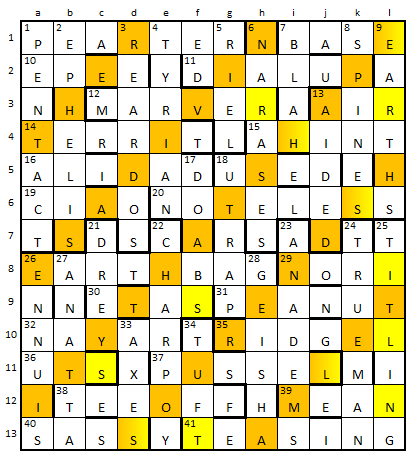
9d just did not want to yield at all – perhaps the two clashes made things worse;
33d wanted to be AXEL for ages but I just couldn’t see how it worked;
36a the biggest headache, knowing that Salt Lake City is in Utah meant, for sure, that UT meant Utah so where does the E come from? Does E mean local? I can’t find it anywhere.
Still, all three eventually capitulated, so it was on to the end game. I tried to make sense of my twelve clashes (not fourteen.) A quick look back at the preamble suggests that two of the adjustments are shared by two answers each, which is when I realised that all adjustments are to final letters of words, There are only a couple of instances where two answers’ last letters intersect and sure enough, 33d and 40a can both have their last letter changed to S (that makes thirteen) but there’s no further inspiration and I decided to leave it overnight. Next day I stared and stared but nothing jumped out at me. As a blogger, that’s when panic sets in, so I decided to start the blog and the Excel grid and all the other stuff in the hope that something would hit me but nada!
OK, time to regroup, the majority of hidden messages are in the diagonals but there’s no genuine diagonal in a 13×12 grid. 🙁 Then it struck me. Given that we’re looking for a statement and the character’s name, it’s probably spread over several diagonals but which ones? A close study of d13-l5 gives a potential candidate of OUR ENDS. A little more detective work and I have the full statement: THERE’S A DIVINITY THAT SHAPES OUR ENDS by HAMRET (of course, that should be HAMLET, which accounts for adjustment number fourteen – in 37a.)
So that’s it. In summary, a relatively easy solve but a fiendish end-game. Many thanks to Chalicea – looking forward to seeing you, again, on Saturday: https://www.fifteensquared.net/2015/06/11/sloggers-betters-york-oct-24-23-5-2015/ – all welcome.
| Across |
|||
| Clue |
Answer |
Adjusted answer |
Wordplay |
| 1 Local’s more lively when fisher’s line becomes tense (7) |
PEARTER | PEARlER (fisher; Line changed to Tense) | |
| 7 Dent top of beech tree (4) | BASH | BASE | Beech (top of)+ASH (tree) |
| 10 Arm chopped off outside of tents (4) |
EPEE | tEPEEs (tents; outside letters chopped off) | |
| 11 Using modem to help backward lecturer at college (6) |
DIAL-UP | AID (help; rev: backward)+Lecturer+UP (at college) | |
| 12 Poet’s ground encompasses heart of heavenly wonder (6) |
MARVEL | MARVER | MARL (ground [poetic]) containing heaVEnly (heart of) |
| 13 Intermittently racial trouble (3) |
AIL | AIR | rAcIaL (intermittently) |
| 14 One boob inside another ring (6) |
TERRIT | TIT (boob) containing ERR (boob) | |
| 15 Advanced clue is less advanced in rural Fife (5) |
AHINT (Scottish: in Fife) |
Advanced+HINT (clue) | |
| 16 Laid out commercial index of surveyors (6) |
ALIDAD | LAID (anag: out)+ADvert (commercial) | |
| 18 Oddly unsteady getting old (4) |
USED | UnStEaDy (oddly) | |
| 19 American spies getting over Berlusconi’s welcome (4) |
CIAO (Italian: Berlusconi’s) |
CIA (American spies)+Over | |
| 20 Unmusical discordant tones the French introduced (8) |
NOTELESS | TONES (ang: discordant) containing LES (the in French) | |
| 26 With attention put label round hard British feature of fortification (8) |
EARTHBAGS | EAR (attention)+TAG (label) containing Hard+British | |
| 29 Type of backward, feebleminded person with nothing going once (4) |
NORM | NORI | MoRON (feebleminded person; rev: backward) minus O (nothing) |
| 30 Small Scottish portion rejected – it’s rank! (4) |
ÉTAT | ETAS | TATE (small portion [Scottish]; rev: rejected) |
| 31 Song of praise with lowest note for plant (6) |
PEANUT | PEAN (song of praise)+UT (lowest note) | |
| 32 Wandering Aryan people of noble Indian caste (5) |
NAYAR | ARYAN (anag: wandering) | |
| 35 Wrinkled, like part of nose after scrubbing black off (6) |
RIDGED | RIDGEL | bRIDGED (like part of nose) minus Black |
| 36 In Salt Lake City local digger’s transport (3) |
UTE | UTS | (double cryptic definition) UTE (local: Native American in Salt Lake City, which is in Utah) UTE (transport of Australian: digger) |
| 37 Jack’s smart naval paymaster has succeeded in replacing bit of rigging (6) |
PUSSER | PUSSEL | PUrSER (naval paymaster) Rigging (piece of) replaced by Succeeded |
| 38 Gent possessing Scots eye for opening move (6) |
TEE-OFF | TOFF (gent) containing EE (eye: Scottish) | |
| 39 Peculiarly lame occasion for dining, for example (4) |
MEAL | MEAN | LAME (anag:peculiarly) |
| 40 Frame band (4) | SASH | SASS | (double definition) |
| 41 Irritating to celebrate after early evening meal (7) |
TEASING | TEA (early evening meal)+SING (celebrate) | |
| Down |
|||
| Clue |
Answer |
Adjusted answer |
Wordplay |
| 1 Shut up cat playing with several rays (7) |
PENTACT | PENT (shut up)+CAT (anag: playing) | |
| 2 Touch of extra pH lies around coloured skin patch (7) |
EPHELIS | Extra (touch of)+PH+LIES (anag: around) | |
| 3 Erect and complete square choirscreen (7) |
REAR-DOS | REAR (erect)+DO (complete)+Square | |
| 4 Red or purple edges of tammy right on Scotsman (6) |
TYRIAN | TammY (edges of)+Right+IAN (Scotsman) | |
| 5 Exchange lire for another currency (4) |
RIEL | LIRE (anag: exchange) | |
| 6 North American completely destroys fruits (7) |
NARASES | North+American+RASES (completely destroys) | |
| 7 Bleak, black place (4) | BLAY | BLAH | Black+LAY (place) |
| 8 Music maker’s tuning peg kept by troupe (6) |
SPINET | SPINES | PIN (tuning peg) inside SET (troupe) |
| 9 Admitting skill, woman turns up and prevents shocks (6) |
EARTHS | ART (skill) inside SHE (woman; rev: turned up) | |
| 13 Having assistance worked as female servant (lacking money) (5) |
AIDED | mAIDED (worked as a female servant) minus Money | |
| 17 Flatfish circling old tongues of land between rivers (5) |
DOABS | DABS (flatfish) containing Old | |
| 18 Acceptable designed part for sanitary contrivance (5) |
U-TRAP | U (acceptable)+PART (anag: designed) | |
| 21 Nests regularly adorned with bits of yew and spruce (5) |
DREYS | aDoRnEd (regularly)+Yew+Spruce (bits of) | |
| 22 Odd job primarily painting Scottish grandchild’s cot in India (7) |
CHARPOY | CHAR (odd job)+Painting (primarily)+OY (Scottish grandchild) | |
| 23 Garlands of frolicking maenads (7) |
ANADEMS | MAENADS (anag: frolicking) | |
| 24 Honourable fellow, formerly Yorkshire fast bowler (7) |
TRUEMAN Fred Trueman |
TRUE (honourable)+MAN (fellow) | |
| 25 Giving name to hedge sparrow (7) |
TITLING | (double def) | |
| 26 Nut, mounting offence across university, bores (6) |
ENNUIS | EN (nut)+SIN (offence; rev: mounting) containing University | |
| 27 Colouring collection of anecdotes about a non-drinker (6) |
ANATTA | ANA (collection of anecdotes) containing A+TT (non-drinker: teatotaller) | |
| 28 Female entertainer, for example, rejected by shocked shia (6) |
GEISHA | EG (for example; rev: rejected)+SHIA (anag: shocked) | |
| 33 Skating jump cut down angular momentum (4) |
AXEL | AXES | AXE (cut down)+L (angular momentum) |
| 34 Porous rock tops off unwieldy fumaroles within limits of Tonga (4) |
TUFA | TUFT | TongA (limits of) containing Unwieldy Fumaroles (tops off) |
A really delightful endgame. Very clever.
A really frustrating endgame. Very annoying.
I must have stared at the grid at least 20 times over the week and I literally only saw the statement last night, so it’s going to take some time for the appreciation to wipe out the memory of the teeth-grinding frustration. But it deserves to, and it will.
Is there any relevance in the title? I could not see one.
A nice puzzle, but the absence of any divine reference in the affected letters took some of the ‘polish off’ :-).
Thanks for the blog kemac. We solved the puzzle reasonably easily (for an Inquisitor) although we scratched our head about a few of them – UTS and UTE was one of them.
At each coffee, tea or meal break, we kept on staring at the grid for the endgame. Like you, Bert noticed OUR ENDS but it still took a few more goes until the rest unfolded.
Like Laphria, we are unsure about the title.
Thanks Chalicea – another clever IQ.
Looking forward to York.
I solved the puzzle, resolved the thirteen clashes and even identified three possibilities for the fourteenth adjustment but still could not identify the hidden statement and character. Assiduous searching of the diagonals revealed OUR ENDS which I thought must be significant but still I failed.
I think it was the non-square nature of the grid and the splitting of the longer words which contributed to my failure. I found it difficult to keep track of the diagonals and had to resort to a ruler to keep my eye from wandering across to a different one – not always with success. So please setters, keep to a square grid when you need to use the diagonals in the end game!
Despite this frustration thanks to Chalicea, and to kenmac for revealing what I couldn’t see.
@3 and @4: Chambers gives “Polish off (coll): to finish off; to dispose of finally”.
When I realised this it allowed me to adjust the Spinet/Noteless pair from Spinet/Notelets to Spines/Noteless. However I was under the impression that the letter should be removed from the ends of the affected clues, and the double clash caused me trouble as I thought the square should be blank.
The end game I missed completely until pushed towards it by a friend…
Thanks to Kenmac and to Chalicea.
Thanks kenmac and chalicea. I filled the grid but could not find the phrase to highlight at all. The hidden message seemed a bit disconnected from the rest of the puzzle to me. It felt like two separate puzzles: a crossword followed by a wordsearch.
I very much enjoyed the gridfill – though I didn’t find it as easy as some seemed to – parsing 29 (NORM) and solving 30 (ETAT) held me up for a long time.
But I really did not like the endgame at all – too much of an intuitive leap required &/or a laborious wordsearch (& I loathe wordsearches). I didn’t bother making much effort at it & simply went to Crossword Solver to find out where the statement was – don’t worry, anyone who objects to that site, I never actually enter for the prize, even when I complete the puzzle without such help.
The Listener often has endgames like this but, for me, it’s one of the reasons the Listener sometimes goes up its own fundament & why I usually prefer the IQ.
Were we alone in being taken in by ARTRIDGE on the fourth row from the bottom? We spent ages trying to justify changing the preceding letter to P and searching the grid (at that stage incomplete) for ALAN and one of his sayings. If this was deliberate, it was a terrific red herring. We finally cracked it after being tipped off to look in the diagonals, where OUR ENDS was enough to enable the full quote to be found in ODQ, which then speeded up the final gridfill. A timely puzzle for us as we finished it the day after watching a cinema screening of Benedict Cumberbatch’s Hamlet from the Barbican. I wish I could say that hearing that line was the PDM! Did anyone else find it odd that half of the alterations were not part of the quotation and therefore rather superfluous?
As with many others, I raced through (most of) the clues & twigged the ‘last letter’ change. Then spent ages hunting for the 14th entry that needed amendment. And ages more looking for the quotation: spotted THAT SHAPE on one diagonal, and THERES top left, and ENDS towards the bottom right. Eventually put those together to get over the finishing line.
But the DIVINITY bit didn’t really come into the theme … neither did Polished Off as far as I could see. Nonetheless, thanks Chalicea.
ken: I recall you blogged this same setter’s Inquisitor 1359 “In the country of the blind …” also with many diagonals to be highlighted; so I thought that the endgame wouldn’t cause you so much of a problem.
Howard L @5: When I sense a really difficult hunt along diagonals, I have in the past resorted to the following. Type the completed grid into a spreadsheet, then move column 2 down 1 cell, column 3 down 2, and so on – thus converting the diagonals to horizontal; then have another look. Sometimes that helps.
Very neat, I must say. After initially getting into an awful tangle by putting REREDOS for REARDOS and trying to find adjustments that would make the NW corner work with that, I guessed that some last letters had to go and then stared at the unfinished grid for what seemed like days until a diagonal squint revealed the Hamlet line (which fortunately I knew). Devilish cunning to require PUSSER to be fixed before HAMLET emerged.
Another possible red herring that diverted me for a bit was the thought that NOTELESS — along with the threefold appearance of many setters’ favourite note UT — was a hint that adjustments involved DO RE MI etc. Dead end, of course.
Isn’t there an extra bar in the blog grid, cutting off the last letter of DREYS?
Many thanks to Kenmac. I always look forward to the Fifteensquared blogs and apologise to Howard L that the grid wasn’t either 15 or squared but believe me, it took many hours of struggling to fit that quotation into a grid – have a try and you’ll see what I mean.
Editors, bloggers and vetters mutter at me that my message is far too often hidden in diagonals, but, of course, there is a long gap between setting and publication and those appearing at the moment were set years ago. The ones I am working on now are not so kind to solvers and bloggers like Holy Ghost who know my style (and oh dear, yes, the device appeared in my EV that same week – just one of those unfortunate issues of timing).
Indeed, as John Lowe so aptly says, Chambers gives ‘Polish off’ as ‘finish off’. I’m a bit of a Hamlet addict and Hamlet’s wonderfully philosophical statement, when he has come to terms with his fate, is my favourite line. Despite all the shouting on a site TMNBM (and with apologies to Holy Ghost and Laphria) , I believe it speaks for itself as an expression, and that there was no need to make those 14 ‘shaped ends’ anagram to a divinity (have a try at that too!). Of course it would have been an extra touch but it would have added another solving complication in signalling it.
In ‘The Story of English’ the researchers recounted a meeting with two hedge trimmers near Stratford who explained in the local language that ‘He rough hews em, I shapes their ends’ – just an irrelevant explanation from me of the notion of adjusting ends.
I really appreciate all that input. Mine are at the easy end of IQ solves so I am meanly gloating that this did cause some head-scratching – the Editor, John Henderson, very kindly didn’t insist on giving the length of the quotation – which would have removed all the difficulty. Sadly, we won’t be with John and many of you in York as we are about to cross the Atlantic for the birth of a granddaughter but hope you all have a great get-together there (and know you will).
Thanks again, Kenmac.
This was a lovely puzzle and a relatively gentle solve, although I did make it unnecessarily hard for myself but somehow refusing to consider TITLING at 25D. I’d seen the potential THERE in the first diagonal, the THAT SHAPE (or, less probably, HAT SHAPE – painful memories of trilbies, perhaps?) and OUR ENDS, or possibly SOUR ENDS, yet still took days to piece these together. I do like the idea of typing into Excel and shifting columns up or down. I shall be trying this technique in the future.
(There, all better now!)
How very kind of you, OPatrick, I was rather down in the dumps about having caused you that teeth-grinding at #2.
Yeah, sorry about that – I had included the last sentence in an attempt to soften the blow, but I wasn’t quite ready to forgive at the time! Although, in truth it was the editor rather than the composer I thought was at fault – I felt a bit more indication of where the message could be found was in order. Perhaps something like ‘a discontinuous but regularly spaced statement’?