This is Triton’s fourth puzzle in the Inquisitor series.
The preamble told us that "Across and down clues are in pairs (either coming first) separated by a superfluous word. These words, in clue order, provide the first parts of several lines of verse. A number of solutions lack definitions – taken in clue sequence, the missing definitions will help the solver to complete all but the last line. A small change to the completed grid will reveal the end of the poem and the name of the author, both of which should be highlighted."
I found this puzzle quite difficult and it took me a while to solve it completely. It wasn’t until I finished the blog that I felt everything had fallen into place. The last two in were the crossing pair at 29 across and 30 down. For a long time I had NADA and DEFT without really understanding the wordplay in either so I reckoned they both had to be wrong. MEET seemed to fit the clue at 30 down and that nudged me towards NAME at 29 across with LEMAN being the old lover.
ELECTORAL at 11 across was my first one in, but it took me ages to sort out it’s pair which I eventually decided was a clue without a definition.
I made my best progress initially with across entries. ADDLED at 6 across and FRONTMAN at 14 across were early entries.
It took me a long time to find any of the entries without definitions as the grid built up with entries that seemed to have definitions as well as wordplay.
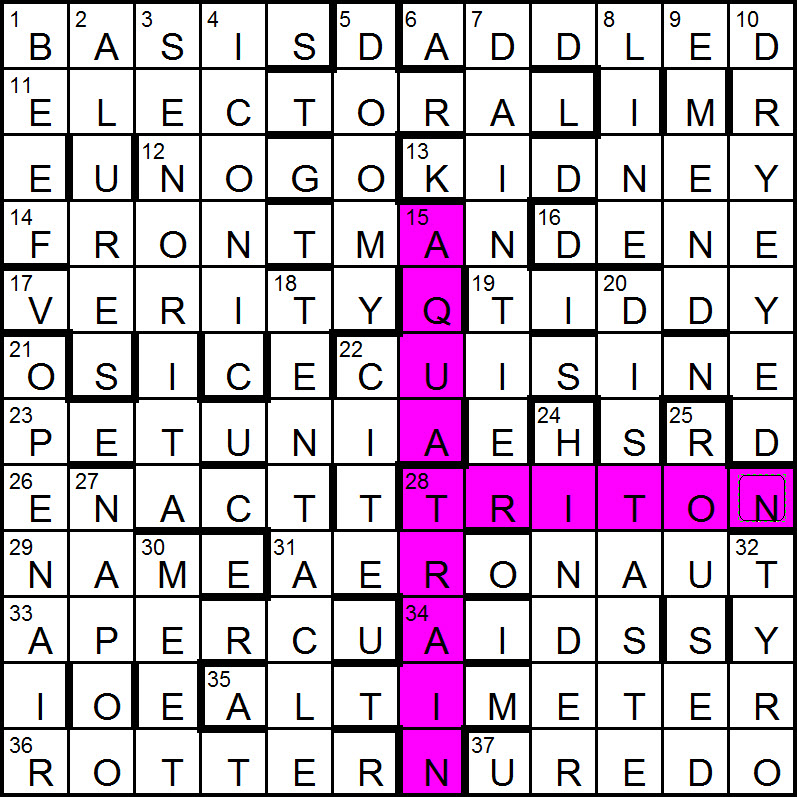
I think it was detecting the superfluous word as SHE at 29 / 22 and realising that 3 down was likely to be SENORITA that provided the penny drop moment. I’d also by this time seen that QUATRAIN and TRITON could be formed in the grid by changing the initial letter of 28 across.
The remaining undefined clues continued to be a problem until I studied the definition for TIDDY at 19 across more closely and realised it could be defined as FOUR to rhyme with NO MORE as a definition for NAPOO at 27 down.
For a while I thought I would be looking for lines from some well known classical poem but it slowly dawned on me that we were building a one-off verse for the puzzle.
I reckon the verse is:
There was a YOUNG LADY [SENORITA – 11 / 3]
Who worked at a sonnet IN VAIN [NO GO 12 / 4]
By the end of line FOUR [TIDDY 19 / 10]
She could manage NO MORE [NAPOO 34 / 27]
The result being just A QUATRAIN [found in the lower half of column 7 after changing the B in BRITON / BRAIN to T)
TRITON is the author of the poem, so I assume TRITON is a SHE.
The superfluous word was most commonly the first word of the second line of the paired clue but it did move within both lines.
It took me a while to realise that each clue was a rhyming couplet as I was focused on splitting the clue into two parts that I could solve rather than looking at the couplet as a whole. There were a few times that I wondered why a certain word was in a clue but I realise now they were all there to help make the couplet.
I think the paired clues must have been difficult to write so plaudits to Triton for compiling the puzzle.
I learnt a new abbreviation – FF for fecerunt which translates as ‘they made it’ in the clue to 15 down.
There were quite a few cricket references in the clues, although you didn’t need to be aware of that to solve the clues.
An enjoyable puzzle.
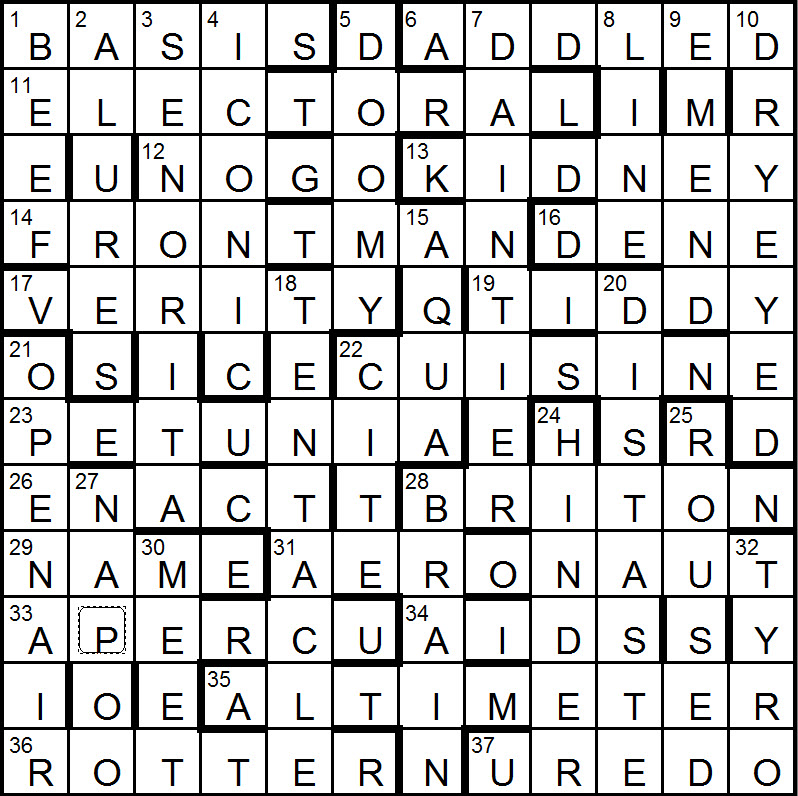
The filled grid looked like this
The final grid after changing one letter and highlighting the thematic word and phrase is shown below
Having read the preamble and solved the puzzle, the title BLANK VERSE is fairly self explanatory. We have some lines of VERSE with some BLANKS that we have to deduce.
| Across | |||||
|---|---|---|---|---|---|
| No. |
Clue |
Word |
Amended Clue – Across first, then Down |
Wordplay |
Entry |
| 1 / 1 |
One probing deep in pitch – it’s Root; there might Exist the early signs of English fight (5:4) |
THERE |
1. One probing deep in pitch – it’s Root (5) |
I (one) contained in (probing) BASS (lowest part in music; deep in pitch) BAS (I) S |
BASIS (root) |
|
1. Might exist the early signs of English fight (4) |
BE (exist) + EF (first letters of [early signs of] each of ENGLISH and FIGHT) BE EF |
BEEF (power; might) | |||
| 6 / 2 |
When penning trumpet passages no more Was clapped out, not right, rotten to the core (6:6) |
2. Clapped out, not right, rotten to the core (6) |
RADDLED ([of a person] aged and worsened by debauchery; clapped out) excluding (not) R (right) ADDLED |
ADDLED (rotten to the core) | |
| WAS |
6. When penning trumpet passages no more (6) |
AS (when) containing (penning) LURE (long curved Bronze Age trumpet of a style still used in Scandinavian countries for calling cattle, etc.) A (LURE) S |
ALURES (obsolete [no more] word for passages) | ||
| 11 / 3 |
Local tree in awful state of polling A sawn-off tree in midst of tract so rolling (9:8) |
11. Local tree in awful state of polling (9) |
Anagram of (in awful state) LOCAL TREE ELECTORAL* |
ELECTORAL (related to [of] polling) | |
| A |
3. Sawn-off tree in midst of tract so rolling (8) |
Anagram of (rolling) TREE excluding the last letter [sawn-off] E and IN and A (central letter of [midst] TRACT) and SO SENORITA* |
SENORITA (no definition in clue – YOUNG LADY) | ||
| 12 / 4 |
Catholicon I criticise in part Of heroes who peg out right at the start (4, two words:6) |
12. Peg out right at the start (4, two words) |
NOG (wooden peg) + O (first letter of [right at the start] OUT) NO G O |
NO GO (no definition in clue – IN VAIN) |
|
| WHO |
4. Catholicon I criticise in part of heroes (6) |
ICONIC (hidden word in [part] CATHOLICON I CRITICISE) ICONIC |
ICONIC (related to [of] anybody or anything venerated or uncritically admired; of heroes) |
||
| 13 / 5 |
Type to deceive, recurrent urge worked through In middle chaps cheat well to make you blue (6:5) |
WORKED |
13. Type to deceive, recurrent urge (6) |
KID (deceive) + (YEN [urge] reversed [recurrent]) KID NEY< |
KIDNEY (sort, kind)
|
|
5. Through in middle chaps cheat well to make you blue (5) |
(O [central letter of {in middle} THROUGH] contained in [chaps {cracks of divides}] DO [cheat]) + MY (cor!; well!) D (O) O MY |
DOOMY (capable of making you sad; to make you blue) | |||
| 14 / 7 |
News format tailormade for A. Burnet? At ten I’d air fresh shows more tasteful yet (8:8) |
14. News format tailormade for A. Burnet? (8) |
Anagram of (tailormade) ([N {new} + N {new} to give news] and FORMAT) FRONTMAN* |
FRONTMAN (Sir Alastair Burnet [1928 to 2012] was a presenter or FRONTMAN for ITV News at Ten for many years) | |
| AT |
7. Ten I’d air fresh shows more tasteful yet (8) |
Anagram of (fresh) TEN I’D AIR DAINTIER* |
DAINTIER (more tasteful [yet]) | ||
| 16 / 8 |
Dell compact lacking element of style A system left among the last in pile (4:4) |
16. Dell compact lacking element of style (4) |
DENSE (compact) excluding (lacking) S (first letter of [element of] STYLE) DENE |
DENE (small valley; dell) | |
| A |
8. System left among the last in pile (4) |
L (left) + IN (among) + E (final letter of [last in] PILE) L IN E |
LINE (an assembly line is an example of a manufacturing system) | ||
| 17 / 9 |
Contrary verse lacks love, with blokes it’s packed Tweak sonnet really adding sex in fact (6:5) |
17. Really adding sex in fact (6) |
VERY (really) containing (adding) IT (sex) VER (IT) Y |
VERITY (fact) | |
| SONNET |
9. Contrary verse lacks love, with blokes it’s packed, tweak (5) |
ODE (poem; verse) excluding (lacks) O (zero; love score in tennis) reversed (contrary) containing (it’s packed) MEN (blokes) E (MEN) D< |
EMEND (alter; tweak) | ||
| 19 / 10 |
Whisky gave a tint to bottles. Piping? No by steaming line will just need wiping (5:7) |
19. Steaming line will just need wiping (5) |
TIDDLY (slightly drunk; steaming [I would have described that as meaning very drunk]) excluding (will just need wiping) L (line) TIDDY |
TIDDY (no definition in clue – FOUR of trumps in the game of gleek) |
|
| BY |
10. Whisky gave a tint to bottles. Piping? No (7) |
DYED (coloured; gave a tint to) containing (bottles) RYE (a type of whisky) D (RYE) YED |
DRY-EYED (not crying [piping]; piping? no) | ||
| 22 / 15 |
A drink, except they made it bluish-looking The touch of class I use in fancy cooking (7:4) |
22. Touch of class I use in fancy cooking (7) |
Anagram of (fancy) C [first letter of [touch of] CLASS) and I USE IN CUISINE* |
CUISINE (style of cooking) | |
| THE |
15. A drink, except they made it bluish-looking (4) |
A + QUAFF (drink) excluding (except) FF (the Latin fecerunt meaning ‘they made it’) AQUA |
AQUA (pale blue colour; bluish looking) | ||
| 23 / 18 |
Plant veg round sides of barrel, near one end A slender limb etc leant round bend (7:8) |
END |
23. Plant veg round sides of barrel, near one (7) |
PEA (vegetable) containing (around the sides of) (TUN [barrel] + I [one]) PE (TUN I) A |
PETUNIA (example of a plant) |
|
18. A slender limb etc leant round bend (8) |
Anagram of (round bend) ETC LEANT TENTACLE* |
TENTACLE (slender limb) | |||
| 26 / 20 |
Play backing punishment with tons of hate – The heartless sadist’s getting in a state (5:8) |
OF |
26. Play backing punishment with tons (5) |
CANE (an instrument of punishment) reversed (backing) + T (tons) ENAC< T |
ENACT (perform; play) |
|
20. Hate – the heartless sadist’s getting in a state (8) |
Anagram of (getting in a state) THE excluding the middle letter (heartless) H and SADIST DISTASTE* |
DISTASTE (hate, although I would use DISTASTE as a slightly milder word than hate)) | |||
| 28 / 21 |
Pom Buttler’s edging roughly into line Exposed, on pair he’s back with new design (6:7) |
LINE |
28. Pom Buttler’s edging roughly into (6)
|
BR (first and last letters of [edging] BUTTLER) + an anagram of (roughly) INTO BR ITON* |
BRITON (Australians refer to Brits as poms)
|
|
21. Exposed, on pair he’s back with new design (7) |
Anagram of (new design) ON PAIR and E (last letter of [back] HE) OPEN-AIR* |
OPEN-AIR (outdoor; exposed) | |||
| 29 / 22 |
Old lover leaving left back Wayne, perchance? She caught piece wanting money in advance (4:4) |
29. Old lover leaving left back Wayne, perchance? (4) |
LEMAN (archaic [old] for a lover) excluding (leaving) L (left) reversed (back) NAME< |
NAME (Wayne is an example of a name) | |
| SHE |
22. Caught piece wanting money in advance (4) |
C (caught) + ITEM (piece) excluding (wanting) M (money), as in M0, M1 etc, measures of money supply) C ITE |
CITE (advance)
|
||
| 31 / 24 |
One flying ace manoeuvring at Rouen Could stop right under airship that’s half gone (8:6) |
31. One flying ace manoeuvring at Rouen (8) |
A (ace) + an anagram of (manoeuvring) AT ROUEN A ERONAUT* |
AERONAUT (balloonist or airman; one who flies)
|
|
| COULD |
24. Stop right under airship that’s half gone (6) |
HINDENBURG (passenger airship that was destroyed in a disastrous fire in 1937) excluding the second five letters of ten [half gone]) NBURG + R (right) this being a down entry, the R is indeed under the remaining half of the airship. HINDE R |
HINDER (stop)
|
||
| 33 /25 |
Insight from a strike when ship’s departed – Manage staff absorbing work that’s started (6:6) |
33. Insight from a strike when ship’s departed (6) |
A + PERCUSS (strike) excluding (when … departed) SS (steamship) A PERCU |
APERÇU (an immediate intuitive insight) |
|
| MANAGE |
25. Staff absorbing work that’s started (6) |
ROD (staff) containing (absorbing) USE (work) RO (USE) D |
ROUSED (instigated; started)
|
||
| 34 / 27 |
Gives help to chieftains getting rid of king The son leaves temple, hiding priest with ring (4:5) |
34. Gives help to chieftains getting rid of king (4) |
KAIDS (North African chiefs) excluding (getting rid of) K (king) AIDS |
AIDS (gives help to) | |
| THE |
27. Son leaves temple, hiding priest with ring (5) |
NAOS (temple) excluding (leaves) S (son) containing (hiding) (P [priest] + O [ring shape]) NA (P O) O |
NAPOO (no definition in clue – NO MORE) |
||
| 35 / 28 |
To shift odd item in I measure height Result bar moved around by someone bright (9:5) |
35. To shift odd item in I measure height (9) |
Anagram of (odd) ITEM contained in (in) ALTER (shift) AL (TIME*) TER |
ALTIMETER (instrument for measuring height, by means of differences in atmospheric pressure) |
|
| RESULT |
28. Bar moved around by someone bright (5) |
Anagram of (moved around) BAR + IN (by) BRA* IN |
BRAIN (a word to describe someone bright) | ||
| 36 / 30 |
Excessive padding on the rear of dancer Scoundrel being qualified to answer (6:4) |
36. Excessive padding on the rear of dancer scoundrel (6) |
(OTT [over the top; excessive] contained in [padding] RE [with reference to; on]) + R (final letter of [rear of] DANCER) R (OTT) E R |
ROTTER (scoundrel)
|
|
| BEING |
30. Qualified to answer (4) |
MEET (qualified) MEET |
MEET (be suitable or satisfy; answer) double definition
|
||
| 37 / 32 |
Try out duck starter very raw – just rash To practise recipe for special bash (5:4) |
JUST |
37. Rash to practise recipe for special bash (5)
|
USE (practise) with R (recipe) replacing S (special) + DO (party; bash) URE DO |
UREDO (urticaria; nettle rash)
|
|
32. Try out duck starter very raw (4) |
Anagram of (out) TRY + O (zero; duck score in cricket) TYR* O |
TYRO (beginner; novice; starter very raw) | |||
There was a young lady . . . from Spain?
…of Spain, I went for.
Astoundingly, I hadn’t noticed the rhyming couplets! Still, at least it gives me a whole new layer of pleasure revisiting the puzzle. It also goes some way to explaining my feeling that, wonderful though it was, it was all just a bit too obscure. My uncertainty over some of the cluing resulted in me persuading myself for quite a while that 30D was MEAT (MAT = padding – on the rear of thE, with the whole clue being some sort of &lit), leaving ‘of’ as the removed word and a very contorted interpretation of the clue for ROTTER at 36A, involving rotater as a synonym for dancer. This in turn lead me to assume that the ending of the poem must be ‘The result of just no brain’, and hence the removal of BRAIN from the grid, with TRITON appearing either side of the gap. Fortunately as I worked through my remaining questions elsewhere in the cluing I realised that this was all just too clumsy and did eventually sort it out.
What I enjoyed most of all about this was that when I succumbed to the temptation to Google, unsurprisingly I didn’t find any hits for the first line or two of the limerick. Being forced to work through it independently gives that little extra glow of satisfaction, even if I couldn’t really afford the extra time!
Big thanks to TRITON and Duncan.
Yes, I had that too. It certainly scans better.
Good fun this one.
Last one to justify was TIDDY having dismissed it several times. Oh, how I kicked myself when I realised … d’oh!
Nice blog and great puzzle. Thanks to all.
jonsurdy @ 1, OPatrick @ 2, kenmac ‘ 3
Indeed, ‘There was a young lady … from Spain’ makes eminent sense. Thanks all
Thoroughly enjoyed this, pleased to get the limerick (and yes my first line ended with Spain), and the last line. A treat from start to end.
There was an old solver from Devon
Who thought this crossword was heaven
Last week’s was fantastical
With theme cartographical
But this was its equal and then some.
Many thanks to Triton for arguably the best Inquisitor this year and to Duncan for the blog.
Blimey. All very impressive: thanks to Triton and to Duncan for explaining how it all worked. I managed to fill ~80% of the grid but this proved beyond me, particularly the clues that lacked a definition. Looking back over various scribbles, I’d managed to sketch out much of the limerick but I was still some distance from cracking this. Well done to those who did.
Brilliant. Much enjoyed, though it took me some time (with many a baffled stare at TIDDY) and I didn’t see A QUATRAIN until I’d got the other rhyme words. Very glad I didn’t yield to the temptation to work through The Lure of the Limerick and suchlike references in search of some classical example.
The deduction that Triton is a SHE didn’t occur to me, any more than that Triton must come from Spain. After all, the Young Lady can only manage four lines of verse and Triton has provably written five!
Many thanks all round.
We are kicking ourselves. Early on we replaced TIDDY with TINY. As the limerick unfolded we failed to spot IN VAIN and NO MORE. Had we looked back at TIDDY we may have struck lucky.
Joyce spent too much time googling limericks and was rather distracted by Mick Twister’s Twitmericks.. It was good to have a look at them again even if it didn’t help with the puzzle.
Thanks Duncan and congratulations on completing it all. Thanks Triton – we will have to try harder next time we meet!
How to thwart the search engine: write a new limerick. What with the sonnet, I was expecting a bonnet, and searched google in vain. But got close enough to thoroughly enjoy an ingenious challenge.
Big thanks to Triton and duncanshiell
I’m just taking the time to fully savour the rhyming couplets, which certainly makes me more forgiving of things like using ‘might’ to clue ‘beef’ and equating tiddly with steaming (as Duncan questions). An extraordinary achievement, though it’s surely a stretch to rhyme Rouen with ‘half gone’!
This was the first Inquisitor I had attempted for quite a while, and it was just as well I had a week’s holiday in which to complete it. I found it very hard to work out which clues (not solutions as the instructions said) were lacking definitions, especially as it was impossible to be sure where the individual clues ended or started. But perseverance paid off and eventually I worked out most of the verse (but lacking four as a definition for tidy) and saw a quatrain and Triton in the grid. I think it was a remarkable achievement and I can only wonder how long it took to compile.
Another belter after last weeks classic too! Steady stream of clue solving starting with electoral and frontman but a bit light on the very start until “There was a” immediately made me think of limericks. Next hold up was thinking (for no good reason!) that the missing definitions would appear at the end, in sequence themselves but out of sequence with the extra words… then further held up on Senorita by thinking they’d all be single words (Meat for beef was pencilled in by this time). A friend suggested young lady from Spain and the whole thing fell into place, guessing the remaining rhymes and reverse engineering to fit clues. Great stuff!!
I thought this was (mild oath) hard. When I’d sorted out SENORITA, IN VAIN etc, I had the limerick running through my head but kept hitting a wall in the last line … and then the three syllables magically arrived.
a difficult puzzle from Triton
with couplets for clues that did frighten
but at long last I saw
that the line count was four
like someone had just turned the light on
Thanks go to him/her, and Duncan for the blog.
I’ve expressed disappointment before about very clever puzzles which can be solved without understanding their full complexity and I thought for a while that this was going to be another example. Once I’d got SENORITA and worked out the first line of the limerick, the final word of the last line had to rhyme with “Spain”, and once I’d realised the poet was Triton one change would give TRAIN. Sorted! That’s obviously the last word and the poem’s about the tragic end of a Spanish Anna Karenina; just a matter of filling the rest of the grid then. But once I’d done that I had a crack at working out the full limerick, essentially for the fun of it, and what a good job I did!
Thanks to Triton for one of the best puzzles of the year so far.
I’m gratified that the puzzle seems generally to have been enjoyed – particularly since writing the clues was a challenge that on more than one occasion I started to regret giving myself! Thanks to all who have commented, and to Duncan for the blog, though please note…
Some crossword setters are of female gender,
And many in their ranks are blessed with youth;
A few perhaps call home a hacienda –
But I am British, male, and long in tooth.
By chance I’ve just learned that Edward Lear was born on May 12 – was it a coincidence that this puzzle appeared very close to this date?
I filled in the grid but couldn’t see how to finish off. I was convinced the verse was going to start “There was a young lady from…”. I really should have connected SENORITA with YOUNG LADY FROM SPAIN. In retrospect it seems harder to miss that to spot, but I managed to miss it anyway.
Thanks for a super puzzle and excellent blog.