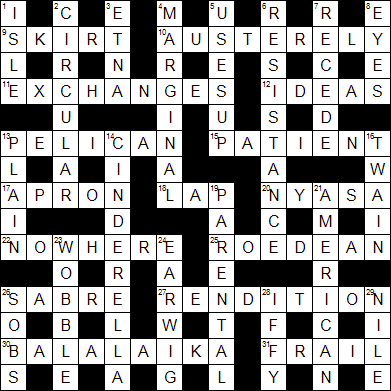
The puzzle may be found at https://www.theguardian.com/crosswords/cryptic/27263.
The usual easy start to the week from Rufus; I thought this one had a rather poor selection of double definitions, but some good clues of other kinds.
| Across | ||
| 9 | SKIRT | Go around in women’s clothing (5) |
| Double definition; SHIFT would fit nearly as well. | ||
| 10 | AUSTERELY | Simply gives us tea when out — depend on it! (9) |
| A charade of AUSTE, an anagram (‘when out’) of ‘us tea’ plus RELY (‘depend’). | ||
| 11 | EXCHANGES | Calls may be made via these money markets (9) |
| Double definition. | ||
| 12 | IDEAS | Schemes thrown aside (5) |
| An anagram (‘thrown’) of ‘aside’. | ||
| 13 | PELICAN | One with a large bill gets the Spanish into a dreadful panic (7) |
| An envelope (‘into’) of EL (‘the Spanish’) in PICAN, an anagram (‘a dreadful’) of ‘panic. | ||
| 15 | PATIENT | One with a complaint but is prepared to wait (7) |
| Double definition. | ||
| 17 | APRON | Ideal stage for kitchen-sink drama? (5) |
| Cryptic allusion. | ||
| 18 | LAP | Comfortable place to sit and drink (3) |
| Double definition. My cat agrees with the first, and is showing it by purring vigorously. | ||
| 20 | NYASA | Lake in Tanzania included in many a safari (5) |
| A hidden answer (‘included in’) ‘maNY A SAfari’, with an extended definition. | ||
| 22 | NOWHERE | At present not there, nor anywhere else (7) |
| A charade of NOW (‘at present’) plus HERE (‘not there’). | ||
| 25 | ROEDEAN | Eggs on head of school — it’s not for boys (7) |
| A charade of ROE (‘eggs’ if it is female roe) plus DEAN (‘head of school’), for the famous girls’ school. | ||
| 26 | SABRE | Cut and wound wild bears (5) |
| An anagram (‘wild’) of ‘bears’. I had not come across it before, but there is a verb to describe what one can do with a sabre. | ||
| 27 | RENDITION | Dramatic performance in translation (9) |
| Double definition. | ||
| 30 | BALALAIKA | It needs pluck to play in triangular formation (9) |
Cryptic definition. A contrabass balalaika. |
||
| 31 | FRAIL | Weak and unable to succeed outright (5) |
| An envelope (‘out-‘) of R (-right’) in FAIL (‘unable to succeed’ ignoring the grammar). As it is also necessary to read ‘out-‘ as “outside”, I do not find ths the best of Rufus’ clues. | ||
| Down | ||
| 1 | ISLE | Setting up Italian agreement, the French give ground (4) |
| A charade of IS, a reversal (‘up’ in a down light) of SI (‘Italian agreement’, yes) plus LE (‘the French’). | ||
| 2 | CIRCULAR | Looking round for a letter? (8) |
| Double allusion. | ||
| 3 | ETNA | Sicilian hothead (4) |
| Cryptic definition.
|
||
| 4 | MARGINAL | On the verge of alarming changes (8) |
| An anagram (‘changes’) of ‘alarming’. | ||
| 5 | USES UP | Goes through customs at university (4,2) |
| A charade of USES (‘customs’) plus UP (‘at university’). | ||
| 6 | RESISTANCE | Underground movement providing opposition (10) |
| Double definition. | ||
| 7 | RECEDE | About to give way and withdraw (6) |
| A charade of RE (‘about’) plus CEDE (‘give way’). | ||
| 8 | EYES | Potato peelers may miss them, if they don’t keep them peeled (4) |
| Double allusion. | ||
| 13 | PLAIN | Beginner in discomfort — that’s obvious (5) |
| An envelope (‘in’) of L (‘beginner’ – although not everyone with L plates is a beginner!) in PAIN ‘discomfort’). | ||
| 14 | CINDERELLA | Rags-to-riches story recalled in new adaptation (10) |
| An anagram (‘new adaptation’) of ‘recalled in’. | ||
| 16 | TWAIN | A writer Kipling never expected to meet (5) |
| A double reference: Mark Twain, and the quote from The Ballad of East and West by Kipling:
“Oh, East is East and West is West, and never the twain shall meet”. |
||
| 19 | PARENTAL | A payment covered by friend of father, perhaps (8) |
| An envelope (‘covered by’) of ‘a’ plus RENT (‘payment’) in PAL (‘friend’). | ||
| 21 | AMERICAN | A woman in Minnesota is likely to be this (8) |
| A charade of ‘a’ plus MERICAN, an envelope (‘in’) of ERICA (‘woman’) in MN (‘Minnesota’), with an extended definition. | ||
| 23 | WOBBLE | Bending elbow with boozer, beginning to sway unsteadily (6) |
| An anagram (‘bending’) of ‘elbow’ plus B (‘Boozer beginning’). | ||
| 24 | EARWIG | An insect from near Wigan (6) |
| A hidden answer (‘from’) in ‘nEAR WIGan’. | ||
| 26 | SOBS | Boss upset and shows distress (4) |
| An anagram (‘upset’) of ‘boss’. | ||
| 28 | IFFY | Suspect in a short time loses head (4) |
| [j]IFFY (‘a short time’) minus its first letter (‘losing head’). | ||
| 29 | NILE | A blue or white flower (4) |
| Cryptic definition, | ||

Thanks to PeterO for the early post. I enjoyed the visuals, and also the word-picture of the cat “lapping up” being on your lap! I was not so grateful for the story of the Australian woman still on her L Plates that you provided to accompany 13d PLAIN – embarrassing!
A likeable puzzle from Rufus, with 10a AUSTERELY, 15a PATIENT, 17a APRON, 6d RESISTANCE, 8d EYES and 14d CINDERELLA all getting a little tick of approval.
I actually don’t know if I can claim a full solve, as I had SHIFT at 9a (I tend to be an impetuous solver far too often). I now think that SKIRT is a much better definition of “Go around”. I had not heard of ROEDEAN but assumed it was a girls’ school -or was it a school in “Jane Eyre”? I had a question mark over “wound” as part of the fodder for 26a SABRE, so thanks for discovering that it can also be used as a verb, PeterO. I also had a question mark beside 31a FRAIL which I thought was a bit 28d “IFFY”. Rather chagrined that I did not get the Kipling link to 16d TWAIN, as I was not aware that Kipling was the author of that famous phrase “Never the twain shall meet.” I was reminded (when I learned that info from the blog) of the dismissive tone of one of my old teachers from 50 years ago, whose favourite putdown was: “Well, my dear, (if you don’t know that) your education has been sadly neglected.”.
Apologies to the setter for thinking that 21d AMERICAN was a bit weak, as I failed to see “A”, ERICA” and “MN” as the fodder.
Thanks to Rufus for a gentle start to the week.
Noce piccy-sort of Spinal Tap.
16dn evokes 60ish year old memory of Muir’s, or was it Norden’s, story of a failed meeting between a drunk and a Dane. “Norse is norse and souse is souse …..” Thanks Rufus and PeterO for a gentle early morning jog.
(Schools in “Jane Eyre” were Lowood and Morton, nothing to do with Roedean.)
Thanks to Rufus and PeterO. Fun as usual. I needed help parsing AMERICAN, but I did dredge up TWAIN from long ago reading and, as an avid playgoer about to see some UK shows, enjoyed APRON.
Thank you Rufus and PeterO.
Good to have Rufus back. The clue for TWAIN was super, but I have to admit that the quote did not come to my mind, and if it had I would not have known who wrote it – my “education has been sadly neglected” (see JinA @1), though I have played hockey against Roedean.
SABRE made me think of academic fencing and dueling scars.
Thanks Rufus and enjoyable start to the week.
Thanks PeterO; no doubt your parsing of FRAIL is correct, although I wondered if FRAIL becomes ‘unable to succeed’ when right (R) is out (omitted). I’m not really sure why ISLE = ground. I tried ‘paternal’ at first for 19d but it didn’t parse.
I liked the PELICAN.
No new comments, but we enjoyed this. We also had shift for 9a, and missed the parsing for American.Although I never played hockey against Roedean, we got that one quickly, so had to reassess our paternal answer for 19d. We loved pelican. Thanks Rufus and PeterO.
I’m with SHIFT as well so don’t know where that puts me in terms of a correct solution.
My weekly Rufus nightmare, however, was reserved for CIRCULAR.
I was another one with SHIFT but I think that SKIRT does work better.
I agree that 31a doesn’t quite seem to work, because FAIL does not mean “unable to succeed”.
On the plus side I thought there were some really nice clues. I liked 14d and 16d, and the insect from near Wigan made me smile. Someone on here mentioned Uxbridge English Dictionary a few days ago, and this clue reminded me of this definition from that game: EXORBITANT – a retired insect astronaut.
Surprising to hear that folks stumbled over ROEDEAN, but perhaps that’s down to geography (I live about 12 miles from the school). Back in my primary school days, I recall that one of my classmates had a grandmother who was headmistress of that esteemed establishment, and was always rabbiting on about her ‘connections’ (to everyone else’s annoyance!). So even without the proximity I’m hardly likely not to have heard of the place!
“Ne’er the twain shall meet”. Recognised that phrase: easy write-in, but I didn’t know it originated with Kipling – until I googled the phrase. Shows how much my literature lets me down!
…and 24 induced me to hum through the old – er – ‘song’ “Ere we go, ‘ere we go, ‘ere we go”….. Do Wigan fans chant it perhaps? 🙂
A little trickier than usual from Rufus
Thanks to Rufus and PeterO
I’d agree with Robi about 31a & 1d – I thought Rufus also had a couple of 28ds in the DT this morning.
The pelican is up there on the podium for me, along with 27a & 14d.
Thanks to Rufus and to PeterO for the blog.
Robi @7
I had not considered the possibility you mention for 31A, and the word order hardly encourages that interpretation. However, the major problem I see with the clue is still the part of speech of FAIL.
hillwalker @3
A friend of mine once set a problem for his students in which the aforementioned Norwegian and drunkard were at the controls of trains thundering toward each other on the same track. They were such-and-such distance apart when each saw the other, and applied the brakes with whatever force. The students were asked to predict the outcome, which was that the trains came to a halt a hair’s breadth apart. I think that anyone who came up with the tag line got no more than a bit of extra kudos.
I agree with bh@13- trickier than usual for Rufus- especially in the SE-and it certainly took me longer! I did get SKIRT and TWAIN- I never even thought of SHIFT- but I did pause over SABRE and AMERICAN. Liked APRON and CINDERELLA.
Thanks Rufus.
Sabre as a verb was new to me, and I missed austerely ( surely the link is the wrong way around). I missed the Kipling reference. I prefer 15a without the ‘but’. My favourite was WOBBLE.
I have never before seen a contrabass balalaika – many thanks PeterO and thanks Rufus
A clear round except I didn’t see the anagram at 12A, so was very dubious about it.
I think I’ve seen similar before, but I also liked 17a APRON. I think it’s the ‘ideal’ that makes it work nicely for me.
Surprisingly for me, I finished this one quite quickly. An achievement for a Monday morning!
JimS@10: I would maintain that FAIL does mean “unable to succeed” if it happens again and again…
Thanks to Rufus and PeterO.
hilwalker @3 — I’m pretty sure there was another My Word story, probably about a lion and some birds, that ended with “and never the mane shall tweet”.
Definitely one of Rufus’s better offerings, in my opinion. Thanks!
Martin @20: “failing” can mean “unable to succeed”, as in the plan is failing / the plan is unable to succeed. But FAIL can’t – it’s a different part of speech.
I don’t believe that “failing” can mean “unable to succeed”
“The plan is failing” states that the plan is not going to succeed. Hovever it does not suggest as “unable to succeed” does that nothing can be done to stop this failure.
Another puzzle in need of a cursory glance form an editor. (Anybody know where we could find one?)
I got it but don’t fully ‘get’ 17A. I note many loved it. What am I missing? I thought the apron was part of the stage. So why ideal? It doesn’t work or ‘click’ for me but I seem to be in a minority of one.
An apron is ideal at the kitchen sink, to protect your clothes from splashes. (Maybe comes to mind less easily if you always use a dishwasher & vegetables ready-washed from the supermarket). But can anyone explain 29D NILE please?
My first response: Flower means river and there is a Blue Nile and A White Nile.
Also to say how helpful Fifteen Squared has been in improving our competence (still very basic) and enjoyment
Thanks both. Another here who didn’t know SABRE as a verb
Favourite was PELICAN. As no-one else seems to have quoted it:
A wonderful bird is the pelican
His bill can hold more than his belly can
He can take in his beak
Enough food for a week
I’m damned if I see how the hell he can
Sorry Wordperson that doesn’t help me. I wear an apron occasionally but my point wa that it needed to say ideal PART of stage to work at all for me. No mattter.
Eric @28
There are “apron stages” and aprons would feature in a kitchen-sink drama, so the apron stage seems ideal? I didn’t see a problem, although “ideal” is possibly not the best word – “appropriate” perhaps?
Could someone please explain how ‘up’ is ‘at university’?
Roedean was rather difficult for someone not from the UK.
Thanks to Rufus and PeterO
Gary @30
Good question. I suppose that, like the similar use of up for London, say, it is intended to convey the idea that it is the best place to be. And if one fails to live up to the standards of one’s university, one might be sent down.
Gary @30
Students at Oxford and Cambridge universities “go up” at the start of term and “come down” at the end of it. Should they be expelled they are “sent down”.