Some delightful new words here, both in the clues and solutions.
I can’t imagine when I will ever get the chance to use prosopopeia or deipnosophist but I am very glad to have found them. Thank you Azed.
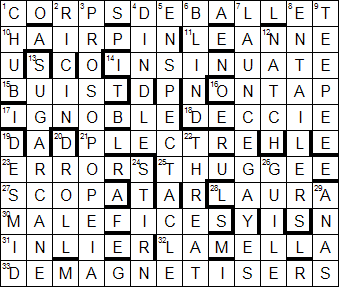
| Across | ||
| 1 | CORPS DE BALLET | Dancing stable, colder around start of performance? (13, 3 words) |
| anagram (dancing) of STABLE COLDER containing Performance (starting letter of) | ||
| 10 | HAIRPIN | Locks leg after bend (7) |
| HAIR (locks) then (with…after) PIN (leg) | ||
| 11 | LEANNE | Lady that’s spare, and not old (6) |
| LEAN (spare) and NE (not, old=obsolete) | ||
| 14 | INSINUATE | Hint isn’t in a clue that’s half missing, faulty (9) |
| anagram (faulty) of ISN’T IN A and clUE (half missing) | ||
| 15 | BUIST | One’s kept in chest or box (Scottish) (5) |
| I (one) in BUST (chest) | ||
| 16 | ON TAP | What’s hot often, and available at all times (5, 2 words) |
| double definition – hot and cold often seen on taps, or a tap may be hot when on | ||
| 17 | IGNOBLE | Nigel’s troubled about outside broadcast that’s inferior (7) |
| anagram (troubled) of NIGEL contains OB (outside broadcast) | ||
| 18 | DECCIE | Interior design, one inspired by Dutch look! (6) |
| I (one) inside (inspired by) D (Dutch) ECCE (look, Latin) | ||
| 21 | PLECTRE | Headless ghost holding lute, initially it twangs the strings (7) |
| sPECTRE (ghost, headless) contains Lute (initial letter of) | ||
| 23 | ERRORS | Duck during basic education, being caught in ‘s’ for slips (6) |
| O (duck, zero score) inside (during…being caught in) RRR (the three Rs, basic education) all inside (being caught in) “S (the letter ‘s’) | ||
| 25 | THUGGEE | Loveless tough worked out tantrum in ritualistic crime (7) |
| anagram (worked out) of ToUGH (loveless, missing O) then GEE (tantrum) | ||
| 27 | SCOPA | Pollen gatherer getting work in southern California (5) |
| OP (opus, work) in S (southern) CA (California) | ||
| 28 | LAURA | Hermit community offering minimum of luxurious mystique (5) |
| Luxurious (first letter, minimum of) then AURA (mystique) | ||
| 30 | MALEFICES | Claim fees wrongly for past crimes (9) |
| anagram (wrongly) of CLAIM FEES | ||
| 31 | INLIER | Rocky outcrop, one overlooking meandering R. Nile (6) |
| I (one) on (overlooking) anagram (meandering) of R NILE | ||
| 32 | LAMELLA | Cooked meal completely over – not a substantial plate (7) |
| anagram (cooked) of MEAL then ALL (completely) reversed (over) | ||
| 33 | DEMAGNETISERS | Eating mess with red bananas, Poles are rendered inactive by them? (13) |
| anagram (bananas) of EATING MESS with RED | ||
| Down | ||
| 1 | CHUB | Fish, rather plump, passing by (4) |
| CHUBby (rather plump) missing BY | ||
| 2 | RICIN | Toxic substance secreted by prehistoric insects (5) |
| found inside (secreted by) prehistoRIC INsects | ||
| 3 | PROSOPOPEIA | Personification from love poet in non-verse writing mostly I accepted (11) |
| O (love) POPE (a poet) in PROSe (non-verse writing, mostly) I and A (accepted) | ||
| 4 | DINDLE | Thrill for Jock racket led astray (6) |
| DIN (racket) then anagram (astray) of LED – Jock indicates a Scottish word | ||
| 5 | EN SPECTACLE | As a sight to see in Paris, accept line ‘Seine’s fantastic’? Not I (11, 2 words) |
| anagram (fantastic) of ACCEPT L (line) and SEiNE missing I | ||
| 6 | BLIND | Smashed bust, obscure (5) |
| triple definition | ||
| 7 | LAUNCEGAYES | Old spears: a lunge directed catches cadet, one certainly following behind (11) |
| anagram (directed) of A LUNGE contains (catches) C (cadet?) then (following behind) A (one) YES (certainly). I didn’t find C for cadet in Chambers. | ||
| 8 | ENTAILERS | They make settlements creating trouble in records (9) |
| AIL (trouble) in ENTERS (records) | ||
| 9 | TEEPEE | Township in short suggests this temporary accommodation (6) |
| TEE PEE or tp in short, a township | ||
| 12 | NATCH | Seat required for dance performance, of course (5) |
| triple definition | ||
| 13 | SUGAR CANE | Get a gun and scare bats in plantation crop (9) |
| anagram (pants) of A GUN and SCARE | ||
| 19 | DESMID | One of algae group that invades mid-sea environs (6) |
| found inside (in the environs of) invaDES MID-sea | ||
| 20 | DROLL | Ventriloquist’s prop, about right for making us laugh (5) |
| DOLL (ventriloquist’s prop) contains R (right) | ||
| 22 | THREAT | What looms pass yarn through mostly on time (6) |
| THREAd (pass yarn through, mostly) on T (time) | ||
| 24 | STIRN | Merkel’s brow isn’t furrowed when Right gets in (5) |
| anagram (furrowed) of ISN’T containing R (right) – the German word not in Chambers | ||
| 26 | GUILE | Cunning dab escapes subject to control (5) |
| GUIdabLE (subject to control) missing DAB | ||
| 29 | ANAS | Deipnosophist’s gems appearing regularly in annuals? (4) |
| every other letter of AnNuAlS – a dinner speaker’s anecdotes | ||
definitions are underlined
I write these posts to help people get started with cryptic crosswords. If there is something here you do not understand ask a question; there are probably others wondering the same thing.
Azed used ‘cadet’ to indicate C in Azed 2272 but apologized in the corresponding Azed slip and said “I’ve simply no idea how I came to dream this up.”
I started to breeze through this (after totally messing up the previous week’s Give & Take), thinking it was unusually easy. Inevitable got held up (in the NW corner I think) and had to struggle to the end.
I don’t remember the previous c for cadet incident because that was just before I started doing Azed puzzles, but I winged it here and didn’t check Chambers. (There are a few non-dictionary sources that seem to confirm C or C/ as meaning cadet – eg http://cap.mdickinson.com/abbreviations.htm .)
^ Inevitably, not inevitable.
Should have added thanks to Matthew for remembering the previous cadet incident, and to Azed for the puzzle, and PeeDee for the blog.
Thanks for that info about cadet Matthew – very interesting. I am hopeless at remembering past puzzles. I solved this puzzle last Sunday but only got round to writing up the blog last night. I couldn’t even remember some of the clues from a week ago. I had to dig out the paper copy from the recycling bin to remind myself of the solutions.
Thanks for the blog; you cleared up the parsing of a few things for me.
I am a bit uneasy about the German word at 24dn. Obviously we can expect foreign words which have been adopted into English and included in Chambers but if Azed feels free to use words from any language that could be a bit challenging! Maybe I am biased because I did French and Spanish at school, and not German!
Ref. CADET-look under CCF. I think Azed forgot where he got the C from!
Nick
If Azed says that cadet=C is justified by Chambers saying CCF is an abbreviation for Combined Cadet Force, then I’ll give up solving Azed.
I have seen this before, e.g. G=green as in RGB.
Nick
I think you’re safe enough there, Matthew, since he has been very clear in the past about not accepting single elements of multi-letter abbreviations, eg R = Royal, justified on the basis that RA = Royal Academy (Azed: “It seems to me to open the door to all sorts of bogus abbreviated equivalents.”)
I’m interested that no-one has commented on the use of ‘overlooking’ to indicate juxtaposition in an across clue (31). The meanings ascribed in Chambers to ‘overlook’ seem to offer no justification for this.
I think if an abbreviation occurs in enough times and in diverse contexts then it does indeed take on the meaning independently. To a large extent that is what dictionaries do, they are arbiters of when something is used often enough to be considered an abbreviation (or indeed a word) in its own right.
G is an abbreviation for green because it is used in many situations, not just in RGB. C for cadet isn’t used in many places other than CCF.
DRC – I wondered about overlooked too. In a down clue it would make sense as the initial letter I would be looking down on the rest of the solution. It didn’t work for an across clue though.
I overlooked it when writing up the blog as generally speaking I don’t like to be too critical, I try and limit my nit-pickings and save them for the comments if anyone else brings the issue up. Basically I see my blog-writing as helping solvers get started or improve, not trying to write a critical review of the puzzle.
13dn – great thought. I have never been in a plantation.
Nick
PeeDee – I think your approach is a very good one.
Writing as someone who has had quite a few ‘interactions’ with the editors of Ximenean puzzles in recent years, I am prepared to stick my neck out and comment on clues which I believe would have been queried by the majority of them as and when I feel that the comments may be of interest to some solvers and may perhaps provoke discussion. In most Azed puzzles (and this one was no exception) there are a couple of clues which I feel may be slightly at odds with current editorial thinking, but I would not routinely remark on them, and typically they (including 31ac in this puzzle) do not come anywhere close to being unfair. I am one of Azed’s biggest fans, and considering that his puzzles are unedited the standard of cluing accuracy seen week after week (and decade after decade) is staggering.
DRC’s last sentence in post 13 sums up my view perfectly. We get the odd clueing error as you might expect from an unedited puzzle, though these are rare and certainly less frequent than issues caused by what passes for the Observer’s IT team! But the standard of accuracy Azed maintains is phenomenal, when you consider the complexity of his puzzles, and rather shows up the sloppy stuff that we get in some of the Guardian’s weekly puzzles… (runs for cover)
cruciverbophile – I really enjoy Azed’s puzzles and the tight clues he writes, very impressive as you say. Where I come unstuck is that I enjoy the sloppy clues in the weekday puzzles too. I have never been able to figure out why liking Azed’s precise style should prevent me from liking other styles too. I might compare it to someone who enjoys listening to a classical musician playing exactly the notes written by the composer, and yet also liking a jazz musician who seems unable to get through a single piece sticking to the notes written by the composer. It seems to me that I don’t need to dislike one to like the other.
PeeDee – it’s very true that liking Azed for his preciseness shouldn’t prevent one from enjoying the rather more relaxed styles adopted by many setters in the weekly puzzles. I too enjoy both. I was actually referring to one or two setters whose clueing is so loose, especially in terms of grammar, that solving becomes more a matter of guesswork than anything else. I don’t want to single out individuals, which is why I wrote in general terms.
I don’t think the much-used classical/jazz comparison really works, because jazz musicians often create their own music. Both are valid styles. I’d compare exceptionally loose clueing to a musician of any sort who attempts to play something but unintentionally is out of tune, misses out notes or plays the wrong ones!
Yes, I think there is a world of difference between those who know the rules but choose on occasion to break them and those who simply don’t know the rules. I have a great deal of time for skilled exponents of their particular art who fall into the former category, among whom I would place Picasso, Araucaria and Mick McManus; I have considerably less time for those in the latter category, who shall remain nameless.
I would not submit a clue to a Ximenean puzzle that used ‘news’ to indicate NN because I know it would be rejected. That wouldn’t stop me using it in a puzzle where a slightly looser style was acceptable to both the editor and the solvers.
cruciverbophile & DRC – yes quite so – loose and incompetent are not the same thing. A weak setter isn’t going to produce a great puzzle in any genre. I apologise for the rather hackneyed jazz/classical comparison but it gets the point across, everybody recognises it.
My core rule for judging a puzzle is to ask did I have a good time solving it? I find checking for rule violations fun as an intellectual exercise but it is definitely a secondary consideration. I think of puzzles as being more of an art than a sport; there are no official rules and no referee. Having said that there are expectations and traditions and a setter ignores these expectations at his or her peril. Not giving the solver what they expect is difficult to get away with and as DRC suggests it takes knowledge and skill to get away with it.
Wasn’t it Afrit that said; “…if a solver can solve a clue, then it is fair…” or words to that effect.
Nick
Well, he certainly wrote:
“He [the setter] may attempt to mislead by employing a form of words which can be taken in more than one way, and it is your [the solver’s] fault if you take it the wrong way, but it is his fault if you can’t logically take it the right way.”
To me, ‘solving’ any clue means not only having the answer but also a satisfactory explanation of why it is the answer; if I can’t achieve this because of inaccurate cluing then Afrit and I both know whose fault that is.
DRC & Nick – I’m reminded here of a phrase in computer programming called “duck typing”. The name comes as follows:
In older traditional languages for something to be considered a duck it had to be scientifically proven to be a duck, ie be of the correct genus and species etc
In some more modern languages to be a duck it just has to do the obvious things one expects a duck to do. If it looks like a duck, walks like a duck and sounds like a duck then IT’S A DUCK! The fact that technically it is a actually flat-billed grebe or whatever isn’t considered important.
I think this has an analogy in the crossword world:
Afrit, Ximenes, Azed and followers have the strongly typed view of the world, a clue has to fulfil all the technical requirements of what constitutes a clue;
the liberal (post-modern?) approach has the duck typed view – if it looks like a clue, you can solve it and it amuses you then it’s a clue.
In computing neither type of language is the right way, you just have to make sure that you use choose a language appropriate to the setting and approach that language with the right mindset. Just the same goes for the puzzles in my opinion.
PeeDee – I think that all good crossword clues, together with most of the poor ones, fall into the second category; the good ones indicate sufficient characteristics of the duck to make the solver confident of the bird’s identity whilst the poor ones don’t. I’ve no problem with the setter taking liberties as long as I can (with the aid of a crosser or two and a modicum of head-scratching followed by a groan) make sense of the clue, but I’m unlikely to be amused by a clue which I can’t solve or which I couldn’t possibly have solved without working back from the answer. I shall say no more on the subject, but will close by offering two examples, one from Sabre which is strictly speaking ‘unsound’ and the other from another setter (who shall remain nameless) which is essentially sound. One duck or two?
“His work showed little independence” for HOWDIES
“Emulated that fellow who has something to eat in the bar?” for BEGGED
Please don’t go away just yet DRC.
“His work showed little independence” for HOWDIES – ha! That one certainly passes the duck test for me. Is it ‘sound’? Does it have some subtle technical flaw that I can’t see?
“Emulated that fellow who has something to eat in the bar?” for BEGGED – I can’t explain that one at all, something to eat = egg is about as far as I can get. Can you explain how it is intended to work please?
The Sabre clue (which was used as an example of a cleverly misleading clue by Shane Shabankareh in the editorial for the May 2018 Magpie) relies on the plural of an interjection which is not also a noun (‘crikeys’, ‘Gordon Bennetts’?) but, frankly, who cares? It’s a great clue.
That fellow who has something to eat in the bar is a BEGGAR (he has EGG in BAR), and if you emulated him then you BEGGED; in essence, pre-processing the cryptic element of the clue gives you the non-cryptic definition ‘Emulated beggar’. You did well to spot the egg, never mind the duck!
I remember the His/Howdies clue from Derek’s message board – inspired quite a few comments.
I am not sure about the BEGGED clue though. Specifically, why would a beggar be eating an egg (why an egg, there are lots of things to eat in a bar) in a bar anyway – I have never seen a beggar in a bar?
Great clue from Enigmatic Variations in the 90’s – I had the two end letters, but it took me ages (like 2 days) to finally get the definition:
Jaws 1 (Spielberg film) – a shark’s enemy (3)
Pl Nick
Thanks DRC. Both are excellent clues are in my book.
Nick – I’m sure at least one person must have complained about the lack of capitalisation for Shark!
It may well have been a capital S, I can’t remember.
Did I miss something about a beggar eating in the bar?
Nick
No, Nick, you didn’t miss anything…I thought that the second clue (which like the – presumably – pickled egg, is not to my taste) was likely to divide opinion!
What I have learned from this discussion is that my previous idea of “there are no official rules” needs to be modified. There are rules, but they vary from publication to publication, and indeed setter to setter. I think the second clue can be seen as a good clue in an appropriate publication, an unreasonable clue in an inappropriate one.
Looking back this is what I am getting at in my original response to cruciverbophile @14. It doesn’t make a lot of sense to compare Azed to the weekday Guardian as they run a different set of rules and the solvers have different expectations. A sloppy clue is only one that doesn’t meet the expectations of the publication/series in which it appears. A clue works in its location, to ask whether something is a good clue in isolation is like asking whether a wall has been painted a good colour, the question makes little sense unless you know where the wall is.
I’d agree with that summary. Consistency, and therefore the expectation from solvers of continuing consistency, will be greatest where a puzzle has a single setter (eg Azed, The Week), a highly-engaged editorial team (eg The Listener, The Magpie) and/or extensive guidelines for setters (eg The Listener, for which the publicly-available guidance notes run to 10 pages and include a table of clueing errors to be avoided). Puzzles with a large group of setters, light-touch editing and no well-defined guidelines around clueing will tend to develop greater ‘tolerance’ in their regular solvers but are still likely to provoke the greatest debate when the already blurred boundaries are stretched.
I seem to have touched a nerve with the last sentence of my post at @14. Perhaps I should rephrase it: I far prefer the fastidious attention to grammatical detail shown by Azed to what DRC describes so well as “light-touch editing and no well-defined guidelines around clueing.” I will never be convinced that something like “first remark to finish” (which appeared in a Guardian puzzle a while ago) can be grammatically justified as indicating RO, but if others think this is OK I will have to accept that. Nobody forces us to do crosswords by the more “libertarian” setters, after all!
I hope I have not given the impression that my comments were aimed at you personally cruciverbophile, your comment just set me thinking, and I have learned something as a result!
Cruciverbophile – my sentiments exactly. Each to their own, but any crossword that used ‘first remark to finish’ to indicate RO would not see me attempting any further clues. I feel I’m on pretty safe ground in that respect with Azed!
Fear not PeeDee – I didn’t think that at all!