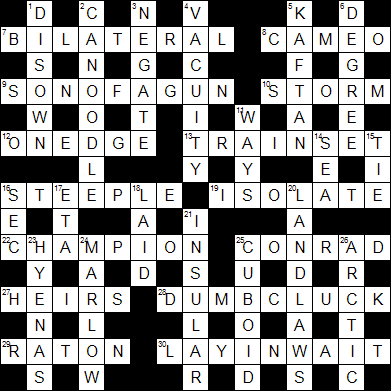
The puzzle may be found at https://www.theguardian.com/crosswords/cryptic/27852.
An extremely impressive offering from Boatman, build around the works of Joseph CONRAD (25A). In the clues I see: Nostromo, Typhoon (two in one clue!), Suspense, Chance, The Informer, The Nigger of the Narcissus, Romance, The Secret Agent, Victory, Heart of Darkness, Under Western Eyes, The End of the Tether, The Tale, Youth and An Outcast of the Islands. Prolific author, Conrad. A couple of references spill over into the answers.
I filled the top half of the crossword quite readily, but the lower half, and the SE corner in particular, proved much more stubborn.
I can see no reason for two clues, 22A and 6D, being in square brackets.
Many thanks to Boatman for the workout; I am in awe at the complexity of the construction.
| Across | ||
| 7 | BILATERAL | Blair mobilised to go round overdue, involving both sides (9) |
| An envelope (‘to go round’) of LATE (‘overdue’) in BIRAL, an anagram (‘mobilised’) of ‘Blair’. | ||
| 8 | CAMEO | Minor role appeared before central character in story (5) |
| A charade of CAME (‘appeared’) plus O (‘central character in stOry’). | ||
| 9 | SON OF A GUN | Thus a reason not to smoke with a French rogue (3,2,1,3) |
| A charade of SO (‘thus’) plus NO FAG (‘a reason not to smoke’) plus UN (‘a French’). | ||
| 10 | STORM | Nostromo, wrecked on ocean, initially lost in Typhoon (5) |
| An anagram (‘wrecked’) of ‘[no]strom[o]’ minus ON O (‘on Ocean initially lost’). | ||
| 12 | ON EDGE | A dictator gains European leadership in Suspense (2,4) |
| A charade of ONE (‘a’) plus DGE (‘Dictator Gains European leadership’). | ||
| 13 | TRAIN SET | Model tracks creative work reversing gusset (5,3) |
| A charade of TRA, a reversal (‘reversing’) of ART (‘creative work’) plus INSET (‘gusset’). | ||
| 16 | STEEPLE | Stone slab, incised with record of church construction (7) |
| An envelope (‘incised with’) of EP (‘record’) in STELE (‘stone slab’). | ||
| 19 | ISOLATE | Losing second fellow, lifeboats sent up maroon (7) |
| An anagram (‘sent up’) of ‘li[f]e[b]oats’ minus (‘losing’) B (‘second’ place, or letter of alphabet) and F (‘fellow’). | ||
| 22 | CHAMPION | [Guardian group accepts position of Corbyn, Opposition leader] (8) |
| A twofold envelope (‘accepts’) of MP (‘position of Corbyn’) and O (‘Opposition leader’) separately in CHAIN (‘group’). | ||
| 25 | CONRAD | Seafarer who wrote about navy leader in A Winding Road (6) |
| A charade of C (circa, ‘about’) plus ONRAD, an envelope (‘in’) of N (‘Navy leader’) in ORAD, an anagram (‘a winding’) of ‘road’. Despite the capitals, ‘A Winding Road’ is not by Conrad. | ||
| 27 | HEIRS | The Inheritors takes on empire’s leader, moving to the left (5) |
| HIRES (‘takes on’) with the E (‘Empire’s leader’) ‘moving to the left’ two places. | ||
| 28 | DUMB-CLUCK | Saying nothing about Chance makes one a fool (4-5) |
| A charade of DUMB (‘saying nothing’) plus C (circa, ‘about’ again) plus LUCK (‘chance’). | ||
| 29 | RAT ON | Act as The Informer in part allocated selflessly (3,2) |
| A subtraction: RAT[i]ON (‘part allocated’) minus I (‘selflessly’). | ||
| 30 | LAY IN WAIT | Prepared to attack in hoard with central character in The Nigger of the Narcissus (3,2,4) |
| A charade of LAY IN (‘hoard’) plus WAIT (James Wait, the ‘central character in The Nigger of the Narcissus’). | ||
| Down | ||
| 1 | DISOWN | Deny row about broadcast (6) |
| An envelope (‘about’) of SOW (‘broadcast’; an old way of distributing seed) in DIN (‘row’). | ||
| 2 | CANOODLE | Once old, a changing disposition to share Romance (8) |
| An anagram (‘changing’) of ‘once old a’. | ||
| 3 | NEGATE | Wipe out revolutionary in The Secret Agent (6) |
| A hidden reversed (‘revolutionary’) answer in ‘SecrET AGENt’. Purists might object to the The. | ||
| 4 | VACUITY | Emptiness shown in Victory with sharpness of vision (7) |
| A charade of V (‘victory’) plus ACUITY (‘sharpness of vision’). | ||
| 5 | KAFTAN | Garment from Boatman’s back, absent in Heart of Darkness (6) |
| An envelope (‘in’) of AFT (‘Boatman’s back’, nautical term) plus A (‘absent’) in KN (‘Heart of darKNess’). | ||
| 6 | DEGREE | [Extent of revolution in BA?] (6) |
| Double definition. | ||
| 11 | WAYS | Under Western Eyes spoke of manners (4) |
| A charade of W (‘western’) plus AYS, in some accents – definitely not RP – sounds like (‘spoke’) ‘eyes’. | ||
| 14 | SEA | Deep brown, without end (3) |
| A subtraction: SEA[r] (‘brown’) minus its last letter (‘without end’). | ||
| 15 | TIE | It is brought up over The End of the Tether (3) |
| A charade of TI, a reversal (‘brought up’ in a down light) of ‘it’, plus E (‘thE end’). | ||
| 16 | SEC | Dry in bits would be halves (3) |
| If one made an envelope (‘in’) of SEC in ‘bits’ it would give BISECTS (‘halves’). | ||
| 17 | ETA | Foreign character central to The Tale (3) |
| A hidden answer (‘central to’) in ‘thE TAle’, for the Greek character. | ||
| 18 | LAID | Boatman taken by Youth set (4) |
| An envelope (‘taken by’) of I (‘Boatman’) in LAD (‘youth’). | ||
| 20 | LAND LAWS | Liberal and left wings to allow end to onerous property legislation? (4,4) |
| A charade of L (‘Liberal’) plus ‘and’ plus L (‘left’) plus AW (‘wings to AlloW‘) plus S (‘end to onerouS‘). | ||
| 21 | INSULAR | Violent run-in, alas, with An Outcast of the Islands (7) |
| An anagram (‘violent’) of ‘run-i[n a]las’ minus AN (‘with an outcast’). | ||
| 23 | HYENAS | They may laugh at grouchy Ena Sharples’s revelation (6) (6) |
| A hidden answer in ‘groucHY ENA Sharples’. | ||
| 24 | MARLOW | 25 across’s central character is gloomy following wreck (6) |
| A charade of MAR (‘wreck’) plus LOW (‘gloomy’), for Charles Marlow, in Heart of Darkness (there is also a Captain Charles Marlow in Lord Jim, but hardly ‘central’). | ||
| 25 | CUBOID | Copper with nothing to offer about a typical cell’s shape (6) |
| A charade of CU (chemical symbol, ‘copper’) plus BOID, an envelope (‘about’) of O (‘nothing’) in BID (‘offer’). The ‘cell’ would be a room. | ||
| 26 | ARCTIC | Cold conditions for developing cacti, right? (6) |
| An anagram (‘for developing’) of ‘cacti’ plus R (‘right’). | ||
Glad about the square brackets PeterO, couldn’t fathom either, nor the word count for 25a being repeated thus (6) (6) in the printout. And the only Conrad I’ve actally read apart from HoD, viz Lord Jim, doesn’t get a guernsey! So it goes. Great puzzle though. The stele bit of steeple rang only the faintest of bells, so a bung in and look up. Ditto dnk the Wait character, though it had to be. Took a bit to remember second=b, and to see the hidden negate. Liked the selfless ration, the sec in bisects and the easy but neat sow in din. Thanks Boatman and PeterO; ideas about the brackets, anyone?
Most enjoyable. I only knew a couple of the most famous Joseph Conrad novels and characters, having studied him a very long time ago. But no matter. I relished the references I recognised and learned a lot more about his extensive writings in the process. Today I parsed everything (!) but missed some subtleties regarding the literary content so was thankful to come here. Thanks to PeterO for a detailed unpacking of the grid. Great blog, and a terrific puzzle, so cleverly contrived by our very own clever wordsmith, Boatman.
[We crossed, GIF@1 on the other side of the country. Brackets and the two 6s due to some typographical gremlin, I suspect. Can’t see any other reason why.]
Very enjoyable, and for once I saw the theme.
I failed to solved 29a RAT ON.
I needed help to parse 16d SEC (very clever!) + 19a ISOLATE which looked like an anagram of lifeboats minus f (for fellow) & b but I could not work it out – I never thought of B = second letter of alphabet.
Thanks Boatman and PeterO.
I have learnt a lot about Conrad’s prolificness today- he is not an author I have read at all. An enjoyable solve, with some clues taking a while to work out, particularly the subtractive anagrams- insular was LOI for this reason. Confess to googling marlow and did not know Wait as a character either. A la the converstaion yesterday (most of the blog comments come after I have retired for the night) does this mean I didn’t finish? IMO I did, though I agree with the sentiment that a clue is not completely solved till parsed. Nevertheless, I count it a win if I have completed the grid; I am very thankful to have come across this site to help me with understanding parsing (and GK not known to me). Good to realise that the brackets etc were probably typos. Thanks to Boatman for a fun solve and to PeterO for the helpful blog.
Those brackets drove me to distraction. I thought it had to have some meaning after being caught by a 4,1,2 device in another puzzle. Seemingly not. Good fun. Thanks to Boatman and to you Peter.
Yesterday’s Qaos was probably my favourite of that setter’s offerings, and today’s is undoubtedly my pick of Boatman’s. I parsed 16d post solve and learned the name of the central character in ‘Nigger of the Narcissus’ which I have not yet read.
A superb offering from Boatman, and thoroughly enjoyed.
Only a couple of answers actually required knowledge of the master’s work (Marlow and Wait to mind), and the play was largely with the titles (k****n had me looking for some time). Didn’t stop me skimming through several of the stories, looking for possible answers – Wait being one. And possible answer for 5D (6 letters, right) actually answering 24. Very cheeky. 6D last in, and BA still says nothing to me – still thanks PeterO for notes.
Another one like that any time, thanks skip.
chinoz@8
I parsed BA as Bachelor of Arts = degree.
I thought the lit. wotk in 27ac, The Inheritors was a shift from Conrad to Golding!
More fool me!
https://en.wikipedia.org/wiki/The_Inheritors_(Conrad_and_Ford_novel)
Best Boatman for a while. Great use of theme. Alas I slipped up putting DEFACE in for NEGATE-didnt properly pArse it (vaguely saw FED upside down which fitted the def…ot did it? Thats the trouble with not checking early entries. Finished in the NE which was trickiest for me but I took some trouble there and having taken too long over the whole thing, didnt get round to checking the early entries.
hanks Boatman and PeterO.
Impressive indeed but guess I’m alone in thinking that a couple of definitions are a bit stretched eg MAR = WRECK and CHAIN = GROUP?
I certainly wouldn’t say the puzzle was wrecked by them.
I agree with PeterO that this is awe-inspiring grid construction. I’m always impressed by how setters re-purpose titles of works in themed puzzles like this so 25 across was a doubly impressive clue. The way 20 pieced together was devious. And 3 was very nice and took me far longer than it should have (Boatman must have been chuffed to find that hidden word waiting for him in Conrad’s title). There were lots of other gems across the clues.
Re: 30 across, the Guardian’s style guide says the n-word is “to be spelt out only if essential to a story (for example, when quoting someone accused of using it)”. I know Boatman’s quoting Conrad and with no harm intended, but I do wonder if that “essential” threshhold is met here. I’m sure some will think this is over the top, but is a policy of extreme carefulness with the word in question compatible with it appearing in the light-hearted context of a puzzle?
Thanks to this Boatman for his tribute to another one, and to PeterO for the blog
Thanks, PeterO and all … I should put an end to the parenthesis-induced anxiety: this is how Hugh marks clues that he particularly wants to look at during editing; he deletes the brackets later, but it seems that here it was the next-to-final draft of the puzzle that made it into print. There weren’t many changes in the version that was supposed to be published, and no-one’s questioned the clues that were involved, so there can’t have been too much wrong with them, but it means that you can enjoy a small window into the editing process and perhaps guess at which other clues might have changed in the final version.
So that shows that it WAS edited!
Would confessing that I’ve never read any Conrad be the equivalent of the oft-repeated phrase “I’m no good at maths”? I hope not – I consider myself very widely read but this is an author I’ve simply never found reason to pick up. As such the two GK clues/parts (“wait” and “marlow” were pretty obscure, making the solution of “lay in wait” unsatisfying and that of “marlow” pretty tricky given the weakness of “wreck” for “mar” (much more “spoil” I would say). A couple of other clues were really stretched too – “second” meaning “b” in “lifeboats” was the last of possibilities after the more common “s” and “i” (second letter of the word). That, to me, made it an indirect anagram just unnecessarily messy. Why is “dumb-cluck” “one a fool” and not just “a fool”? And “champion” was another I felt had to be but “chain” for “group” was nothing I’d have built up from scratch, only vaguely justified after. I suspect the square brackets were signals by Boatman that he was considering replacing those clues!
Thanks PeterO for the parsing of “sec” and “heirs” neither of which I had spotted. Aside from the issues mentioned there were some really clever clues here – “rat on”, “sec”, “son of a gun” and “steeple”. I also liked “sea” as an example of a case where the synonyms are endless but the theme of course has you thinking of this first…subconscious manipulation at work.
Re the PC police and the Narcissus, doubtless everyone is familiar with Agatha Christie’s “And then there were none” which was renamed from the British title on publication in America in the late 1930s. I see Conrad’s work was also renamed (“The children of the sea”) in the US. Hardly a modern trend to remove racially insensitive language! Of course, the question here is whether the offending word should appear in the crossword and I can see no way around this – the title has to be quoted exactly, especially in a crossword any euphemism or deletion may be confusing as the reader could interpret it as wordplay. I am perfectly happy with the idea that we choose not to use a word, but I am less comfortable with the past being edited.
Thanks Boatman – a very clever puzzle, with a remarkable degree of theming. Did not happen to float my boat, but I’m an irascible b****r at times, so don’t mind me!
Boatman @14 sorry – crossed. Thanks for clearing up the “[]” – my guess was not far off!
Certain animal cells are also cuboid (https://en.m.wikipedia.org/wiki/Simple_cuboidal_epithelium)
Thanks Boatman@14 – I had erroneously interpreted them as indicating triple defns.
Thank you Boatman for a fantastic puzzle and and PeterO for a super blog (you have overlooked The Inheritors).
Joseph Conrad is one of my favourite authors and we have most of his books, so the crossword was a lovely surprise this morning.
Thanks to Boatman and PeterO. I got a bit confused with the blog re brackets. As a dinosaur I still do the newspaper version and there are no brackets in my paper. I enjoyed this, but came unstuck in the SW. I misguidedly entered lie in wait for 30a which meant I did not get 21d. Knowing nothing about Conrad I also failed on Marlow and consequently rat on. Hey ho there is always tomorrow and thanks again to Botaman for a very ingenious puzzle and to PeterO for sorting out the blog.
Sorry all about the double entry, fat fingers?
PetHay @21 – Interesting … It sounds as though the print edition (which I haven’t seen) may have carried the correct final version, then. Did you notice any other differences between the two? There was a very small change in 26 Dn, for example.
PetHay @22
There’s no double entry to apologise for. I had already binned your original, incomplete comment before I saw your latest comment @22.
Thanks to Boatman for a great crossword and PeterO for the blog.
Nothing to add to the many comments. This dinosaur also did the (bracketless) print version, which has “very poor” instead of “cold” in 26dn.
Thanks Boatman, I had not noticed but the paper reads “very poor conditions for developing cacti, right?
As is often the case, I appreciate today’s puzzle more after reading the blog than during the solve, although I was able to parse everything except INSULAR. Favorites were 9a, 22a, 14d and 20d, and the misdirection of ‘broadcast’ not being a homophone indicator in 1d. ISOLATE finally went in after I stopped trying to make an anagram of li_eboat_, but I failed on KAFTAN, starting it with ‘c’ and only partially parsing it. (It was late and I was tired, at least that’s my excuse.)
Seeing the n-word in 30a was a bit jarring, but I think it was perfectly acceptable in context. Some schools here in the US have banned teachers from assigning ‘Huckleberry Finn’ on the grounds that it contains the offending word, thus depriving students of a delightful literary experience.
A minor quibble: It was unfortunate to have ‘c’ clued as ‘about’ in both 25a and 28a. Thanks to Boatman and PeterO.
Sorry Marienkaefer we crossed.
PetHay- no need to apologise. Great minds working in tandem, clearly.
No need to say too much here, I think the puzzle speaks for itself. Boatman must be my favourite setter – I particularly like his trademark way of using apparently similar constructions in different ways.
Thanks Boatman and PeterO.
Thanks to Boatman for dropping by, and explaining those brackets.
Cookie @20
In view of the length of the list, it is no surprise that The Inheritors did not make it to the final cut. Thanks for pointing it out.
DaveinNCarolina @27
… and when ‘broadcast’ does not indicate an anagram, it gives AIR – which, with its three letters, led me astray for a while.
pedro @12
‘wreck’ may be on the strong side for the way MAR is generally used, but I think it close enough; and to give an example that has popped up recently, Boots is a chain/group of chemists.
The only thing more disheartening than an n-bomb is all the people explaining why it’s fine
Thanks to Boatman and PeterO. I fared better than usual with this setter but still needed help parsing SEC and RAT ON.
Robin @32 given we have seen various defenses of the use of the n word here, including the historical context, requirement for literary accuracy and the paper’s own style guide, would you care to provide an explanation as to why you think it is not fine? I understand you have a strong personal feeling about the use of the word, but I equally feel a comment such as yours either needs to be indicated as being a purely personal opinion, or backed up with some sort of argument to support it, as others have.
I hope that comes over as polite and non-confrontational, which is how it is intended.
Pedro@12, I meant to address your question of chain as a synonym for group. How about a ‘chain of islands,’ such as the Aleutians?
Robin @32 – I do understand your point. My feeling about this is that Conrad was deeply critical of the conventional attitude at the time towards other races: he used the word “nigger” because he knew that his readers would have certain expectations and would be shocked to find that the hero turned out to have all the dignity of any human being, and would be provoked into questioning their assumptions. I’m fairly sure that that’s why the original title has survived unbowdlerised, at least in UK editions. It’s an important part of his body of work, and it would have opened up an equally worrying set of questions if I’d left it out – but if I’d felt that Conrad has used that word because he was conventionally racist, then I’d have simply avoided it – I might even have avoided using his work as a theme altogether.
Charlie at #13 already pointed out the dubiosity (at best) of whether the style guide’s criteria apply here. The clue could easily have used the same reference without spelling out the title (“25A’s hero” or something) or used a different approach altogether.
Other than that, are you seriously asking me to explain what’s wrong with the n-word? I mean that’s several decades of essays by people with more insight than me, but in brief, it carries the weight of centuries of slavery and murder. The latter is still going on and the effects of the former aren’t fixed yet. It’s a word that you can’t use in a national publication without accepting the effect it’s going to have on countless people. It’s not there to be had fun with in crosswords by a predominantly comfortable, predominantly white crowd.
(That was a reply to thezed @ 34, btw. Boatman, thanks for your explanation. We’re not going to see eye to eye on this one but thank you for all your crosswords.)
I’m with Charlie M @ 13 and others. It’s a word best avoided. That title need not have been included in the puzzle. DaveinNCarolina @ 27, I doubt any African American would be “delighted” at encountering the n-word in their reading. Sufficient reason in my opinion to remove it from the curriculum, or at least use an edited version.
Robin @37 no obviously I am not asking for an explanation for what is wrong with the n-word. Please credit me, and other posters here, with some modicum of intelligence. No-one has spoken in its defence in general – that is clearly a straw man. I was asking why, given various arguments presented as to the validity of using the word specifically in its historical context and in a quotation, you felt that this was not reasonable. If I am to be persuaded that the style guide is wrong and that leaving history unedited is wrong, I would like to hear a reason – that is all I was asking for and I am still intrigued to know what that reason is.
Thanks Boatman and PeterO
In contrast to virtually everyone else here, I really didn’t enjoy this. I have a record number of question marks – 12 – against clues where I didn’t understand the parsing, or didn’t like for other reasons (“Losing second” to remove B in 19a, “eyes” in 11d when it’s not pronounced that way in the solution). I also have never read any Conrad – the only thing I knew about him was that the film “Apocalypse Now” was loosely based on “Heart of Darkness”.
6d showed that I could ignore the square brackets.
I did like HYENAS.
I haven’t said that the style guide is wrong or that history should be edited, whatever that means. I think the style guide is about right, and if we’re playing style guide lawyers, I don’t think wanting to use the n-word to fit in a clever crossword theme makes it “essential to a story”. I tried to explain why I don’t think it’s appropriate to drop the n-word in a crossword, and well, I’m not going to type it all again.
Robin @ 38 – No problem. There’s no question that actually using the word raises deep concerns – what we’re talking about here is whether it’s ok even to refer to other people using it. Whether we can ever accept that, to my mind, depends on context and being sensitive to the meaning it has for the reader. I find it dangerous to consider the possibility that we might chose to eliminate a word from discussion entirely, not least because that would allow the true racists to claim it as their own – but that’s only one view, seen through the filter of one person’s experience, and I’m always interested to see how other opinions differ.
Thanks for popping in with your thoughts on this, Boatman. For me, it comes down to the fact that there are already words “eliminated” entirely from crosswords. A search of 15^2 suggests the c- and f-words have never appeared in a Guardian crossword covered by the blog, for example. For many readers there would be no possible context that could justify publishing those particular letter sequences – even if they appeared as part of titles of literary works. Perhaps a silly example, but if a crossword had as a solution the name of some faraway town which happened, purely coincidentally, to be spelled identically to the c-word, I don’t think the commenters here would have much time for context! If *some* words are off-limits, then for some of us it’s hard to see why the n-word wouldn’t belong in this non-negotiably unpublishable category. And if you think it belongs there as I do then questions of accuracy and literary merit – however interesting – seem besides the point.
I don’t think a blanket policy of avoiding this word entirely for crosswording purposes would necessarily be an intervention in the literary or political debates that have been raised here – which could still continue in all their complexity in other arenas better suited to them. It would just be a recognition that some words are too charged and controversial to ever sit comfortably in the particular context of a crossword.
Despite a few relatively easy ones that gave me the theme quite early on, I found a lot of this really tricky. Still, it was a nice tribute from one Boatman to another (though I was naturally a little disappointed that there was no Lord Jim).
Good to see the traditional dual use of “Boatman” with the two different connotations at 5d and 18d.
Thanks Boatman and PeterO.
Tricky stuff with the N word. I am so conditioned against, it I was very uncomfortable to read it here, but it was justified. Brilliant work to include so many Conrad titles, and for those who have not read any, I can only suggest they have a bash. My dad’s favourite author (not that that carries much weight here, although dad introduced me to the Everyman many years ago, and all that followed…). He also instilled an abhorrence of words like that, which were maybe more prevalent in those days.
I have read a few Conrads myself, and they are very satisfying. I haven’t read the N of the N yet, so perhaps I should. Thanks to setter, blogger and posters: interesting as always.
Thank you, Robin and Charlie M, for taking the time to (yet again, as it seems we must) remind people what the problems are with the N-word. We would not be “erasing history” by choosing not to use the full word in citing a book’s title.
If we want to talk about “erasing history”, come to that, I can think of no better example than using the N-word in ignorance of, or in deliberate devaluation of, its historical context. It was a word weaponised as a tool of white supremacy. It was used to dehumanise human beings so that their white Christian owners could be at peace with themselves for the atrocities they committed. Well past the era of slavery, the word was used as a threat. In some cases it was a precursor to lynching or judicial murder. Today’s seemingly unending stream of unpunished murders commited by police officers reminds us that this threat is still very much in force.
On a different topic: thank you, Boatman, for a fantastic crossword.
Non-print solvers might like to know that 6d was also different in the print edition: “A bit of a revolution in BA?” I prefer the print version. The version in the blog seems to me to lie awkwardly between being a double definition and a triple definition, without quite succeeding in either capacity. “Extent” is a good synonym for “degree”, whereas I find “revolution” and “extent of revolution” to be poor synonyms for that word. The print version is a completely successful double definition, IMHO.
The N discussion does credit to this column. What surprises me is the way in which casual references to drugs – often to account for an ‘e’ are commonplace and never objected to.
Re the n word, the eminent late Nigerian author Chinua Achebe objected to what he thought was Conrad’s racism though the title of his seminal work ‘ Things fall apart’ was derived from one of the said Conrad’s book. Failed miserably in this Boatman, getting only half: will live to fight another day.
Managed to get all but a couple, though some of the parsing passed me by. In 20 down I fixed on to David Laws, as a Liberal (Democrat). Clearly wrong; and a bit strained. But got me the right answer. Many thanks to Boatman for a good work out, and to Peter O for clearing up some of the confusion.
A really challenging puzzle. Yorkshire lass and I completed, but did not parse ON EDGE, ISOLATE and CHAMPION. Pleased with ourselves as newbies to the daily cryptics. Many thanks to Boatman and PeterO. Only thing missing from this string is the acerbic muffin comments we were expecting! Hope he is OK.
Lord Jim @45 – Indeed! Of all the Conrad titles, I found yours the hardest to use in a really satisfying way, so I dropped it in favour of one or two others that worked better. I did write a Lord Jim clue of sorts, though, and you can see it in my Twitter account from yesterday. You’ll be happy to know that it’ll also be featured as the teaser clue to the puzzle when it appears in the sequel to Boatman – the first 50 … assuming there is a sequel, of course – I’ll need to set another 20 or so puzzles first, so it’ll be a couple more years before we find out.
Irishman @51 – Glad you got there! Muffin is apparently alive and well @41 and liked HYENAS, which is good enough for me.
I am also one of those dinosaurs who buys the paper and I can confirm no extraneous brackets or double counts in the print version. Incidentally I think we’re now left with a pair of counts in the Tory leadership contest, or at least I think that’s what she said…..
Regarding the contentious use of the n-word, like CharlieM and others I was a little surprised to see it appear. However if that’s what the book is called, that’s what it is called. This is not rhe Ministry of Truth and we can’t rewrite the past however much we might wish to.
Harhop @48
Different things offend different people, and it may be you are more offended by casual references to widely consumed illicit substances than I am. But in the scale of how offensive each one is, surely you agree there is no comparison between referencing “E” and using the N-word.
Given that a history of drug abuse seems to be one of the qualifying factors in the current contest to select our next PM, I am not going to get upset by the occasional drug reference in my daily crossword, though if taking drugs risks turning you into someone like BJ or Gove, just say no.
Great puzzle, thanks Boatman and PeterO.
I parsed SEC as ‘in bits would be halves’=’halve s’= SECond
but that’s probably not the intended.
Also, a crossword is a work of fiction, and some of you need to go to a rap gig and get over it .
Thanks Boatman!
I appreciate that you are pushing boundaries…
Excellent puzzle Boatman, thanks. Took me back to my college days, and a revisit to the novels of Conrad. 11d was a bit dubious as already pointed out. STEEPLE was my COD.
Must confess when I saw the clue for 30a I groaned inwardly, knowing it would bring out the PC crowd in their full glory. Why do we have to edit and hide the past? Let us face it, these words were used once, for whatever reason, for good or for bad. Are we going to deny these things happened? Of course not. But we cannot sweep it all under the carpet and pretend it never happened. It’s better in the full light of day so that people can learn from earlier mistakes. There are still some people who insist the Holocaust never happened. Should we omit all references to it as well? Why not edit out the word GAY while we’re at it?
Sorry about the diatribe, just fed up with all the hypocrisy.
There were some crackers here. 16d for example, even though it defeated me. But overall my reaction chimed with Muffin’s. As it often does.
Charlie M @ 44
Scunthorpe?
I think PeterO’s note for 24d understates Marlow’s importance in Conrad’s work. He is the named narrator in four stories (the 2 mentioned plus Chance and Youth), and probably also of the work referenced in 30 across – the narrator is unnamed, but Marlow is the character Conrad uses when he wants to frame a story, as a sort of alter ego. For those who want reassurance that Conrad is a proper novelist for reference in a Guardian crossword, read Nostromo – it is tough going, but unmistakably the work of a great author and an unrivalled description of the social and moral destructiveness of capitalism and greed in Latin America. Plus he is a true European – a francophone Pole who chose to live in England and write in English. Thanks to Boatman and PeterO for reminding us of him.
@ Roberto 58: It’s less about erasing the past and more about thinking about how the crossword is likely to be received in the present. Do you really think as you seem to suggest that avoiding this title in a crossword would make any difference at all to the historical record?! The appearance or non-appearance of this title in this crossword was never going to be the difference between anyone learning or not learning the lessons of history…! What it always was going to do was drop an extremely offensive and contentious word into what’s supposed to be a bit of fun. As I’ve noted already, setters would never dream of using the heavy hitter swearwords, and certain setters/newspapers also avoid references to death and disease out of consideration for solvers. Obviously nobody could anticipate every possible solver’s reactions to a given word, but if there’s any one word which setters could cross out of their dictionaries for good, surely it’s this one. I’m sure nobody wants to hear me say anything else on this so I’ll leave it there. Thanks again to PeterO for the blog and Boatman for the crossword.
Gonzo @ 56
I don’t like rap music, so I’m unlikely to go to a gig. Dismissively telling people to “get over it” might do in some situations but the N-word is particularly offensive these days, so this is not one of those situations. Just because some rap artistes have reclaimed it and use it liberally does not mean it isn’t still highly offensive to many, when used in other contexts. The nuance here is that it is of course part of the title of a great work of literature!
Roberto @58
Speaking as one of “the PC crowd in their full glory”, I thought yours was a provocative post and wonder whether this may have been your intent. You ask “why do we have to edit and hide the past?” I don’t think that’s quite what people are doing, but times have changed. For most people the N-word has become unacceptable, certainly more so than when the novel was written, so most people try to minimise its use, while people of all colours are hugely offended by it. One can only speculate how Conrad would have reacted if he was writing today, but I doubt if he would have used the same title.
You say “these words were used once … for good or bad”. I am struggling to see the good in the N-word – was that what you really meant? I don’t see much good in slavery, the associated bigotry that underlay it, and race-hate words like this that came from it. Is this an attempt to take a balanced view, as Trump did when he talked of “good people on both sides” in reference to the white supremacists’ march? Not sure yours was any more successful than his.
I’m puzzled as to what Holocaust denial has to do with this; it’s a false comparison in my view. Denying the Holocaust is factually incorrect and included in most accepted definitions of antisemitism. Omitting all reference to the Holocaust panders to the antisemites. But referring to the historical fact is not the same as using the N-word.
And why should we edit out the word GAY? The only people offended by it surely are homophobic bigots who want the 1950s back, and you’re more likely to find them discussing a Telegraph puzzle than a Guardian one.
Likewise, sorry about the diatribe, but this is how we feel in PC World.
Needless to say,I’m with Roberto@58 and reading some of the comments above made me despair. This is only a crossword after all!
Not a bad puzzle with RAT ON being my COD.
Thanks Boatman.
With thezed@40 – grant us a modicum of intelligence. Boatman@36 has provided a context for Conrad’s use of the word.
No-one, read NONE, here has advocated use of the word. To conclude that its presence in the title of piece of canonical literature (the rest of you can look it up) is defending or promoting its usage is just mischief making.
Being such a well-read lot, perhaps you should take your copy of said book and cast it into the fire.
Roberto @ 58:
I am tempted to say that we are actually in agreement. I, too, ask, “Why do we have to edit and hide the past?”
When we use a word without understanding its (literally) murderous history, we are editing and hiding the past.
I grew up in the British educational system, and we learned almost nothing about even very recent Irish history. Tudors, yes. Bloody Sunday — not so much. Classic instance of editing and hiding the past.
The American educational system edits and hides the past all the time. How many people have heard of Black Wall Street, and what happened to it? Yes, it’s there on Wikipedia (just like the existence of the N-word) so it’s not literally erased from history. But most people haven’t heard of that particular atrocity, and that has real consequences in the present day.
Every colonial power edits and hides its past.
So, yes, I am with you on not wanting to edit and hide the past. But let’s be really thorough about it.
Peter Aspinwall @ 64:
I think this has been a rather good and nuanced discussion. It’s up to you if you choose to despair, but what I’m seeing here is civil discussion about a genuinely thorny topic. It is a harmless scratch-free topic only for those whose circumstances allow them to ignore the thorns.
PS Is there such a thing as “only a crossword”?! Heresy!!!
chinoz @ 65:
To be fair, neither has anyone “conclude[d] that its presence in the title of piece of canonical literature (the rest of you can look it up) is defending or promoting its usage”. That particular mischief has not been made here.
Just one question. Why ‘revolution’ in 6down?
Phyllida White @68
One DEGREE is one-360th. part of a revolution. Evidently, as indicated by Faisceau @47, the clue should have been emended to read “A bit of a revolution in BA?” which makes it a little clearer.
Throughout these discussions posters have used the euphemism “the N word”. How is that better than the word itself?
Great crossword and and great blog so thanks Boatman and PeterO
One last note to Boatman, if you’re still reading – please take a look at all the cheering-on “ignore the PC brigade” type comments, here and on the Guardian page. It is a statistical certainty that one or more of them is an out-and-out racist who has used the word in hatred – and that guy now thinks you’re on his side.
We expected there would be a few up there ready to pounce on the word and make it into a big deal.
Thankfully we also have the holistic views from JohnB @ 54,Gonzo @56, Roberto @ 58 and Peter A @64.
Pedro, count me in @ 71 please!
Robin Johnson: you will not stop out and out racism by banning words, anymore than you will deal with misogeny by inventing words like ze. These traits are from the heart and just because you claim to be free from prejudice does not mean you are. I have been married to a black West Indian saint for almost 50 years but neither of us would claim to be entirely free from the curse.
FFS it’s a crossword
… by which you presumably mean that care should have been taken not to introduce a controversial issue into such a trivial environment …
Thankyou Peter O for Land Laws and Sec.
Van Winkle were you responding to me at 11:10? As a linguist by training, I am not in the prescriptive camp. I believe the comments here should be about the crossword. I personally mightn’t like the politics, or historical reality, and there are a lot of terms in the crossies which I find offensive as a woman, but this is meant to be a blog about crosswords.
I don’t see how those of us who are not black can possibly pontificate on whether those who are are right or wrong to take offence at the use of the N word. What a privileged position not to feel the word’s sting.
Thanks to Boatman, PeterO, Robin, Charlie M, 1961Blanchflower and Faisceau. Enlightenment all round.