The puzzle may be found at https://www.theguardian.com/crosswords/cryptic/28047.
Despite the Don’s predilection for less common words (only 21A ADAR SHENI was new to me – and the anagram wordplay, coupled with a vague definition, was not helpful), this was completed in good time, and, apart from the above mentioned 21A, I have no complaints.
| ACROSS | ||
| 1 | HATE MAIL | Had maiden caught in cold shower some offensive words? (4,4) |
| An envelope (‘caught in’) of ATE (‘had’) plus M (‘maiden’, cricket summaries) in HAIL (‘cold shower’). | ||
| 5 | SCHEMA | Plan to get English degree after school (6) |
| A charade of SCH (‘school’) plus E (‘English’) plus MA (‘degree’ of Master of Arts). | ||
| 9 | CLASSICS | Form 1 starts to consider some well-known books (8) |
| A charade of CLASS (‘form’) plus I (‘one’) plus CS (‘starts to Consider Some’). | ||
| 10 | OPT OUT | After work, seller is to escape getting involved (3,3) |
| A charade of OP (opus, ‘work’) plus TOUT (‘seller’). | ||
| 12 | ERATO | Source of inspiration in lecture, having switched sides (5) |
| ORATE (‘lecture’) with its outer letters swapped (‘having switched sides’), for the Muse of lyric poetry; her eight sisters are less frequently encountered in crosswords. | ||
| 13 | REBELLION | Bishop in staggering movement, hero in act of defiance (9) |
| An envelope (‘in’) of B (‘bishop’, chess notation) in REEL (‘staggering movement’) plus LION (‘hero’). | ||
| 14 | LAMENTATIONS | Book to excite man into tales (12) |
| An anagram (‘to excite’) of ‘man into tales’, for the ‘book’ of the Old Testament. | ||
| 18 | ASTRONAUTICS | Scot and Austrian working together in a branch of science (12) |
| An anagram (‘working together’) of ‘Scot’ plus ‘Austrian’, for the science of space travel. | ||
| 21 | ADAR SHENI | Added time had arisen after injury (4,5) |
| An anagram (‘after injury’) of ‘had arisen’, for a thirteenth month added 7 times every 19 years in the Jewish calendar to keep the year, otherwise of 12 lunar months, in sync with the seasons – serving essentially the same purpose as a leap year. | ||
| 23 | OSTIA | Island thus seen looking west from Roman harbour (5) |
| A reversal (‘seen looking west’ in an across light) of AIT (‘island’) plus SO (‘thus’). Ostia Antica is the site of ancient Rome’s port. | ||
| 24 | CUTS IN | Interrupts with instruction to reduce wickedness (4,2) |
| CUT SIN (‘instruction to reduce wickedness’). | ||
| 25 | VITIATES | Mars — a visit (ET) to be arranged? (8) |
| An anagram (‘to be arranged’) of ‘a visit ET’. | ||
| 26 | DENVER | City‘s place of vice, always hiding its face (6) |
| A charade of DEN (‘place of vice’) plus [e]VER (‘always’) minus its first letter (‘hiding its face’). | ||
| 27 | ANGSTROM | Physicist showing anxiety with short memory (8) |
| A charade of ANGST (‘anxiety’) plus ROM (‘short’ for Read Only ‘Memory’), for the Swedish physicist Anders Jonas Ångström | ||
| DOWN | ||
| 1 | HACKER | Prime minister on television, one seeking to steal information (6) |
| Double definition, the first being the fictional Jim Hacker of the TV sitcom Yes, Prime minister. | ||
| 2 | TRAJAN | Emperor‘s function to keep rule in India (6) |
| An envelope (‘to keep’) of RAJ (‘rule in India’) in TAN (tangent, mathematical ‘function’). | ||
| 3 | MUSCOVADO | Sugar upset tot before Virginia tucked into fish and duck (9) |
| A charade of MUS, a reversal (‘upset’ in a down light) of SUM (‘tot’) plus COVADO, an envelope (‘tucked into’) of VA (‘Virginia’, USPS standard abbreviation) in COD (‘fish’) plus O (‘duck’). | ||
| 4 | INCARCERATED | Put away in vehicle, packed in box: drug smuggled in (12) |
| A charade of ‘in’ plus CAR (‘vehicle’) plus CERATED, an envelope (‘smuggled in’) of E (‘drug’) in CRATED (‘packed in box’). | ||
| 6 | COPAL | Black stuff with core of soft or hard material (5) |
| An envelope (‘with core of’) of P (musically ‘soft’) in COAL (‘black stuff’). Copal is a hard resin. | ||
| 7 | EMOTICON | Them old books? I study something on the computer! (8) |
| A charade of EM (‘them old’. Although now regarded as a colloquial abbreviation for ‘them’, in Old English it was a form in its own right) plus OT (Old Testament ‘books’) plus ‘I’ plus CON (‘study’). | ||
| 8 | ASTONISH | A bit like part of Birmingham, creating surprise? (8) |
| ASTON-ISH (playfully, ‘a bit like part of Birmingham’. If you do not know Birmingham, think soccer and Aston Villa) | ||
| 11 | OBSTETRICIAN | Treat bionics unconventionally as medical specialist (12) |
| An anagram (‘unconventionally’) of ‘treat bionics’. | ||
| 15 | TECTONICS | Note penned by investigators for geological study (9) |
| An envelope (‘penned by’) of TONIC (‘note’) in TECS (colloquial abbreviation for detectives, ‘investigators’). | ||
| 16 | BALANCED | Weapon housed in rotten stable (8) |
| An envelope (‘housed in’) of LANCE (‘weapon’) in BAD (‘rotten’). | ||
| 17 | STRAITEN | Distress of nurse once, characteristic concealed (8) |
| An envelope (‘concealed’) of TRAIT (‘characteristic’) in SEN (‘nurse once’; State Enrolled Nurse was a graduate from a training course, prior to reorganization in 1990) | ||
| 19 | STATER | Country with rupee coin (6) |
| A charade of STATE (‘country’) plus R (‘rupee’) | ||
| 20 | HANSOM | Carriage provided when Dane, maybe, is given honour (6) |
| A charade of HANS (‘Dane, maybe’) plus OM (Order of Merit, ‘honour’). | ||
| 22 | SNIPE | Criticise bargain with Europe, finally (5) |
| A charade of SNIP (‘bargain’) plus E (‘EuropE, finally’). | ||
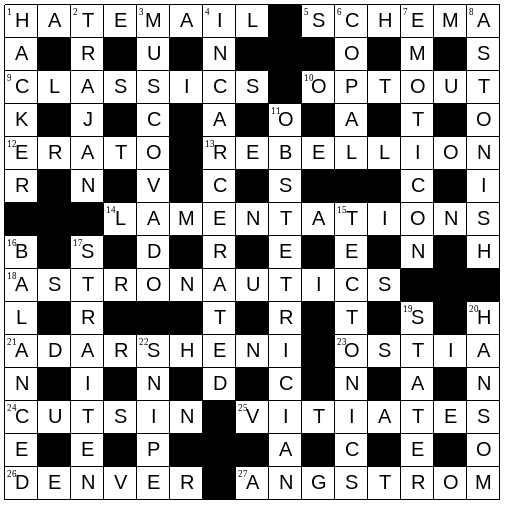
Pleasant puzzle, readily solved and parsed. Had not heard of 21A or 2D (last one in), but both were derivable from their clues and confirmed later. This puzzle continues a recent run of enjoyable puzzles. However the real joy for me was that we have now gone a whole week without the great ELK controversy rearing its contentious head. May it now rest forever in peace, or at least be confined within an insignificant elopement from the normal blog commentary.
My vocabulary is clearly no match for that of PeterO (or Pasquale). In addition to ADAR SHENI, I was not familiar with MUSCOVADO or OSTIA, or of ‘ait’ in the clue for the latter. COPAL and STATER are words I’ve probably seen in other crosswords, but I didn’t remember them. Everything considered, I’m happy to have missed only COPAL and HATE MAIL, both fairly clued and gettable in hindsight. Thanks to Pasquale for providing enjoyment in defeat and to PeterO for the parsing of TECTONICS and STRAITEN.
My favouritse were MUCOVADO, and ASTONISH – although it took me a while to solve 8d because I had initially entered SCHEME at 5a (assuming this would be Master of Economics).
New for me were AIT = island, ADAR SHENI, COPAL, STATER = coin, as well as Aston being in Birmingham.
I could not parse 12a, 15d.
Thank you Pasquale and Peter.
rodshaw@1 – I enjoyed your insignificant elopement joke 🙂
The older I get the more I find I did once know each of the words in any grid, but the more difficult it is to recall them! That certainly described this puzzle, but on the whole I thought it was a fun solve, and I enjoyed the variety of subjects covered. The long anagrams made for a good workout.
Agree re the long anagrams, Dr WhatsOn, but they were the keys to opening up the puzzle. However, lamentably (!) this was a dnf for me, as despite teaching about Judaism for over 20 years, and probably knowing ADAR (the month in which Purim is celebrated) somewhere in the back of my brain, I had not heard of ADAR SHENI and so I missed solving 21a. Its definition was fair enough I guess but it didn’t help me and I neither saw “injury” as an anagrind nor did I untangle the anagram itself.
I did knew 23a OSTIA from teaching about ancient Rome long ago, and saw the parse as I remembered “island” =”ait”, although the latter is a word I have only ever met in crosswordland. Despite that ancient history teacher claim, I had not encountered the old Greek coin, STATER, at 19d. Funnily enough though I did know the ASTON part of 8d ASTONISH as I have heard of Aston Villa – and my football knowledge is parlous at best.
I found it an interesting puzzle but it was for me hard work and it was disappointing not to finish. Nevertheless, thanks to Pasquale. I really appreciated the explanatory early blog, PeterO.
“I did KNOW…”!
A bit more on ADAR SHENI for anyone who’s still a bit baffled by it. A lunar month is about 29 and a half days, so with 12 of them you are about 11 days short of a year; if you add in 7/19 of an extra month you get to the required 365.25. Adar by the way is one of the 12 regular months; sheni means second, so 7 years out of 19 you get two Adars.
sorry Don & Hugh…21a is simply ridiculous in a daily blocked puzzle. An obscurity clued with a very woolly definition and an anagram. Bad egg.
A clearer definition of 21a might have ruined the surface a bit, but I’m with the majority so far of finding the obscurity plus the definition somewhat unfair. The pedant in me didn’t like the superfluous apostrophe s in the clue for 2d, though the answer was simple enough. 6d was also new to me, but was fairly clued, I thought. I got OSTiA by knowing the port rather than the word for island. On the whole an enjoyable solve.
Toughie today for me. I dont usually like too many anagrams but in today’s case they certainly helped me to get going. I recognised that ‘had risen’ was an anagram but even with the cross letters there were many possible configurations. If i finished every puzzle i wouldn’t feel i had learnt anything so i don’t mind obscure words like adar sheni, copal and stater, none of which i knew before today.Whether i remember them or not is a different matter!
Agree with Baerchen. Tried googling various combinations for 21a before giving up in a temper. What’s the point of this clue when without the (obscure) GK there is little chance of guessing the answer? (And why should it come down to guessing anyway? Bah!
I’m with baerchen & Tomsdad re 21a – a bit too much specialised knowledge needed for a weekday puzzle in my opinion. I’ve been ill and I’m taking things easy at the moment so had time to work it out then check the answer; feel sorry for those having to go to work.
Otherwise, I did enjoy the puzzle so thank you Pasquale; special thanks to PeterO for the early blog.
Not unusual for Mr Manley to put a hopelessly obscure clue in the SW corner. I think that he doesn’t like the solver to have a full grid without recourse to reference sources.
The rest of the puzzle gave no problems.
Agree with @8 and @11 re 21a. Reduced to putting in random letters and hitting the check button. And then no moment of recognition, or even half-glimmer. Otherwise a nice puzzle. I particularly like the “I’m Sorry I Haven’t A Clue” turn at 8d. Could almost hear Barry Took’s voice . . .
……”and its still one-one so it looks like we’ll be going into Adar Sheni” (ere Martin wots the lingo for penalty shoot out?)
Thanks Pasquale and PeterO
ADAR SHENI was my unknown too, though with the crossers “guessing and checking” didn’t take too long – I agree that that shouldn’t be necessary, though.
Apart from that, the scientific bias meant that this was a quick solve by Pasqaule standard, though I didn’t parse ERATO. I also didn’t know STRAITEN as “distress”, but it was easy to guess from “straitened circumstances”.
“Hard material” is an odd definition for a resin, especially confusing for me as I used to use copal oil in oil-painting occasionally.
ASTONISH was favourites. As johnmcc @14 says, it could be an entry in the Uxbridge English Dictionary.
Tomsdad @9. I’m afraid I can’t agree with your gripe about the apostrophe s in 2D. You don’t HAVE to read it as a possessive, and for me “Emperor is” parses perfickly.
Blaise @ 17 I agree, both 9 and 26 are fine unless the clue is read wrongly.
Beaten by 21 but no complaints about the fairness of it, wasn’t keen on ‘hard material’ as the definition in 6d, took a while to square away ‘tonic’ with ‘note’ and found it all an excellent and challenging puzzle.
Thanks to Pasquale and PeterO
I’d have needed a whole ADAR SHENI to get ADAR SHENI.
Does 8 have another applicable solution? As well as ASTONISH (definition ‘surprise’) couldn’t it be ALARMING, parsed as À LA RMING, with RMING being the ‘part of BiRMINGham’ and ‘creating surprise’ the definition? That’s how I initially parsed the clue, which I quite liked!
Good but challenging stuff as ever from Pasquale. Favourite clue other than my invented one was the one for ASTRONAUTICS. Thanks to Pasquale and Peter O for the blog.
ADAR SHENI somehow came to me out of the ether as I contemplated the anagram and had a couple of crossers, but as others have said, it is truly obscure. So I was pleased to finish. I also liked the long scientific anagrams. Thanks to Pasquale and PeterO.
Agreed with comments on 21A; first clue I’ve needed help with in quite a while on the Guardian.
I enjoyed the slight red herring double definition in 2D (‘duck’) although this was enter-then-parse for me. Also enjoyed 9A and 8D – and the two mini-themes and general grid as well. Thanks, Pasquale.
Chameleon@20: Same here! Had put in “alarming” originally. Re “Adar Sheni”: Clues like this that take me out of my GK comfort zone and add interesting bits to it are one of the reasonswhy I do crosswords in the first place. Keep them coming, Pasquale and many thanks for the lucid blog, Peter O!
Five new words for me and I ended up losing out on the consonant lottery at the now infamous 21a. Hard work but worth doing for vocab development as well as my two favourites, ASTON ISH and the reminder of “Yes, Prime Minister”.
Thanks to Pasquale and PeterO
Thank you to Pasquale and PeterO.
Less formidable than Pasquale usually is for me, apart from 21ac which was more like an Azed offering. It was clearly an anagram though, and, away from my Chambers, I had to recourse to the check button.
Tidied and sorted out the food cupboard yesterday, so 3dn, both dark and light, went in quickly.
DocWhat @7: Thanks very much for the ADAR SHENI explanation. If the lunar month is 29.53 days, I assume the arithmetic becomes (29.53 x 12) + (29.53 x(7/19)) = 365.25
How did I do, Prof?
I didn’t know ADAR SHENI, but then if you don’t want an obscure word or phrase don’t do a Pasquale crossword. He is on record as saying he likes to extend solvers’ vocabulary (although I don’t think I’ll be using that one anytime soon.)
I thought this was fairly gentle as the Don’s crosswords go. I appreciated the mixture of Science and Arts in the puzzle.
My favourite clue was for VITIATES with the ‘Mars’ misdirection.
Thanks Pasquale and PeterO.
Thanks for the blog. I used OneLook dictionary search for adar sheni – marginally better than a reveal, clocked it was an anagram, but well unfair obscure GK IMO. Had to google stater and copan, also obscure GK.
More or less what Robi said @27
I found more than usual to enjoy here – CLASSICS, OSTIA, MUSCOVADO, ASTONISH, VITIATE and the helpful long anagrams. As for many others, ADAR SHENI was my last one in and I felt no shame in using Word Wizard to find it and I appreciated the clever surface when I did.
Thanks, Pasquale and PeterO.
@Robi 27…I can only speak for myself of course but I’m perfectly happy to see obscure words & phrases in puzzles, although this setter deliberately goes out of his way to use them, which is why I don’t consider myself a fan and generally don’t bother with his output (although I have bought some of his books, so there’s that). What I don’t like is getting a clue for an unindicated Hebrew phrase using a very woolly (in my opinion) cryptic definition and an obvious but useless bit of anagram fodder.
My point in posting this is that I hope the editor will read it, and tell Don next time to go back to the drawing board.
Robi@27 said it for me also although I didn’t think the clue for 21a was up to Pasquale’s usual standard. As well as VITIATES I liked BALANCED and also discovering this meaning of STRAITEN. Thanks to Pasquale and PeterO.
Well, there you are! I have a whole string of clues for the few common nine-letter words ending in I in my database, but I didn’t want to recycle SERENGETI, TOSCANINI, etc. and I wanted to keep that I for the sake of the crossing answer , so I took a chance to be innovative. Distinct Marmite reaction? I can live with that! Thanks for the feedback, one and all — and happy to please some of the people some of the time.
Chameleon @ 20: I wouldn’t be surprised if your parsing had occurred to the Don.
Thanks to him and PeterO and the Doc for the calendar enlightenment.
For those still confused, as I was, about lift mechanics, I’ve left a link to an animation on yesterday’s blog @ 60.
@ Pasquale
Marmite reaction? Doesn’t that depend on some people actually liking it?!
Thanks for popping in anyway. I enjoyed the rest greatly
I’m pleased to have learned about Adar Sheni, but it’s hardly a Marmite reaction when the most positive comment is what do you expect? Nor do I see where the innovation is; the clue is simple but useless. But it’s tough on an unfailingly reliable setter to take the flak. Everyone except for one person knows the Guardian needs someone to care about what goes into the crosswords.
Thanks Pasquale, PeterO
No surprises here, I also found it tough but fairly clued. Like many others 21a was the last one, and was one of a couple of new words. That said, I had heard of Adar, therefore it was merely a case of where the h and n went. Favourite was probably Aston…ish and thanks to Pasquale for the challenge and PeterO for the blog.
JinA@5. Living near the Thames gave me an advantage re 23a. There are at least 14 “aits” on the river. Had a great 40th party on Raven’s Ait! Alternative spelling is eyot – about 15 of them on the Thames.
I loved both the clue and the fascinating calendar sums it’s provoked here. It was clearly clued, and if we’re not prepared to do a bit of consonant shuffling, we might as well shuffle off to the big grid in the sky.
New to me were copal and, of course, adar sheni. When I learn new words, I usually find that they suddenly crop up again somewhere else, much to my surprise. So I’m on the lookout for both of these in the near future. If anyone spots them, please let me know.
Sorry. I’m new to commenting. I forgot to thank the setter and blogger. Ta muchly.
Thank you Pasquale for the challenge and and PeterO for a helpful blog.
Reading Richard Burton’s book The Lake Regions of Central Africa last night I came across the word ‘copal’ and meant to look it up this morning…
The problem with 21ac is that it is both obscure and impossible to guess. Once you’ve recognised the anagram and got the crossers, you can guess a.a. she.i (or at a push sne.i) but any combination of the other letters looks just as plausible. If you’ve never seen the answer used (and who has?), you are left with having to look up each combination until you get lucky.
@Pasquale
Can you explain what you mean by being “innovative”? Do you mean by including ADAR SHENI in the grid rather than Toscanini or Serengeti, or do you mean by clueing it with an anagram?.
If the clue had read, for example “Picked up by radar, she niftily makes up for lost time!” or whatever, then the solver can see it’s an embed/hidden/lurker and bung the right bits into the grid from the crossers. My issue is that faced with A_A_/ S_E_I and unused anagram fodder letters of D,R,H,N what else is there to do other than press “reveal”?
il principe dell’oscurità @38: Me too, well said. Can’t imagine why some solvers don’t enjoy obscurities like this.
Many thanks to The Don for taking us off-piste, say I.
baerchen @43: Where’s the fun in pressing the reveal button? The H in your anagram fodder pretty much had to follow the S and that only leaves a handful possible combinations. The third one I tried was Sheni which Mr Google told me was something to do with the Jewish calendar, so that only left ARAD or ADAR and, bingo!
As my American friends are wont to say, “What’s not to like?”.
I’d never heard of ADAR SHENI, of course, or COPAL or STATER coins or MUSCOVADO sugar either. I did know AIT island, a regular in US noncryptic crosswords. I think it’s particularly an island in a river — especially in the Thames, but there are several in the Connecticut River, which runs a mile or so from my house. The duck in MUSCOVADO misled me for a while as I tried to make something out of Muscovy ducks, while I’ve never heard of the sugar.
Did anyone else think that the episodes of “Yes, Prime Minister” wasn’t as funny as the overpoweringly trivial issues that came up in “Yes, Minister”?
Sorry, “episodes weren’t”.
It seems I had an advantage over most other folk here: I took a crash course in Hebrew prior to a business trip a few years ago. Bonus bit of information: Monday is Yom Sheni (the second day, assuming the week starts on Sunday). The course actually had the line in it for translation – I kid you not – “Monday is the first day”, resulting in sheer gobbledegook!
So I had a different reaction to 21a than everyone else – not concern that the information required was obscure, but embarrassment on realizing that I didn’t know if there were any leap thingies in the Arabic calendar. But that’s just me.
@William 45.
Fortunately, we are all different. I personally can’t imagine anything duller than sitting on the 0710 from Orpington to Cannon Street wrestling with the wifi signal, fiddling with various combinations and pressing “check” until I get the right answer. Moreover, back in the days when I actually used to sit on a train at that time in the morning, Sergey Brin & Larry Page weren’t even twinkles in their parents’ inboxes so that option would not have been possible.
Perhaps I could reiterate my point: no problem with obscurities, problem with clueing them like this
As a relative newcomer I am a little hesitant to comment, but I don’t see how 43 @baerchen’s clue is any fairer than the setter’s. If you’ve never heard of the expression how would you spot it as a hidden answer? For me both 6dn COPAL and 19dn STATER were new but both gettable from the wordplay without having to go through too many alternatives. (For 6dn I did actually try OILOF and OPPIL first, I am ashamed to say!) For 21a on the other hand, even with all the crossers there are 24 alternatives, which is what makes it slightly unfair in my opinion.
baerchen @49: See your point. My method only works with access to either a dictionary or Google. I rarely have access to either of these when I’m away in the caravan in the middle of a field and I notice my solving times increasing markedly on these occasions!
Apart from the contentious 21a, I thought this was quite a gentle Pasquale. Had to use some aid to crack 21a, I admit.
Dr Whatson @48 There aren’t any leap thingies in the Arabic calendar, which makes, say, Ramadan, come ten days earlier each year than the last.
matematico @ 50 Baerchen’s clue only has one possible answer once you have the parsing and some letter positions from crossing clues, Pasquale’s does not, that is the point he is making.
Thanks to Pasquale and PeterO.
Hadn’t heard of ADAR SHENI and knew I was out of my depth so happily hit the Reveal button and toddled off to the www for elucidation. More living and learning, and preferable to the alternatives imho.
It’s not too far off topic to trot out my favourite hobby horse about calendarization – taking, say, a year when 31 December is a Sunday why not determine that 1 January is also a Sunday and proceed seriatim: the result would be that every date would then fall every year on the same day (my birthday would always be on a Thursday for instance) with many benefits accruing, especially around the Christmas holidays. Leap years would be accommodated by having a 32 December instead of 29 Feb and yet another Sunday. While we’re at it we could get rid of the ridiculous names we use for the months, whereby the seventh etc months in ancient Rome – September, October etc – are by no means the seventh etc month of anything. Rant over.
I also found 8d to be “alarming” and confidently hit the Reveal button only to receive a surprise. But I did enjoy the tour.
PS
31 December 2023 is a Sunday. Hint hint……
All been said about ADAR SHENI- actually,rather too much for my taste – and I’d never heard of it either! That said I thought this a bit easier than is usual for PASQUALE.
Thanks Pasquale.
A dnf for me as well today. Adar sheni being the culprit, but once PeterO had revealed the answer I pulled down my father’s old thick Random House dictionary from the1960s, and there it was. Oh well!
Thanks Pasquale and PeterO
Well I took forever to finish this, the big stumbling block being that thar Hebrew phrase, and by now, pretty much everything’s already been said. On the positive side, I’m perfectly aware that Pasquale revels in including lesser-known vocabulary and so wasn’t surprised at COPAL, STATER, MUSCOVADO and ASTRONAUTICS. I enjoyed the various references to the classical world, giggled at ASTONISH and smiled at the misdirection in the clue to VITIATES. Until only 21A was left. I had all the crossers. I knew it was an anagram. I had absolutely no intention of hitting the reveal key. My approach was much like Johnmcc’s and Howard’s: I kept trying different variations of the remaining four letters, then painstakingly looking in dictionaries to see if such a combo of two words existed. Got there in the end, but entirely due to a cussed refusal to let myself be beaten.
All the above comments – from folk I’m willing to bet are collectively a fount of wide-ranging education and knowledge – make it patently clear this clue was, well, not one of this setter’s finest, so I’m feeling pleased with myself that I actually completed the puzzle – but in response to Rodshaw@1 saying it was derivable from the clue”: Really???? My answer to you, my dear chap, is Elk. Elk elk elk elk elk. There. I feel a lot better now, and am off for a celebratory beer. Thanks to Pasquale for the mental tangling and to the brilliant PeterO for all the help untangling.
I found this tough and a DNF for me (you’ll guess why!). Actually, I like ADAR SHENI for the reason given by Eileen @29. Had I seen the potential for a surface like that, I’d have gone for the clue too. In a similar vein, I thought the setter missed a trick at 19 where “Country with king on old coin” makes a nice image, IMHO.
Thanks, Pasquale for the brain-stretching and PeterO for the blog.
Wellbeck @59
🙂
I wondered if the second “elk” was Vulcan giving us the finger, but I suspect that the lead time wouldn’t have allowed that.
DNF (except by cheating on the LOI… no guesses for which).. I did think that requiring such an obscure bit of GK for one clue in an otherwise fairly gentle crossword made it somewhat unbalanced. A bit like a nice stroll in pleasant scenery, with a nasty pit full of spikes right at the end. Could someone please throw me a rope?… Oh, thank you, PeterO, much appreciated.
The Ångström was a very handy unit back when I studied crystallography, most interatomic spacings being a few of them. The symbol Å also seemed splendidly exotic. Sadly Professor Ångström’s namesake is nowadays reduced to a mere 0.1nm, which is a bit dull in comparison. My thanks to Pasquale for including him in today’s crossword, which I did enjoy, despite my gripe above!
Thanks Pasquale for a challenge and PeterO for this hugely helpful explanation. Sorrynotsorry to bang on about 21A but while i agree the clue is unfair under exam conditions, an occasional increased level of obscurity is very helpful for people like me still at the earlier stages (i hope) of their solving life. For example, i only got Ostia because it was in Private Eye in an easier to parse form a couple of weeks ago. So here i guessed the definition, wrote it in, and was confirmed with crossers, though it took PeterO to explain it, and now i will think of Ait for island in future, assuming my memory can cope. Muscovado was my favourite with Trajan a close second.
My experience was the same as Julie’s (@5), inasmuch as my way into the puzzle was to get the four long answers. In my case they were the first four to go in, and I needed them to make headway into each of the four quadrants.
I followed the discussion of ADAR SHENI with interest. I certainly didn’t mind having to learn this phrase (I expect to encounter an unfamiliar phrase or two in any piuzzle, not necessarily Pasquale’s!), but I take baerchen’s main point that reliance on the anagram fodder and a cryptic anagram indicator for such a phrase virtually reduces the solving to guesswork – in marked contrast to an abundance of sound, solvable clues in the rest of the puzzle. The clue demonstrably works, and I don’t object to it, but I admit that I cheated in order to get the answer quickly having sussed the wordplay.
Thanks to Pasquale and PeterO.
As a Jew I had no trouble with Adar Sheni once I’d got a few crossing letters, but it was a surprising answer and I did wonder how many people would have heard of it. It seems not very many. I’d never heard of copal and had no access to the Internet to check it, but I’m not complaining. : )
There are always going to be solvers who have a built in advantage where certain obscurities are concerned: living by the Thames makes ait a familiar word to me, as I imagine being Jewish does for ADAR SHENI. I’m familiar with the books of the Bible, but what if the required knowledge had been about elements of the Koran – and for how long will Biblical books alone continue to be “expected” knowledge while the scriptures (and calendars) of other faiths are not?
However, ADAR SHENI was an obscurity to most solvers, and probably deserved a more helpful definition (though I can sympathise with Pasquale yielding to the temptation of football related misdirection). I admit to being so unfamiliar with the answer that even after I revealed it I needed to Google Adar Sheni to make sure he didn’t play for Aston Villa…
Just to add that, as Gladys says, your life experiences inform your general knowledge. I have learnt many previously unknown words from crossword puzzles (when I remember them). I probably don’t incorporate the new words into my everyday vocabulary, but there’s always that pleasure of recognition when one crops up in a book or newspaper – or University Challenge. Just this morning, I opened a novel and the first sentence mentioned Emperor Trajan.
I had to resort to the anagram finder in my Chambers app for 21a. Thought it was going to be a Latin phrase.
It would appear that some solvers (but not all) would rather cheat on a difficult word for instant gratification and spend a few minutes writing a moan to join other moaners than spend the same time logically working out possibiilities and use a common dcitionary for verification and satisfactory enlightenment.The impatience that modern technology seems to encourage! Pity really!
Don, thanks much for this puzzle but … Adar Sheni is not the name of the additional month! The name of the additional month is Adar Rishon. Seven times in every nineteen years, Adar Rishon is inserted before the usual Adar, and in those years the usual Adar is referred to as Adar Sheni. How can you tell the difference? Adar/Adar Sheni has 29 days, and Adar Rishon, the extra month, has 30. Also, Purim, which is celebrated every year, is celebrated in Adar Sheni in leap years.
Here’s a helpful reference: https://www.timeanddate.com/date/jewish-leap-year.html
And another: https://en.wikipedia.org/wiki/Adar
Looking forward to a clue for Adar Rishon in your next puzzle!
Pasquale @70
I have an uncomfortable feeling that you were obliquely, and therefore politely, referring to me (@65) when you wrote ‘some solvers would rather cheat …’. I did in fact look up the answer here in order to eliminate all but one of the many (theoretical) possibilities that the answer (ADAR SHENI) could have been. I still looked up that answer in a dictionary for enlightenment – one dictionary (Collins) being much more enlightening than another, as it happens.
It’s one thing to use a dictionary to look up a word when you know what the word is and want to know what it means, but it’s quite another to use it to look up all the logically worked out possibilities one by one until the one I’m looking for turns up. One other solver used an online word finder, I noted. I could have done, but I used this page instead – something I rarely do – as I had come to the end.
I’m sorry if I was a contributor to the negative tone of some of what has appeared here – I did not intend to be. For a clue that demonstrably works (whatever different solvers might think about its pitch or quality), I thought some comments went too far.
Not sure a setter should be bragging about a clue he expects most solvers to need external research to solve.
I’ve been solving cryptics since the seventies and can’t really remember a poorer clue.
An adjustment to a calendar isn’t ‘extra time’ for a start and I find it strange that apparently guessing a combination of letters and then checking to see if it’s right is considered solving by so many people including an experienced setter.
@Pasquale 70
This website is an invaluable resource for solvers (like me) and for compilers (also like me).
If compilers either ignore or fight back against constructive criticism on this site – and return fire by describing posters as “moaners” – then they make a grave error. As you have done.
This anagram clue for ADAR SHENI should never have seen the light of day (in my opinion) and the editor should have binned it (also in my opinion).
Best wishes, Rob (Knut/Julius/Hudson/Magnus)
baerchen @74 pasquale @70: I would just add that a “challenging” clue should at a minimum be … correct. The wordplay and the definition actually point to different words, as explained above @71. Here the setter identified an obscure word that fit the grid, but could not be troubled to learn its meaning. I’m afraid I would characterize that as “sloppy” rather than “innovative.”
My initial comment on the Guardian site was that ideally the solver should be able to do a daily cryptic without having to resort to aids. Pasquale seems to think we all carry the OED onto the 7.13 into Birmingham New Street. As others have said, it is not the obscurity in itself, it is the manner of its cluing that’s the point here. I don’t mind being educated – I have learnt an extraordinary amount by tackling Azed, The Inquisitor and The Listener over the years, but with respect (though not much) to Pasquale, those puzzles are pitched at a crowd who are likely to be at home and have time and inclination to resort to the ever-reliable Chambers.
Still, he doesn’t seem to care, and FWIW I’m appalled by his rather petulant reaction on here to what clearly was warranted criticism. No-one likes criticism but if you decide to stick two metaphorical fingers up at the average solver don’t be surprised if they get annoyed
I’m far too late to this I know, but agree that Pasquale’s tone and name-calling in response to valid criticism does him no favours. I’m generally in awe of the setters, and very grateful to all of them for their work, but it’s nice to know how they view some of us at least!
Shocked myself by getting dredging 21 up from the back of my brain. I can’t imagine many outside the Tribe would know it. Alas Copal was new to me and I missed Erato from spelling Muscovado as Muscavado!
Also didn’t parse 23a, but “Roman harbour” is a bit of a dead giveaway anyway. 8d is real Uxbridge English Dictionary material.