An enjoyable puzzle from Gozo, and you won't need to get out the encyclopedia. Thank you Gozo.
All the across solution are loan words from other European languages.
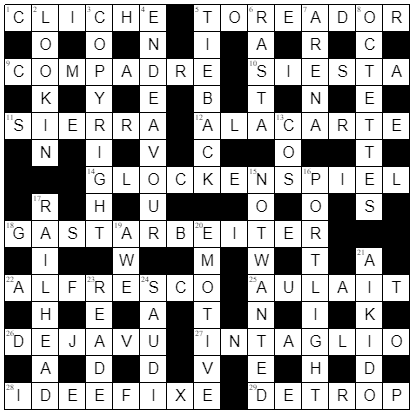
| ACROSS | ||
| 1 | CLICHE | Old saw that’s lost its cutting edge (6) |
|
cryptic definition – a saw is a saying |
||
| 5 | TOREADOR | Reissued order to a fighter in the ring (8) |
|
anagram (reissued) of ORDER TO A |
||
| 9 | COMPADRE | Group of activists admitting old member as friend (8) |
|
CADRE (group of activists) contains O MP (member, of parliament) |
||
| 10 | SIESTA | Seat is ordered for afternoon nap (6) |
|
anagram (ordered) of SEAT IS |
||
| 11 | SIERRA | Ford car range (6) |
|
double definition |
||
| 12 | A LA CARTE | A trolley porter brought round with various dishes (1,2,5) |
|
A CART (trolley) inside (with…brought round) ALE (porter) |
||
| 14 | GLOCKENSPIEL | Sleeping rough holding rugby forward and instrument (12) |
|
anagram (rough) of SLEEPING contains LOCK (rugby forward) |
||
| 18 | GASTARBEITER | Foreign worker organised rebate, gratis (12) |
|
anagram (organised) of REBATE GRATIS |
||
| 22 | ALFRESCO | Backed slave distributing coal outside – outside! (8) |
|
SERF (slave) reversed (backed) inside (with…outside) anagram (distributing) of COAL |
||
| 25 | AU LAIT | “With milk added”, the Spanish shout is heard (2,4) |
|
sounds like (is heard) OLE (a shout, in Spanish) |
||
| 26 | DEJA VU | Outsiders who decolonize Java and Vanuatu, strangely seen before (4,2) |
|
the outer letters (outsiders who) of DecolonizE JavA and VanatU |
||
| 27 | INTAGLIO | Toiling away at first, reproducing artwork (8) |
|
anagram (reproducing) of TOILING and Away (first letter) |
||
| 28 | IDEE FIXE | Former partner I nourish with one returning obsession (4,4) |
|
EX (former partner) I FEED (nourish) with I (one) all reversed (returning) |
||
| 29 | DE TROP | Carried back once is just too much (2,4) |
|
PORTED (carried, once=now obsolete) reversed (back) |
||
| DOWN | ||
| 2 | LOOK IN | John and relatives make a quick visit (4,2) |
|
LOO (John) and KIN (relatives) |
||
| 3 | COPYRIGHT | Protection from officer by end of day – and no mistake (9) |
|
COP (police officer) then daY (end letter) and RIGHT (no mistake) |
||
| 4 | ENDEAVOUR | Cook’s ship on trial (9) |
|
double definition – captain James Cook's ship |
||
| 5 | TIEBACK | Draw support for fabric which secures curtains (7) |
|
TIE (draw) BACK (support) |
||
| 6 | RASTA | Star dancing with a Jamaican (5) |
|
anagram (dancing) of STAR with A |
||
| 7 | ARENA | New in district, found place of entertainment (5) |
|
N (new) inside AREA (district) |
||
| 8 | OCTETTES | Groups run away from poor stone cutter (8) |
|
anagram (poor) of STOnE CuTTEr missing RUN |
||
| 13 | COS | Cut-price ingredient of a BLT, perhaps (3) |
|
COSt (price, cut) – cos is a lettuce, the L in a BLT |
||
| 15 | NOT WANTED | Unwelcome redevelopment of town along with track extension initially included (3,6) |
|
anagram (redevelopment) of TOWN then AND (along with) including the first letters (initially) of Track Extension |
||
| 16 | PORTLIGHT | Illumination on board carriage that’s not heavily armed (9) |
|
PORT (carriage, bearing) and LIGHT (not heavily armed) – a window (light, illumination) on a ship (on board) |
||
| 17 | RAILHEAD | Charladies lost cover around distant train terminus (8) |
|
anagram (around) of cHARLADIEs missing outer letters (lost cover) |
||
| 19 | AWE | “Say When” used regularly brings wonderment (3) |
|
every other letter (used regularly) of sAy WhEn |
||
| 20 | EMOTIVE | Touchy leading economist with reason (7) |
|
Economist (first letter, leading) with MOTIVE (reason) |
||
| 21 | AIKIDO | In which there is commotion about one kick. Not half! (6) |
|
ADO (commotion) contains (about) I (one) KIck (not half) – to be read as either an &lit or an extended definition: In which there is… |
||
| 23 | READE | In literature, a developing novelist (5) |
|
found inside literatuRE A DEveloping – Charles Reade |
||
| 24 | SAUDI | Small car for Middle Easterner (5) |
|
S (small) AUDI (car) |
||
My first entries were SIESTA and SIERRA, so I spotted what was going on immediately. Never heard of GASTARBEITER before.
Thanks Gozo and PeeDee
Enjoyed this more subtle themed puzzle which I was able to do in a self-isolated single sitting. Took five or six across clues for the foreign words to click.
Found a lot of very straightforward clues, but needed to fly to a dictionary to uncover GASTARBEITER, but that was the only ‘foreign word’ that I didn’t know. Took a while to get the ‘illumination on board’ definition.
Finished with COPYRIGHT, CLICHE and the strangely spelt OCTETTES.
Hadn’t heard of PORTLIGHT – Chambers doesn’t give it – but bunged it in (last) anyway.
Got the theme early, which helped with e.g. GASTARBEITER and prompted a re-run of the 1st across pass before tackling the verticals.
Haven’t read READE, clearly a good time to catch up.
A satisfying puzzle. Thanks to Gozo & PeeDee.
Octettes? New to me. Show me a reference in the last fifty years, say, which is octette rather than octet.
Maybe it was invented for eight female singers … 🙂
OCTETTES could be an addition to the theme, as could SAUDI, RASTA and AIKIDO.
I knew GASTARBEITER, but it isn’t really a loan-word: as far I know it’s only used in a German context.
I enjoyed most of this – my favourite being the semi-&lit 21d AIKIDO – but I’m afraid it would have been a DNF without electronic aids, as I’d never heard of GASTARBEITER, IDEE FIXE, DE TROP, or PORTLIGHT. As far as I can tell that last word is only found in American dictionaries, so perhaps that qualifies it as part of the theme?
And can someone explain how the word ‘who’ works in 26a please? To me, it just makes the ‘Outsiders’ instruction less clear, verging on unfair. Am I missing something?
Thanks to all.
Thanks Gozo for an amusing challenge. Never heard of GASTARBEITER before, had forgotten that Cook’s ship was the ENDEAVOUR, and couldn’t figure out AIKIDO but overall had few problems. Favorites were AU LAIT, COMPADRE, and IDEE FIXE. Thanks PeeDee for the blog.
Angstony @7 – while writing the blog I wondered about how to explain “who” in 26a too. My conclusion was that the word is in there mainly to improve the surface reading and works only loosely in the cryptic reading. The clue wouldn’t be allowed by the strictest of editors.
Having said that this is the FT which doesn’t have an ultra-orthodox crossword editor, Gozo isn’t an ultra-orthodox setter and I’m not an ultra-othodox solver. Personally I’m not bothered by some looseness, in fact I quite like it in measured amounts. For me it can make a puzzle feel less stuffy, so I let it go.
I hope I’m not coming across as just nitpicking for the sake of it, PeeDee. As I think I’ve mentioned to you before I’m not looking for Ximenean precision, but I think it’s a fine line between ‘some looseness’ and ‘some unfairness’. To my mind at least this clue was on the wrong side of it, because it didn’t just improve the surface, it made the wordplay less coherent.
Hi Angstony – I think “unfairness” is a misleading word, it suggests an ordinary solver can’t get the answer. Everyone here seems to have solved the clue no problem, so not unfair in the common use of the word.
You use it here in a rather technical sense to mean something along the lines of “the wordplay does not explicitly indicate the solution”. In this case the wordplay only suggests at the solution. Call it loose or unfair, fundamentally it seems the same thing to me.
My main issue behind all of these discussions is that there is not a single set of rules that all setters must follow, each editor and setter gets to choose how closely they want to stick to this ideal of fairness.
To be fair to you: your comment @7 does not suggest that Gozo is breaking some absolute and universal “rules”, your comment is written from a personal perspective. I have misread that and I owe you an apology there. I think am conflating this comment with others from previous discussions and from other people. Mea culpa.
Hmm… I don’t think everyone solving a clue necessarily exonerates it from criticism. The definition was easy and the crossers confirmed it, but wordplay should provide another coherent way to arrive at the solution regardless of those factors, shouldn’t it? And the fact you said yourself that you “wondered about how to explain” it suggests to me that it wasn’t really “no problem”.
You’re right that there is no single set of rules for setters, though. And that means we all must decide for ourselves the degree of ‘looseness’ we are willing to tolerate, or not, as the case may be. I’m personally fine with slightly ungrammatical devices like ‘sweetheart’ = E for example, but not with surface filler words that render the wordplay more difficult to interpret. I guess I can concede that ‘unfair’ may be too strong a word to describe that, but it’s difficult to know how else to describe it. ‘Improper’ perhaps?
Oh and there was honestly no need to apologise. I wasn’t offended or taken aback by your comment… just aware that my questions might have been seen as mere pedantry.
Yes, I agree with you that solvable doesn’t exempt a clue from criticism. What you have is a constructive observation on the clue, not just nit-picking.