Perhaps it is misguided of us to expect a gentle puzzle for the first of the Listener year. This one promised a literary work and we were going to find ‘echoes’ in every clue. Rather surprisingly echoes did ring – Death, dead, unreal city, Leman, Smyrna, Ganga, April (warmish earth is what sets off tubers) – surely not that great favourite of one of us from those long-gone A Level days, and of the other from Oxford? But yes! It was Eliot’s The Waste Land in which case four of the work’s five key phrases would be: The Burial of the Dead; A Game of Chess; The Fire Sermon; and Death by Water, since we had to write the ‘fifth’ below the grid, What the Thunder Said.
Oh but there was a lot of solving to do before that final moment with twenty pairs of clues each producing a misprint that had to be corrected in order to spell out an instruction ‘to enable solving the other clues’. SPUR/ FIT/PESETAS/ DECIDING/ TRIPS/ STINKY/ DESERVED/ MUCH/ RETRACES/ FAT/ SLAP/ DAMMED/ BEDS/ LUST/ PLAY/ DRY/ MEANS/ SICKER/ and CUPS produced the rather strange phrase AX WORD OR STRING IN CLUE, so we knew we had to find extra words or bits of words in the other halves of those fairly tough clues.
Fortunately, we were given numbers to help us put those in order, and, sure enough, 1,2,3,4,5 spelled THE BURIAL OF THE DEAD. Home and dry! (Well, not quite – we still had to progress via that GAME OF CHESS to the DEATH BY WATER and who was it who died? PHLEBAS the Phoenician – what a gruesome and gloomy section of the poem!) Chaliceas’s notes in her Faber paperback told us that ‘What Tiresias sees, in fact, is the substance of the poem’ and there were PHLEBAS and TIRESIAS. How beautifully the entire crossword recalled the poem!
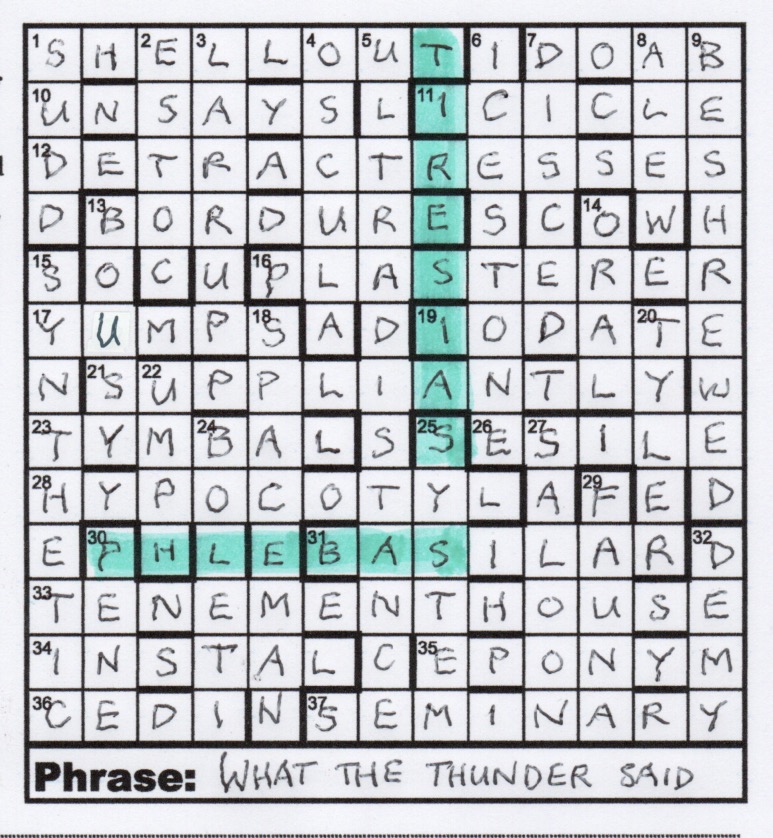
Sure enough, the alcohol was there.”What is a BOUSY?” we wondered when half of a clue spelled it out,’Smell from body beginning to sprout centre of disturbed yard once stinko/ old sour liquid’s run off to draw back’. ESILE solved the other half, so we had an old low-down drinking place and vinegarish alcohol, and ‘Empty bottles, I see …’ Not a very appealing selection of alcohol but Priest is a new Listener setter, we think, and must nevertheless be admitted to the Listener Oenophile Setters Elite – Cheers, Priest!
We perhaps ought to add that while the clues were well-wrought and fair, the demands of carrying the Eliotan echoes also made them pretty challenging, and reminded one of us of the old-style Torquemada puzzles that rolled all the clues into a single narrative. Perhaps we ought to see more like that – but they’re hard to set and stay Ximenean too.
One clue did seem to have come a cropper perhaps somewhere in the editing process: 13a was clearly BORDURE defined as “shield part” and “Wat” also clearly the segment to be removed, but the only way we could make the wordplay work was (RED BOULDER – LED)* (“out”) with the ER from “water” being the secondary anagrind in the sense of “perhaps” – not a very likely solution. The Listener website then published a correction adding “deserted” to the end of the clue, which didn’t seem to help, but in the end resolved itself if we took “red” as also a very unusual anagrind with “deserted’ leading to D, so that the fodder was BOU(led)R (wat)ER D. Was this the original intention or a fix? We vote for latter.
By this time we were wanting to get back to Eliot himself, but Vagans couldn’t resist adding a few lines in first-year undergraduate style:
January is the cruellest month, bringing
Hard new Listeners out of the deathly darkness, mixing
Memories of how old-time puzzles were constructed
With the desire for novelty, stirring
Dull solvers with strange requirements
When keeping covered warm in the winter was our need.
But sudden shafts of inspiration surprised us.
So we drank coffee and more and talked amongst ourselves
Half-remembering Eliot from when we were young
And wondering what we might make out of such
A heap of broken images.
My apologies Chalicea, but I posted on the other blog for this before I read your contribution. I came to the same conclusion as you about 13a. Not the best of clues I think, but trying to mirror a long poem in a set of clues like this is no mean feat.
I suppose if you’re familiar with the work the theme would have leapt out at you but this solver certainly isn’t (by which I mean I’ve heard of it but never read it). Still, perfectly solvable anyway.