I feel privileged to have received an Azed puzzle for my turn at this blog.
I would like to express my appreciation for the feeling of familiarity (however parasocial it might be) that I experience completing an Azed puzzle, which feels, I imagine, rather like corresponding with a pen pal whom I will never meet. I was a late arrival to this game, having looked with curiosity at the Azed puzzle on the Guardian site for quite a number of years before actually trying to solve one. It has been highlight of my career as a blogger to see CINERARIA appear as a solution in Azed No. 2,645, not too long after I had joined the Azed blogging team. Coincidence? Maybe, but I doubt it. Thanks again to Azed.
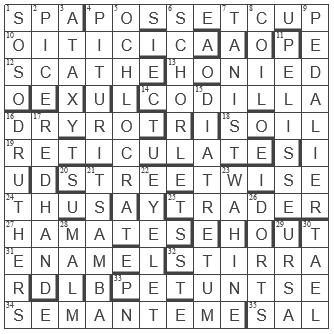
| ACROSS | ||
| 1 | SPA |
Spring team, number lost (3)
|
| SPA[N] (team) minus (lost) N (number) | ||
| 4 | POSSET CUP |
Messy sops and so on at an end in covered bowl (9, 2 words)
|
| Anagram of (messy) SOPS + ETC. (and so on) + UP (at an end) | ||
| 10 | OITICICA |
Oil-yielding tree here in Marseille occupied by wild coati (8)
|
| ICI (here, in Marseille, i.e., in French) inside (occupied by) anagram of (wild) COATI | ||
| 12 | SCATHE |
Female bandaging pet’s injury once (6)
|
| SHE (female) around (bandaging) CAT (pet), listed in Chambers as “archaic or dialect” | ||
| 13 | HONIED |
Like seductive language that is cloaked in old-fashioned script (6)
|
| I.E. (that is) inside (cloaked in) HOND (old-fashioned script, listed in Chambers as “an obsolete form of ‘hand'”) | ||
| 14 | CODILLA |
Coarsest part of flax, unfavourable in the end (7)
|
| ILL (unfavourable) inside (in) CODA (the end) | ||
| 16 | DRY ROT |
Fungal mass trod in a mess round track shortly? (6, 2 words)
|
| Anagram of (in a mess) TROD around (round) abbreviation of (shortly) RY (track, i.e., railway) | ||
| 18 | SOIL |
Mould to fatten manure (4)
|
| Triple definition | ||
| 19 | RETICULATE |
Netted luce, treat I cooked (10)
|
| Anagram of (cooked) LUCE TREAT I | ||
| 20 | STREETWISE |
E.g. peach in stew is bubbling, displaying savvy (10)
|
| TREE (e.g. peach) inside (in) anagram of (bubbling) {STEW IS} | ||
| 24 | THUS |
Ruffians delivering last of beating and suchlike (4)
|
| THU[G]S (ruffians) minus (delivering) last [letter] of [BEATIN]G | ||
| 25 | TRADER |
Tidy skill shown in backing businessman (6)
|
| {RED (tidy) + ART (skill)} all reversed (shown in backing) | ||
| 27 | HAMATES |
Some bones swallowed in haunches (7)
|
| ATE (swallowed) inside (in) HAMS (haunches) | ||
| 31 | ENAMEL |
Designation in wing coating (6)
|
| NAME (designation) inside (in) EL (wing) | ||
| 32 | STIRRA |
Jail senior naval officer for corruption in Scotland (6)
|
| STIR (jail) + RA (senior naval officer, i.e., Rear Admiral). The “definition” here is more of a grammatical observation: according to Chambers, this is apparently a Scottish corruption of the archaic word “sirrah.” | ||
| 33 | PETUNTSE |
China product, terribly steep, including a lot of wine? (8)
|
| Anagram of (terribly) STEEP around (including) TUN (a lot of wine?) | ||
| 34 | SEMANTEME |
Chap in group with uncle once conveying what amounts to an idea (9)
|
| {MAN (chap) inside (in) SET (group)} + EME (uncle once, listed in Chambers as “obsolete”) | ||
| 35 | SAL |
Large Indian tree, a willow, not short (3)
|
| SAL[LOW] (a willow) minus (not) LOW (short) | ||
| DOWN | ||
| 1 | SO-SO |
Double provided, indifferent (4)
|
| SO + SO (“double” provided) | ||
| 2 | PICE |
Coin, not English – it was worth little abroad (4)
|
| &lit and PI[E]CE (coin) minus (not) E (English) | ||
| 3 | ATAXY |
Lack of coordination always interrupted by exercise? (5)
|
| AY (always) around (interrupted by) TAX (exercise) | ||
| 4 | PITURI |
Aussie narcotic? It’s served in a small cake (6)
|
| IT inside ([is] served in) PURI (a small cake) | ||
| 5 | OCHLOCRAT |
Advocate of power to the people brandishing torch with coal (9)
|
| Anagram of (brandishing) {TORCH + COAL} | ||
| 6 | SCHORL |
Institution, right to replace old black stone (6)
|
| SCHO[O]L (institution) substituting (to replace) R (right) for O (old) | ||
| 7 | TANIST |
Gardener giving off unpleasant smell? He was due to follow the chief (6)
|
| [BO]TANIST (“gardener”) minus (giving off) B.O. (unpleasant smell), referring to a Celtic system of inheritance | ||
| 8 | COIL |
Fuss formerly created by one in grip of depression (4)
|
| I (one) inside (in grip of) COL (depression), listed in Chambers as “archaic,” thus “formerly” | ||
| 9 | PEDALIER |
Piano board (8)
|
| The competition word | ||
| 11 | PELISSE |
Coat for youngster peels off and is taken inside (7)
|
| IS inside (taken inside) anagram of (off) PEELS | ||
| 15 | DIATRETUM |
A rum diet – tons imbibed, all mixed in old glass bowl (9)
|
| Anagram of (all mixed) {A RUM DIET around (imbibed) T (tons)} | ||
| 16 | DRUTHERS |
Herd’s wandering round fixed course, cowboy’s choice? (8)
|
| Anagram of (wandering) HERD’S around (round) RUT (fixed course), listed in Chambers as American slang | ||
| 17 | RED HAND |
Ulster’s symbol had broken apart in split (7, 2 words)
|
| Anagram of (broken apart) HAD inside (in) REND (split) | ||
| 21 | TSAMBA |
Barley dish, mass in a fibre turned over (6)
|
| M (mass) inside (in) {A + BAST (fibre)} inverted (turned over) | ||
| 22 | EYELET |
Key, by the sound of it, for embroidery decoration (6)
|
| Homophone of (by the sound of it) ISLET (key) | ||
| 23 | WAHINE |
Complaint about a Maori woman (6)
|
| WHINE (complaint) around (about) A | ||
| 26 | DORTS |
Jock’s pet took a walk almost, climbing (5)
|
| STROD[E] (took a walk) minus last letter (almost) inverted (climbing). Chambers lists this as “noun plural” defined as “sulks.” | ||
| 28 | MALM |
Clay-chalk mixture in normal manufacture (4)
|
| Hidden in [NOR]MAL M[ANUFACTURE] | ||
| 29 | URSA |
Wagons feature? Guardsman shows this regularly (4)
|
| Alternate letters of (regularly) [G]U[A]R[D]S[M]A[N]. The clue refers to the fact that the constellations Ursa Major and Ursa Minor are also known as “the Wagon” and “the Wagon of Heaven.” | ||
| 30 | TAEL |
Chinese weight, requiring muscle to lift round East (4)
|
| LAT (muscle) inverted (to lift) around (round) E (East) |
unfortunately, I entered dirts for dorts without thinking
other than that slip, I really liked this one, if not a little anagram-heavy. A mild challenge over the start of my week
There were quite a few clues where I wasn’t sure about the definition, but I thought the wordplay was clear, so I felt like I was solving clues rather than just guessing answers.
l could remember there is a word like OITICICA but not how to spell it, and I spent some time thinking the wordplay was backwards but I suppose ‘X occupied by Y’ can work either way. I also couldn’t remember the word ‘sallow’ for ‘willow’ in 35a; I could remember ‘salix’ and ‘sale’ but they didn’t help.
Being from New Zealand, I think WAHINE is a normal word that I hear frequently, and find it funny to imagine that if I were from somewhere else it would probably be one of several words in this puzzle that I have only seen in crosswords.
Thanks, Cineraria and Azed.
Parasocial? Not a word that Azed would be likely to use, since it’s not in Chambers (yet) but I see that it’s Cambridge Dictionary’s word of the year, and describes the one-sided relationship between a fan and a celebrity they will never meet. Luckily, for those of us in the UK, Azed hosts a lunch every five years at which it’s possible to meet the great man in person, and even take tea in his garden.
Like Matthew, I had doubts about OITICICA, but it had to be correct.
The slip for the November competition was published punctually, but was disappointingly brief. I wonder if it will be Azed or Gemelo who will provide the Christmas special this year? We’ll find out next week.
Finished this fairly quickly on Sunday evening, which was quite a relief after the struggles I have with Gemelo. A couple I didn’t parse, although I kicked myself when I saw the explanation of EYELET.
I found this fairly straightforward, but had a couple of quibbles. Unlike Matthew@2, I don’t see how “occupied by” can work both ways; here, ICI is occupying the anagram of coati, not occupied by it. Why not say “surrounded by” or some such? 32ac: “corruption” is, as Cineraria says, an observation; it is certainly not a definition. There are any number of words that are corruptions of something else, both in Scotland and elsewhere.
You’re right that CINERARIA in no. 2645 might not have been a coincidence. Years ago, after I had become a regular entrant in the clue writing competition, my surname appeared as 1 across in a non-competition puzzle. Chambers gives it as a Miltonic variation of an everyday word. Until then I hadn’t known that it was in a dictionary.
Genius here finished the puzzle in three minutes while blindfolded and wrote possibly the greatest clue ever composed for the competition word. Unfortunately, the clue he submitted was for PEDALLER, not PEDALIER…
MM@5: The first definition of “occupy” in Chambers is “to take possession of”–not the first usage that comes to my mind, either, but one which works with the grammar of the clue for 10A.
Taking up Munromaiden #5’s point, I think the thing I like about Azed is his loyalty to the Chambers dictionary, to the extent that he warns you if a word isn’t in it. If the clue uses a word or phrase lifted from the Chambers definition (in this case “corruption”) and you can cross-check that in Chambers, then you can be sure you have hit the target. It’s like having a set text in a school exam. I never mind when he uses obsolete, Spenserian, or old Scottish words that I never knew existed, whereas I rather resent it when other setters do.
I understand the “corresponding with a pen pal whom I will never meet” feeling. I think this is largely down to Azed setting using only pencil, and paper and his head. No computers involved, no picking from word searches or computer generated lists. Araucaria/Cinephile was the same. The resulting puzzle feels more personal than most setters.
Cineraria #8: does it, though? To take possession of, yes, in the sense of occupying a house, say, or one country occupying another. But if you occupy a house, you live within it; it doesn’t live within you.
MM@11: I take your point, and if I had written the clue, I probably would have inverted the elements. To expand on my earlier comment, though: the first three definitions of “occupy” (as a transitive verb) in Chambers are “to take possession of; to capture; to hold.” The subsequent definitions move on toward the notion of one thing “inhabiting” another, so the meanings do seem distinct. I am not sure that I can think of a comparable example of the usage intended by Azed here, but, for example, I do not think that an expression such as “France was occupied by Germany” means only that some elements of the Wehrmacht were present on French soil.
Cineraria@12: okay, I take your point! I just feel that there is a fine line between misleading, which is fun, and obscure, such that the solver must resolve the wordplay before actually solving it. Another barred crossword recently used “happily” as an anagrind; “unhappily” would be fine, but the only excuse I could think of for “happily” was as a synonym for drunkenly – and then it starts to feel like a clue to a clue.
LW@7: sympathies – PEDALLER was my initial entry too, until I realised my error. I don’t usually have time on Sundays to tackle the puzzle but I like if possible to solve enough clues to work out the word to be clued so I can chew it over. I immediately assumed the double-L word, so time wasted until I sat down with Chambers and looked it up. Not sure my eventual entry was the greatest clue ever composed, but it wasn’t the most inspiring word…
Where is this puzzle in the print version?
The contents page states that it can be found on pages 40-48 but I don’t see it. Page 40 has the Everyman, page 41 has the Gemelo, but seemingly no Azed.
Weird.
James @15: This puzzle should be in the paper dated 7th December. The current pattern is that Azed appears on the first Sunday of each month and Gemelo on the other Sundays, but never both in the same edition.
As noted by Bridgesong @3, it is not yet clear what will happen with the Christmas competition due for publication on 21st December this year.
Thanks PB @16.
Would suggest it’s a printing error on the contents page of the 14 December edition in that case (which specifies Azed as being in the puzzles section on pages 40-48).
I see that the Christmas Competition puzzle published in The Observer today is a plain Azed. This will no doubt be a disappointment to some solvers, but it comes as a relief to me. I have written this before starting my attempt to solve the puzzle and will of course not make any further comments about it until the blog for that puzzle appears on this site.