I found this morning’s IO more accessible then usual.
Some very witty ideas – a fun challenge that kept me on my toes. Many thanks to IO.
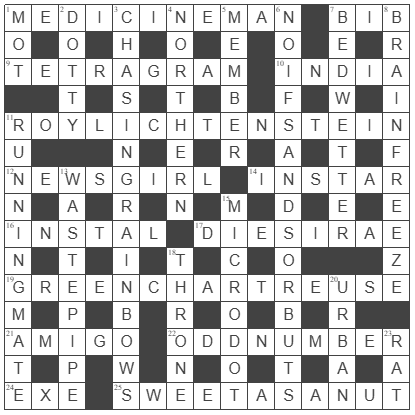
CINEMA (films) in MEDIN[a] (native quarter, failing to show A)
Double definition
TET (swim?) + RAG (offensive newspaper) is going on RAM (strike)
SINK or SWIM being tetragrams, i.e. 4-letter words. Swimming is one part of a tetrathlon, or tet. My parsing does leave ‘swim’ doing double duty.
[f]IND I A[m] (unsuited)
‘India’ is ‘I’ in the NATO alphabet
(HOSTEL with input from INNER CITY)* (*undergoing redesign)
SLEWING* (*our of control) over R[oad] (surface of)
IN STAR (leading performer)
From the solution to the previous clue (indicated by ellipses), change R (right) to L (left); i.e. ‘switch sides’
with DIE (croak); (SIRE (dad) holds A)
REUSE (recycling) after putting GREEN (area) on CHART (map)
Green Chartreuse is a herbal French liqueur made by monks. Apparently only two monks know the recipe.
AM I (is first person) + GO (shot)
ODD (random) + NUMBER (means to anaesthetise)
EX (one used to love her) + E (energy)
Referring to the river EXE in Devon
S (special) + WEE (little) + (TUNA (fish) + SAT (put))< (<back)
(TO (closer) + [referendu]M (closer to)) (<closer)
‘Mot’ is the French word for ‘word’, hence ‘to Macron’, a famous Frenchman
OTT (too much) for A (one) at D[a]Y (noon, i.e. midDAY)
CHAS (Charles) needs BOWS (weapons) to secure INGRAIN (fast fix)
‘Castles in Spain’ are unrealistic, unattainable ideals, and ‘chasing rainbows’ is to pursue such things
N (navy) + OR (as an alternative) + THE RN (British service, The Royal Navy)
(ME ME (egotist’s twin priorities) include B (book)) + R (reading)
‘Twin’ tells us to double the egotist’s priority; R for reading comes from the British education system’s 3 Rs: reading, writing, arithmetic
(B[lo]OD TRANSFUSIONS; LO (look) out)* (*for intermixing)
WED BETTER (married above oneself) as a Spoonerism
[b]RAIN FREE (drought-affected, on leave B[ahrain’s] (foremost)) + ZE (zone)
I assume the intention is ‘Zero Emissions’ for the zone
Cryptic definition
In Edward Lear’s poem, the owl and the pussycat elope (run away to marry) making them ‘running mates’
A STEP (first part of plan) to access WIPE (dry)
((TO (for) + DOC (medic) + I’M (one’s)); R[adiography] (heading for) to divide) (<up)
“THROWN” (cast, “during recital”)
‘Can’ and ‘throne’ both mean toilet
UN (country club, United Nations) furnished with BAR (taproom) rotating
‘Rotating’, like ‘cycling’, tells us that some of the front letters of the word need to move to the back
TAR< (jack, <to the gods)
I think ‘to the gods’ or ‘from above’ is a backwards indicator; ‘tar’ and ‘jack’ being a sailor
Could 9ac be Tet(offensive) then rag and ram?
I found this less accessible than usual.
Thanks to both.
TETRAGRAM
offensive=TET
Def: sink or swim?
GREEN CHARTREUSE
putting area (golf)=GREEN
BRAIN FREEZE
B+RAIN FREE +
on leaving zone=ZE
RAT
to the gods—>towards the sky, I think
Thanks Io and Oriel.
INSTAR
Are we to take
‘of leading performer’ as ‘IN STAR’
(leading performer per se is STAR)?
Always thought a pow-wow was like a parley, something you did, rather than a person, but hey ho. And I thought 1d was the three closers of referenduM sO geT. Like KVa, not sure about instar. Maybe like “stage presence is a necessary quality in [a] star/of [a] leading performer…”
Nice puzzle anyway, cheers Io and Oriel.
Gif@3
MOT
Parsed it as you did.
Sorry but another tiresome puzzle from this setter.
1a Why is powwow a definition of medicine man? It isn’t in my book. Medina also not well clued imo.
7a nho bib=fish
22a one is a poor definition here. The are literally an infinite number of other odd numbers.
3d Ingrain is a weak synonym for fast fix imo
11d seems pretty spurious as cryptic definitions go
Etc etc
As for the rest a plethora of very difficult clues with hard to spot definitions and no laughs at all.
I solve these through obstinacy but take no pleasure. These are complete outliers compared to the general level of the ft which I otherwise enjoy.
Thanks for the very necessary blog.
Thanks for the blog , great to see IO Wednesday , I do try very hard the rest of the month not to complain about puzzles being too easy . I think the grid was helpful , lots of white , many first letters and friendly long answers . Even an answer for fans of Coldplay .
James@6 , a few thoughts .
POWWOW definitely a term for a shaman .
one? indicates an example of an ODD NUMBER .
INGRAIN a term for fixing the dye to the thread , making it fast .
RUNNING MATE could apply to humans but also horses , a favoured horse may have a running mate from the same stable to set a fast pace .
Thx Roz, each to their own
Echo the parsings in the first four comments.
I found this an approachable jump around the grid after a slow start and even managed to quickly see ‘x for y’ in DOTTY which is my usual blind spot.
Thanks Oriel for the blog
6dn: Brewer 2018 p 716 has the following, which is the nearest I could find to the answer for this clue:
Ifs and/or buts Qualifications or potential impediments, usually invoked in the negative as something not to be countenanced, as in ‘Let’s have no ifs and buts’.
I could not find the phrase actually used by Io in any of the usual dictionaries. Can anyone cite a respectable source for it?
The online Cambridge Dictionary has this
no ifs, ands, or buts
idiom US (UK no ifs or buts)
Thanks KVa@12.
How can “surface of” properly act as a first letter indicator in 12A?
Chambers has “the upper layer” as a meaning of “surface” that would provide justification for such usage in a down clue, but that won’t do for an across clue.
Good fun which isn’t something I often say about IO 🙂
IN STAR of=in as they can both mean among?
I thought INDIA was very cute
Initially had NO IFS BUTS OR ANDS which seemed to make sense as extension of the more common English phrase
Roz@7 Mr McGee has said he regrets his Coldplay remark. A bit
Cheers I&O
I completely agree with James P.
Bagpuss@14 my Chambers93 has surface=…..or face of anything
and face=the front or surface of anything .
Bodycheetah@15 , Chambers93 has simply of=in .
That remark has spread far and wide , my students refer to Coldplay , Radiohead etc as bedwetting music .
Roz@17. I think the entry you’re referring to says (in full) “the outer boundary or face of anything”. That doesn’t seem to me to refer explicitly to the front – it surely means the outside (appearance). The “outer boundary”, as an indicator, could refer to both the first and letters. Using this as a justification for first letter indication seems pretty iffy to me.
12ac further to comments 14, 17, 19. The definition of surface given by Bagpuss@19 is certainly the one in the current edition of Chambers (2016 p 1566). I do not think that chaining definitions together (from any dictionary) is convincing unless one can be sure that the middle word in the chain (face in this case) is being used in the same sense in both links, and I am far from convinced of that here.
The key word in the Chambers defition is OR , but if I need to explain there is no point me explaining .
I have said too much on this blog so will not look at it again .
PB@20 I’m not sure what you mean by “chaining” in this context, as the words I’ve quoted constitute a single entry, which has to be read as a whole. It is surely an incorrect reading to extract “face of anything” and treat it as a free-standing definition of “surface”. In this entry, the words “of anything” clearly apply to “the outer boundary”. The function of “or face” is to provide an amplification of the word “boundary”. The meaning of “surface”, in relation to an object, given by this definition is to the exterior of the object (that part of it which is outward facing), not to its front.
For surface my OED has: ‘1. The outermost boundary (or one of the boundaries)…adjacent to the air or empty space…’ r being ‘one of the boundaries’ of road seems fair to me.
Bagpuss@22: By “chaining” I mean going from the definition of surface to the meaning “face” and then from the definition of face to the meaning “front”.
Rich@23: That is helpful. SOED 2007 p 3120 gives us the following, which avoids all arguments about the meaning of the word “or”:
surface A noun 1 The outermost limiting part of a material body, immediately adjacent to empty space or another body; each of a number of such limiting parts.
We can certainly go from the second option here to “surface” indicating “first letter of”.
Rich@23 What about the “adjacent to air or empty space bit”? As I haven’t mentioned this already, I’d better say that if “surface of” were an established first letter indicator it would have received extensive use as such in the past. It doesn’t appear in the relevant indicator lists in any of Chambers Crossword Dictionary, Cryptipedia (https://cryptics.fandom.com/wiki/List_of_letter_selection_indicators) and the excellent Clue Clinic (see https://clueclinic.com/index.php/letter-selection-indicators/).
JP @ 6 I don’t know which your book is, but both Chambers and the OED give “medicine man” as a meaning of powwow, with the latter’s first citation being from 1624.
Another excellent and engaging puzzle from JH, to whom thanks, and also to Oriel.
Almost a rare finish of of a John Henderson puzzle (although thankfully becoming an occasional rather than a blue moon event)
Unfortunately ANY NUMBER (which I think works if the definition is random) blocked two of the more straightforward clues.
As always a mix of wow and what!? With this setter.
Enjoyed the very cute INDIA
Thanks IO and Oriel
Bagpuss@25: So far as I am concerned:
The only criterion for the validity of an indicator is whether it can be justified in terms of the dictionary meaning(s) of the word(s) used. Whether it is an established indicator or not is completely irrelevant. The various third party lists that you cite are good or not so good according to how well they fit to that criterion, and I very much hope that the people who maintain them would never claim that their lists are exhaustive. I am sure that they are useful references for setters, but, when discussing the validity of a specific indicator, it is better to go straight to the dictionaries rather than taking a detour through those lists.
PB@28 It is certainly true that these lists are not exhaustive, but I should not go so far as to say that precedent (or absence of it) should be disregarded. In the present instance, the use of “surface” as a first letter indicator in an across clue is something which is absolutely certain to have been rejected by many setters in the past because such usage is not supported by any of the standard dictionaries used for daily cryptics (Chambers, Collins, ODE, Concise Oxford).
I don’t normally do the FT, but an exceptionally delayed long train journey gave me ample time to struggle through this. It was certainly difficult, but my only real quibble is with RUNNING MATE; there is no evidence from the poem that the Owl and the Pussycat are running away from anyone or anything. They simply go to sea, and decide, after a singing display from the Owl, to marry; the poem’s action is around how they acquire a ring, and details of the wedding itself. Perhaps Vance could have been Trump’s pacemaker…..
11dn (further to comments 6 and 8 and replying to 30): The cryptic part about the Pussycat and the Owl does say “perhaps”, so should not be taken too literally. As to the definition “pacemaker”, Chambers 2016 gives us
p 1103 pacemaker a person who sets the pace in a race (also fig);
p 1364 running mate a runner who makes the pace for another.
Really, I think the second of these should be enough but I gave the first as well to remove any doubts. These are the first definitions given for each term. According to the notes at the front of the dictionary (page xv), “Normally the most common meanings are given first”.
Surely the word surface is one we are all familiar enough with that we can judge its use without picking apart dictionary definitions and constructing pseudo arguments based on presumed behaviour of unspecified earlier setters. The question seems to be, can surface refer to one part of the outside, or does it necessarily refer to the whole. ‘The surface’ of an object is the whole of the outside, but ‘a surface’ of an object can be part of it. Eg a cube has six surfaces. Collins puts it perfectly clearly: the exterior face of an object or one such face.
Today’s Times puzzle has ‘Grand little room attached to surface of ice?’
James@33 is that 5 letters?
Yes, sorry for omission.
James@33 The clue in today’s Times that you refer to is 7D. As I said @14, the definition in Chambers that I mentioned there justifies the use of “surface of” as a first letter indicator in a down clue. There is nothing convincing to be said, in my view, for its use for that purpose in an across clue, notwithstanding your assertion about the meaning of the Collins entry, but I am not going to say any more about that here. Perhaps we shall see it used in an across clue in one of your puzzles soon?
I’ll try to remember.
The argument about down vs across clues, in this case at least, is one that relies on convention rather than reason. The letter is taken from a word in the clue that is horizontal. The word itself does not appear in the solution, so can’t really be said to be ‘down’.
I agree with James@37 here. A similar point applied in the recent FT puzzle by Rosa Klebb, where 1dn read “Back in Montecito, bored stiff (7)”. Because the instructions for the hidden reversal are telling us to read the clue backwards to find the answer, the horizontal reversal indicator “back” is logically correct.
PB@38 You may agree, but there are crossword editors who don’t. For example, John Henderson (aka Io in the FT) will not allow the use of “back” as a reversal indicator in a down clue in crosswords which appear in the Inquisitor series which he edits.
My own view is that anything which works as a reversal indicator in an across clue will also work as such in a down clue because all clues are displayed in horizontal text. But it doesn’t work the other way round, there are reversal indicators which work for down clues which do not work for across. For example, “from the south” is a well-established reversal indicator for down clues which would not have that effect in across clues.
But the point at issue in this correspondence is not the applicability of reversal indicators. It is about the use of “surface of” as a first letter indicator. In the clue for IGLOO in today’s Times, the solver has to imagine ICE placed in a down light and then remove all but the first letter. That works because of the meaning of “surface” as “the upper layer”.
Very rarely for me, I gave up on this one. Too many doubtful synonyms, and cryptic tricks that were just annoying rather than clever or amusing. A shame as I normally enjoy FT puzzles