Another elegantly crafted puzzle from Redshank. Thank you.
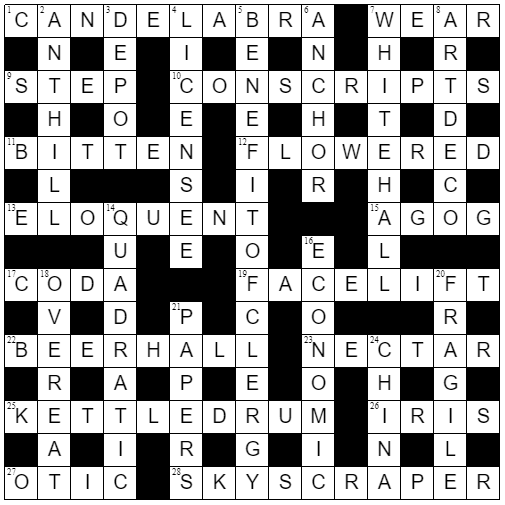
| ACROSS | ||
| 1 | CANDELABRA | Where tapers are balanced unsteadily by artist (10) |
| anagram (unsteadily) of BALANCED then RA (Royal Academician, artist) | ||
| 7 | WEAR | Conflict over East River (4) |
| WAR (conflict) contains (over) E (eastern) – the River Wear | ||
| 9 | STEP | Stage favourites return (4) |
| PETS (favourites) reversed (return) | ||
| 10 | CONSCRIPTS | They’re called up to study texts (10) |
| CON (to study) SCRIPTS (texts) | ||
| 11 | BITTEN | Dry Parisian well walls corroded (6) |
| TT (teetotal, dry) inside (with …walls, outsides) BIEN (well, French) | ||
| 12 | FLOWERED | Fully developed female let down (8) |
| F (female) LOWERED (let down) | ||
| 13 | ELOQUENT | Articulate European crowd welcome heartless monarch (8) |
| E (European) LOT (crowd) contains (welcome) QUeEN (monarch, heartless) | ||
| 15 | AGOG | Longing to leave in a Golf (4) |
| GO (to leave) in A G (golf, phonetic alphabet) | ||
| 17 | CODA | A medic recalled last part of movement (4) |
| A DOC (medic) all revered (recalled) | ||
| 19 | FACELIFT | Occupants of 28 do this renovation (8) |
| definition / cryptic definition – the occupants would be brave to climb the stairs | ||
| 22 | BEER HALL | Dance over here disturbed nightspot in Berlin (4,4) |
| BALL (dance) contains (over) anagram (disturbed) of HERE | ||
| 23 | NECTAR | Workers collect this chest he’s left in close (6) |
| ChesT missing HE’S inside NEAR (close) – worker bees | ||
| 25 | KETTLEDRUM | Skinhead cornered alcohol (10) |
| KETTLED (cornered) RUM (alcohol) – head is the membrane of a drum | ||
| 26 | IRIS | One teacher backs flag (4) |
| I (one) SIR (teacher) reverse (backs) | ||
| 27 | OTIC | Bar measure excluding priest involved with hearing (4) |
| OpTIC (measure of spirits, in a bar) missing P (priest) | ||
| 28 | SKYSCRAPER | Broadcaster’s bound to cover rare gherkin, say (10) |
| SKY’S (broadcaster’s) CAPER (bound) contains (to cover) R (rare) | ||
| DOWN | ||
| 2 | ANTHILL | Author Diana toured new home for workers (7) |
| ATHILL (Diana Athill, author) contains (toured) N (new) | ||
| 3 | DEPOT | Drank heavily going round warehouse (5) |
| TOPED (drank heavily) reversed (going round) | ||
| 4 | LICENSEE | Publican shows hostility beside Poles in shelter (8) |
| ICE (hostility) with N S (poles) inside LEE (shelter) | ||
| 5 | BENEFIT OF CLERGY | I neglect offer to work in Times for church approval (7,2,6) |
| anagram (to work) of I NEGLECT OFFER inside BY (times, multiplication) | ||
| 6 | ANCHOR | Presenter ran choral group (6) |
| found inside (group of) rAN CHORal | ||
| 7 | WHITEHALL | Comic that costs £140 on board and is pink (9) |
| double definition – Jack Whitehall (comic) and the property on a British Monopoly board | ||
| 8 | ART DECO | Colourful style of a Republican Dail member and novelist (3,4) |
| A R (republican) TD (Teachta Dala, Dail member) and ECO (Umberto Eco, novelist) | ||
| 14 | QUADRATIC | Notice pig breaking fast briefly, using roots? (9) |
| AD (notice) RAT (pig) inside (breaking) QUICk (fast, briefly) – quadratic equations (like all other equations?) have roots | ||
| 16 | ECONOMIC | Efficient English wag keeps working (8) |
| E (English) COMIC (wag) contains ON (working) | ||
| 18 | OVEREAT | Risk inflation? Take hour out and risk it again? (7) |
| OVERhEAT (risk inflation) missing (take out) H (hour) – if you overeat you run the risk of inflating your waistline | ||
| 20 | FRAGILE | Delicate paper kept in folder (7) |
| RAG (newspaper) inside FILE (folder) | ||
| 21 | PAPERS | Press perhaps breaks down, missing hub (6) |
| anagram (breaks down) of PERhAPS missing middle letter (hub) | ||
| 24 | CHINA | Feature a service (5) |
| CHIN (feature) then A – a dinner service | ||
A tad tricky for Redshank but mustnt grumble,Never heard of Jack Whitehall bit played Monopoly once.
I didn’t understand the ‘Comic’ bit of 7d, but enjoyed the other part of the double def and its reminders of Monopoly. I also couldn’t see how ‘Skinhead’ related to KETTLEDRUM. If I remember my maths from many years ago, a QUADRATIC equation contains numbers squared and therefore solving it involves square roots. Don’t ask me for any more detail!
I liked the ‘gherkin, say’ def for 28a and the ‘renovation’ of its occupants at 19a.
Thanks to Redshank and PeeDee
Thanks for the blog PeeDee.
I was pleased to solve all of this unaided except for Kettledrum. Redshank has certainly assumed solvers have very diverse general knowledge today!
A very challenging and satisfying puzzle today. It was a slow trickle until I got 5d BENEFIT OF CLERGY – my favourite clue as it happens – then I managed to pick the pace up a bit.
And this isn’t a complaint, because it didn’t stop me getting the answer at all, but isn’t the de-capitalising of a proper noun (Gherkin) for the sake of the surface reading normally considered unfair?
Thanks to all.
Thanks to Redshank and PeeDee. For WHITEHALL I did not know either the UK monopoly item or the comedian but I found the latter via Google. I had trouble parsing PAPERS and FACELIFT and especially enjoyed BENEFIT OF CLERGY. Ben Jonson, for one, was spared hanging by pleading B of C by reciting the Lord’s Prayer to show that he was literate and was branded with a T for Tyburn so that he could not use this escape again.
Angstony @4 re capitalisation: in my experience writing these blogs what is “normally” considered unfair depends on one’s idea of normal. For The Times capitalisation is normally important, for the Guardian it normally doesn’t matter. On most issues the FT usually sits somewhere between the two: less strict than The Times but more so than The Guardian.
Thanks, PeeDee @6. That’s interesting because I’m pretty sure I got the idea that it’s unfair from reading the Guardian blogs, where I lurk regularly, but only rarely comment.
Searching online just now I found another regular FT setter Alberich’s site, where comes down quite strongly on the side of it being wrong: “Deliberately misspelling a word does not say what you mean, and although calling this a misspelling may be overstating the case a bit, that’s what omitting a capital letter amounts to.”
Although I’ve read that piece several times now and I’m still not sure I understand why false capitalisation the other way – e.g. Bill = ‘account’ – is perfectly fine. I mean it surely still amounts to not saying what you mean, doesn’t it?
Hi Angstony – I don’t think it makes much sense to say that a feature is “right” or “wrong” and must be always allowed or always forbidden. If Alberich thinks something matters then in Alberich’s puzzles it is wrong there. If another setter thinks it doesn’t matter then in his/her puzzles it is OK there. What I find is that The Guardian seems to have looser editorial constraints on what gets published than some other papers. The puzzles are sometimes strict, often not. The Times is consistently strict. The FT is somewhere between the two.
It is no surprise that one sees the comments objecting to loose capitalisation in the Guardian because that is where the editor allows it to happen more frequently. It used to puzzle me that the Guardian (supposedly liberal) had the least tolerant comments of all my blogs. But then I realised that it was because those with little tolerance have more to object to than in the other puzzles.
Out of interest, why does there have to be a right or wrong on capitalisation anyway? I can see why murder and theft can’t be allowed and have to be forbidden, but what harm does having a different attitude to capitalisation do? Redshank doing one thing doesn’t prevent Alberich doing another. There is no confrontation here, both can coexist so why does one have to be right and the other wrong? Enjoy them both I think.
I sincerely hope that we never get a Governing Body of Crosswords that defines what is allowable in puzzles!
I hope I didn’t give the impression that I was trying to create conflict between Alberich and Redshank, that was certainly not my intention. I really just wanted to know if there was anything about the ‘gherkin’ clue in particular that absolved it from the charge of breaking the capitalisation rule, as I understood it to exist.
As for your live-and-let-live approach to it: on the one hand I tend to agree with you that the last thing we need is for setting to be policed to the nth degree. In fact I am often appalled and amused in equal measure at how petty some of the comments are in the Guardian blogs. There was an argument last year about a clue for a single castanet, for goodness sake. And don’t get me started on all the moaning about references to celebrities who are objectively famous, but, “I’ve never heard of them!”
On the other hand I do have some sympathy for those, like Alberich it seems, who equate ‘strictness’ with ‘fairness’ to some extent. I once tried solving the crossword in my mum’s local paper and it was awful! Loose definitions, missing indicators, superfluous words, you name any ‘bad’ practice and it had it. And more to the point it made it harder to solve, but not in any enjoyable way. I guess what I’m trying to say is, there has to be a line drawn somewhere. If puzzles like that started appearing in the nationals I could hardly blame anyone for pouring scorn on them.
I suppose like most things in life it’s all a matter of personal taste. I don’t see enough of a difference between the widely accepted version of false capitalisation and the supposedly unfair version, so I will be forgiving of the latter in future. But nothing on Earth will ever persuade me to forgive an indirect anagram. 😀
Uncapitalised proper nouns in “broadsheet” cryptic crosswords are vanishingly rare. I assume that Redshank uses one here because The Gherkin is a nickname, rather than a proper noun.
Capitalised or not, “gherkin” is just a pickle to me as I don’t know the skyscraper called The Gherkin. I missed that one as well as WHITEHALL, since I knew neither of the definitions in the clue. All in all I liked this crossword because clues like 13a, 23a, and 26a made up for the things I missed. Thanks Redshank and PeeDee.
Thanks Dansar @10. That makes sense. I didn’t even know it was a nickname, as it’s the only thing I’ve ever heard it called. But now we shift from the rules of crosswords to the rules of grammar: should persistent nicknames be capitalised? I’m leaning towards ‘yes’ but I’m open to persuasion.
I’m not happy with 27a. Otic relates to the ear not hearing. Auditory and Aural are the words for hearing.
Angstony @12
I think that Collins and perhaps others do list “the gherkin” as capitalised, but as the term started out as a (somewhat pejorative), nickname, I would say that this allows Redshank some wriggle room.
As for the the distinction between English grammar and crossword grammar, I see none.
Without the application of a set of broadly accepted “rules” (i.e. the grammar of the English language ), we are engaged in a child’s game of I Spy where the validity of an answer depends upon the whim of an unreliable witness.
Great crossword. Enjoyed picking through the clues. Difficult too; I missed 4 clues but they are well explained here. Really interesting test this one! Thanks to Redshank and PeeDee.
My ruling on capitalisation is simple. If the surface reading works best with (or without) capitalisation then go with that and disregard the definition part in this regard.
Dansar @12 and Angstony – I agree with you that having a broadly accepted set of rules is essential. The key for me here is “broadly”, what does that mean? There seems to be two ways to read this:
1) The rules are universal and absolute (documented by academics) and one can’t just pick and choose what one considers important. Broadly means that there are only a few people who would operate outside this set of agreed rules.
2) The rules are relative, individuals choose what counts as grammatically important for them in their circumstances. Broadly indicates that there is a very large overlap on what various people consider important, but there is no single absolute set of rules that everyone must follow all the time.
When I write my blogs I try and follow this principle:
If the setter is solidly of the first mindset (Azed say) then I like to solve and blog the puzzle in that spirit. If there is any question of grammar (or meaning, syntax etc) then I get the reference books down off the shelf and and start checking.
If the setter shows elements of the second mindset then I try to solve the puzzle in that spirit. If the clue is clever, amusing and I can solve it then it who cares if it follows the spirit rather than the letter of the law?
The gherkin clue leaves me in a bit of a quandary: Redhsank seems to be a normally rigorous setter and so I should treat the clue in that light: the clue is malformed as the definition needs a capital to be the name (even the nickname) of the skyscraper rather than an actual gherkin (Collins supports this).
On the other hand the clue is solvable, clever and amusing and grammatical technicalities aside it slots nicely into the puzzle as a whole, one of my favourite clues in fact. Is one technical breach of the “rules” even relevant here?
Thanks Redshank and PeeDee
An interesting puzzle that I was able to complete with a coffee and muffin (albeit a 40 min slow drink!) Still left with WHITEHALL basically biffed. Was only whilst doing my final check run through that I saw the Monopoly property (clever!) – had to come here to discover the comic – quite funny when I listened to one of his sketches !! Quite a lot of general knowledge required throughout the puzzle.
Finished with the clever OVEREAT, the tricky to parse PAPERS and that WHITEHALL as the last one in.
PeeDee @17: “Is one technical breach of the ‘rules’ even relevant here?”
Maybe not, but I think it’s always worth having a discussion if clarity is sought. I’ve found this one both interesting and thought-provoking thanks to you and Dansar.
i nearly completed this and I learnt a lot from the blog and comments: thank you.
I even got 28a SKYSCRAPER (but only after I had all the available letters from crossings; and I had got FACELIFT, which brought a smile only after I got 28a!)
I did get QUADRATIC, but how can a pig be called a rat?
In return, I thought 23a was excellent!
Lucio – for RAT/PIG think b-movies and gangsters “you dirty rat…”