A most enjoyable start to the day from Monk.
A nicely paced solve with lots of witty ideas. Thanks to Monk.
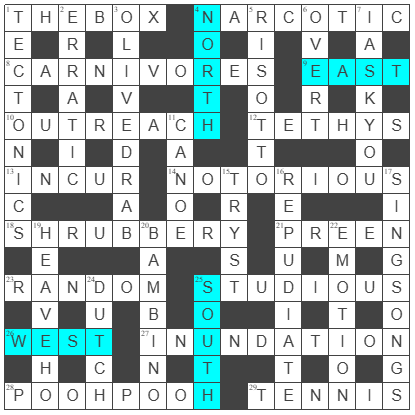
X (times); THE (article) + BO (Derek, for one) introduces
N (new) + (O[ats] (source of) eaten by ARCTIC (freezing)
‘Horse’ is a word for heroin, a narcotic. The question mark implies we should think laterally for the definition.
CARES (anxieties) involving ROVIN[g]< (roaming, mostly, <around)
(A SET)* (*bungled)
OUTRE (unconventional) + [b]ACH (composer, without B/non-British)
THEY* (*developed) breaking T[exa]S (banks in)
Tethys is one of Saturn’s moons
[ru]IN CUR[able] (to some extent)
NO (refusal) + (SUITOR* (*injured) holding O (ring))
SH (quiet) + RUBBERY (flexible)
PR (pair) + NEE< (once called, <round)
MOD< (ministry, <overthrown) after RAN (what political candidate did)
MOD = Ministry of Defence
STUD (boss) + (IS eating OU[t] (mainly))
[vie]W (finally) + EST (established)
IN + (D (delta) flanked by [unl]U[cky] (essentially) + NATION (people))
HOOP< (band, <revolutionary) repeatedly
[pres]S IN NET[herlands]< (covered by, <backtracking)
CONTEST* (*extravagant) consuming CI[ty]< (50% of, <backing)
TAR< (seaman, <turned up) in ERIC (Morecambe?)
(BARD (poet) + EVIL (angry) + O (over))< (<being sent up)
I don’t see another way to parse this, but ‘angry’ and ‘evil’ aren’t synonymous in my mind
[seve]N [tw]O [fou]R [fee]T (ultimately) added to H (height)
(O + SIR)< (old + gentleman, <upset); OTT (that’s too much, over the top) stuffing
[c]OVERT (secret, not the first)
(IOU SAY)* (*roughly) about K (a thousand)
Clutching O (what looks like lifebelt); CANE (switch)
[pay]S [deb]T (at last) following TRY (test)
PUD (dessert) in REI[g]ATE (Surrey town, losing heart)
(SIN (wrong) + G[irl]S (tips from)) hampering G (good) + SON (boy)
E (European) imprisoned in HAVE (keep) + HO[t] (fiery, not entirely)
ON< (<climbing) + BAMBI (a deer) – vice versa
Vice versa tells us to change the order of things, so put the deer in front of the climbing ‘on’
EMOTI[c]ON (smiley, perhaps, avoiding C[ircus] (head of))
DUT[y] (service, brief) supported by CH (church)
‘Dutch’ is an abbreviation of ‘Duchess of Fife’, rhyming slang for ‘wife’
S (second) + [y]OUTH (lad, dropping [sill]Y (back from))
My faves: NARCOTIC, TETHYS (novel WP), NORTH, CANOE and DUTCH.
OLIVE DRAB
Chambers has ‘very disagreeable or angry’ under ‘evil’.
Thanks Monk and Oriel.
Quite chewy but got there in the end. Liked shrubbery.
Am I alone in being slightly disappointed that east and west are in fact located in the northeast and southwest of the grid, unlike the appositely placed north and south? Perhaps I should get out more.
Excellent
I liked SHRUBBERY and PREEN. I found the compass points a bit too much of a help.
Thanks Monk and Oriel
3dn: As well as the definition from Chambers quoted by KVa@1, Collins 2023 p 687 has evil adj “4 (of temper, disposition etc) characterized by anger or spite”. I wondered about this when solving, but my almost immediate thought was that if Monk has used some definition, that in itself is strong evidence that it can be found in at least one good dictionary.
A usual Monk puzzle with well-constructed clues and plenty of NHOs (although not so many this time). And enjoyable. Liked EMOTION, POOH POOH as well as the variety.
I could not parse CANOE (nice clue now I understand it) or THE BOX. I did not bother to look for the Surrey town in REPUDIATE. And I am afraid most bears are omnivores not CARNIVORES.
Thanks Monk and Oriel
8ac: The Concise Oxford 2011 p 215 defines the noun carnivore as “an animal that feeds on flesh” or (in Zoology) “a mammal of the order Carnivora, which comprises the cats, dogs, bears, … “. I would argue that the first definition includes omnivores, but the second definition leaves no doubt that bears may be called carnivores.
I suggest the test of whether bears are carnivores should be the practical one of deciding whether you would get close to a hungry one.
I too couldn’t parse CANOE because I was looking at “an O” as looking like lifebelt” and couldn’t work out why CE meant “switch”. I assumed something electrical. I suppose the lack of an indefinite article before “lifebelt” should have shown me where I had gone wrong.
Babbler@8: I am not sure that I would care to get close to a hungry herbivore if I were thereby blocking access to its food supply. More to the point, the question at issue with regard to the clue at 8ac – at least as I understand it – is not whether bears eat meat: that is not in doubt. The question is whether the definition of carnivore includes omnivores or not.
Sticking to practical issues, an important part of the reason that, for questions relating to the meanings of words, I prefer to rely on dictionary definitions is that these are accessible to setters in advance of publication, whereas comments on these blogs, however sensible they may be, are only of use in the future if the setter is using the same word, or a very similar word. This is quite a different matter from questions relating to the acceptability of devices such as indirect anagrams or the unsignalled splitting of clue words: answers to such questions can be applied more widely in the future.
Excellent puzzle.
Challenging but entirely fair.
Congratulations to setter.
Thanks for the blog
Slightly irrelevant but (I think) interesting: I see from my zoology book that some members of the order Carnivora don’t eat meat at all. A giant panda is one example.
Good fun but once east and west were in place the other two were write-ins which I just had to parse, which takes a bit of the fun out of it.
On the “carnivore” debate, strictly members of “carnivora” are not “carnivores” but “carnivorans” so the argument from the taxonomic classification is not sufficient to rescue the clue. However, “carnivore”, even in the scientific world, means any animal which eats animal flesh for nutrition, which bears do. Animals which exclusively eat meat (such as many cats) are obligate carnivores. So yes, scientifically a bear is a carnivore and an omnivore and the clue is fine, though I did do a double-take at first after listening last year to a “More or Less” on how many berries a bear can eat in one day. And, of course, one should never forget that, just because a word has a strict scientific definition, it can also have a less strict meaning outside of that context.
Thank you Monk and Oriel.
Jack@12. Please cite the authority on which you are claiming that members of “carnivora” are not “carnivores” but “carnivorans”. The definition I quoted from the Concise Oxford is supported by Chambers 2016 p 237 and Collins 2023 p 316 as well as the larger Oxford dictionaries.
Thanks Monk for a super crossword. I had many favourites including OUTREACH, SHRUBBERY, STUDIOUS, INUNDATION, OVERT, and BAMBINO. I needed a word finder to get NARCOTIC and the blog to fill a few of my parsing gaps but generally I found this to be smooth sailing. Thanks Oriel for the blog.
PB@13: The CUP text book “Carnivoran Evolution” (Goswami A, Friscia A, eds. Carnivoran Evolution: New Views on Phylogeny, Form and Function. Cambridge University Press; 2010.) states “the term ‘carnivoran’ is a phylogenetic classification, in contrast to ‘carnivore’, an ecological classification describing any meat-eater”. “Carnivoran” is also listed in Merriam-Webster and Collins dictionaries.
But as I said, that does not exclude the word “carnivore” being used non-scientifically as well – my point was that, in this instance, even wishing to be scientifically pedantic about a definition means the clue is fine from the behavioural definition. It is also not uncommon to find scientific errors in dictionaries as they are descriptive where scientific communication is frequently reliant upon prescription for precision. When people misuse words, dictionaries reflect that. Perhaps instead of “strictly” it would have been better for me to have said “scientifically”.
Jack@15: What you call misuse of words, I call natural development of a democratic living language.
Thanks to Oriel for the usual fastidious blog, to all for the positive feedback, and special thanks to the redoubtable Pelham Barton for not only his trademark adherence to meticulous verification by source but, on this occasion, making the excellent point (paragraph 2 of post #9) which probably addresses >95% of the concerns raised on any crossword blog.
As for the omnivore/carnivore debate, it doesn’t bear🐻thinking about, though this source has bears eating meat when the weather gets colder. So, in my defence, since I set the clue a couple of weeks ago (during a cold snap), I was technically correct at the time😜.