This is the first Azed puzzle to appear since the announcement last week of his retirement from the monthly clue-writing competition.
The full story can be read here (but may be behind a paywall). In brief, Jonathan Crowther, aka Azed, has been compiling the cryptic puzzle in The Observer under that name since 1972. Every month he has judged a clue-writing competition where solvers must first fill the grid correctly and then devise a clue to replace a definition given by him. At its peak, there were well in excess of 500 entries a month, but this gradually declined as newspaper circulations fell. Every month, Azed would publish a report on the previous month’s competition, giving the names of the three winners and their clues as well as those deemed by him as Very Highly Commended and also the names of those whose clues were merely Highly Commended. There would follow a short essay discussing the puzzle and issues of clue-writing style. These reports were known as slips, being printed on one long sheet of paper, sent out to subscribers. There is an archive of the slips from their inception until May 2022 at the splendid & lit website, since when the slips have been published on Derek Harrison’s Crossword Centre website.
Among the names of the winners of the competitions to be found in the slips in the early years are some well-known in the world of crosswords, such as Don Manley, but also Colin Dexter, who named his detective after another regular winner, Sir Jeremy Morse.
In addition to this unique dialogue between a setter and his solvers, there were regular dinners or lunches, usually at an Oxford college or hotel, where solvers could meet one another and also, of course, meet Jonathan. These events usually coincided with a milestone number in the puzzle sequence, starting, I think, with No 250 in 1977. In more recent years, these lunches (the last two have been at Wolfson College) have been followed by tea in the Crowther garden, which is situated quite close to the college. This exceptionally generous gesture has been much appreciated by those who have attended, amongst whom I count myself fortunate to have been included.
Last week’s Observer published the results of the last two competitions and Azed published his last, valedictory, slip. Today’s puzzle is therefore the first monthly puzzle by Azed which does not include a clue-writing competition, although there will be the usual random draw for prizes from those submitting correct entries (which can now be done online). In due course, we are told, Gemelo will take over the clue-writing competition. Speaking personally, it has taken me the best part of forty years to win a prize in an Azed competition (it was fully five years before I even got a Highly Commended!) so I hope that the transition will not be too long delayed.
Turning then to this week’s puzzle, I was delighted to encounter the archaic term SIR-REVERENCE amid a fair sprinkling of terms from Latin, Greek and even Hungarian, all of which can be found in Chambers Dictionary. The puzzle had more than the usual number of four-letter words, which can often be more difficult to solve than longer ones, but with three checked letters, there was only one letter in each which might prove ambiguous. Solvers may be interested to know that I solved this puzzle more quickly than the previous day’s Guardian Prize puzzle, since although Azed uses a lot of unfamiliar words, the wordplay, and the generous checking, make it relatively easy to solve, provided you have Chambers available.
My continuing thanks and congratulations go to Azed.
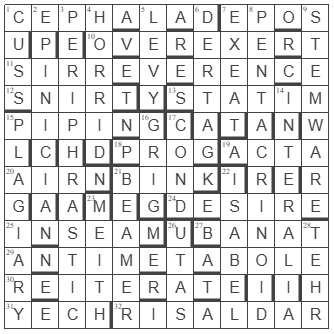
| ACROSS | ||
| 1 | CEPHALAD |
After cheap exercises, boy’s facing head (8)
|
| *CHEAP, LAD. Chambers defines this as a zoological or anatomical term meaning “situated near, facing towards, or passing to the head”. | ||
| 7 | EPOS |
E.g. Homeric events, read in repose (4)
|
| Hidden in “repose”. This singular word can mean either an epic poem or a series of events of the kind that form the subject of epic poetry. | ||
| 10 | OVEREXERT |
English king in public to exercise too much? (9)
|
| E REX (English king) in OVERT (public). | ||
| 11 | SIR-REVERENCE |
Bishop always replacing line in quiet? It was waste (12)
|
| RR (Right Reverend, term of address for a bishop) EVER replacing L in SILENCE (quiet). Chambers explains this term meaning excrement as a corruption of the phrase save reverence, used apologetically when anything vulgar or disgusting has to be mentioned. | ||
| 12 | SNIRT |
Exercises rolling over yielding a chortle from Mac (5)
|
| TR(a)INS (rev). | ||
| 13 | STATIM |
Easy? Not half, to touch up inside forthwith (6)
|
| TAT (to touch up) inside SIM(ple) (easy). | ||
| 15 | PIPING |
Incandescent cake decoration (6)
|
| Double definition. | ||
| 18 | PROG |
Univ officer broadcast on TV? (4)
|
| Another double definition; the university officer is a proctor. | ||
| 19 | ACTA |
Player, by the sound of it secretary’s responsibility (4)
|
| Homophone of “actor”. Acta are official minutes of proceedings. | ||
| 20 | AIRN |
What’s wielded at Troon, to display by name (4)
|
| AIR (display) N(ame). Chambers gives this as a Scottish form of “iron” but I don’t know if in practice it is used to describe the golf club of that name. | ||
| 21 | BINK |
Where plates are stacked in wine container set before king (4)
|
| BIN (wine container) K(ing). Another Scottish term but not indicated as such. | ||
| 24 | DESIRE |
Long for reeds scattered round island (6)
|
| I(sland) inside *REEDS. | ||
| 25 | INSEAM |
Inner part of shoe man is seen flourishing round Spain (6)
|
| E (country code for Spain) inside *(MAN IS). | ||
| 27 | BANAT |
Outer district of Hungary, part of exurban Attala (5)
|
| Hidden in “exurban Attala”. | ||
| 29 | ANTIMETABOLE |
If old-fashioned schedule about over, here’s a rhetorical device (12)
|
| AN (old form of “if”), O(ver) (cricket abbreviation) inside TIMETABLE (schedule). It’s a figure of speech in which the same words are repeated in inverse order. | ||
| 30 | REITERATE |
Old German cavalry man devoured parrot! (9)
|
| REITER (old German cavalry man) ATE. | ||
| 31 | YECH |
Dance turns containing bit of crudity – ugh! (4)
|
| C(rudity) inside HEY (dance, rev). | ||
| 32 | RISALDAR |
Cavalry commander left in wild raids Arabia (8)
|
| L(eft) inside *RAIDS, AR(abia). | ||
| DOWN | ||
| 1 | CUSS |
Di’s ignored in debate, a stubborn one (4)
|
| (dis)CUSS (debate). | ||
| 2 | EPINICIAN |
Recalling paean, I can pine if endlessly out of sorts (9)
|
| *(I CAN PINE I(f)). An epinikion or epinicion was an ode, or paean, in honour of a victor. This is the adjectival form. | ||
| 3 | PERIPHRASTIC |
Circumlocutory, awful chipper about opening of red wine (12)
|
| R(ed) ASTI (a wine, often found in crosswords!) all inside *CHIPPER. | ||
| 4 | HORRID |
Army mostly found accepting religious instruction repellent (6)
|
| RI (religious instruction) inside HORD(e) (army, mostly). | ||
| 5 | LEVY |
Call for humour when it’s missing (4)
|
| LEV(it)Y (humour). | ||
| 6 | DER TAG |
Time for start of struggle grated awfully (6, 2 words)
|
| *GRATED. No indication that this is a German phrase, but it is in Chambers. | ||
| 7 | EXEAT |
Permission for e.g. bishop outside to dine (5)
|
| EX (outside) EAT (dine). I’m slightly confused by the wording of the clue, because an exeat is a permission granted by a bishop rather than to him (or her), as the clue implies. | ||
| 8 | PENTACRINOID |
Describing certain fossils, depiction ran awry (12)
|
| *(DEPICTION RAN). These are the fossils of feathery five-rayed stars on a long stalk. | ||
| 9 | STEMWARE |
Glasses etc, warmest when spread on middle of chest (8)
|
| (ch)E(st) inside *WARMEST. | ||
| 14 | INTER ALIA |
Included in rest, later treated among protuberances (9, 2 words)
|
| *LATER inside INIA (protuberances). | ||
| 15 | PLAGIARY |
A girl mostly miscast in drama, pinching others’ ideas (8)
|
| *(A GIR(l)) inside PLAY (drama). More usually described as plagiarism. | ||
| 16 | GRIG |
Making runs in sport locally (cricket) (4)
|
| R(uns) (a cricket abbreviation) inside GIG (sport). Both “gig” (in the sense used in the clue) and “grig” are dialect terms, hence “locally”. | ||
| 17 | COND |
Spenser’s learned by heart – forgive one let off (4)
|
| COND(one) (forgive). Sometimes referred to as Edmund or just Ed, Spenser’s eccentric spellings are to be found in Chambers and are thus fair game. | ||
| 21 | BEAMER |
This one’s put in to drive ‘quicky’ aiming high (6)
|
| ME (this one) inside BEAR (which can mean to drive). It’s another cricketing term, describing a fast ball towards the batsman’s head. There is another meaning of “beamer” as slang for a BMW motorcar, but it’s not given in Chambers. | ||
| 22 | ISABEL |
Might she have beguiled Pascal? (6)
|
| ISABEL is an anagram of BLAISE, Pascal’s first name. I think that this clue may qualify as an & lit clue, one where the definition and wordplay are the same, but it can sometimes be difficult to determine. | ||
| 23 | MEITH |
Scottish border – it divides one such heading north (5)
|
| IT in HEM (border, rev). “Going north” is used here to show a reversal in a down clue. | ||
| 26 | UTAS |
An eighth day, or half a seventh, counting up (4)
|
| SATU(rday) (rev). A utas is the octave, or eighth day of a church festival. | ||
| 28 | TEHR |
Characters heading for the eastern Himalayan range may identify me (4)
|
| Initial letters of “The Eastern Himalayan Range”. Another possible & lit clue. |
Thanks for the blog , some interesting long words and very good clues for them . An unusual middle to the puzzle which took a bit of sorting out . For PROG I think Univ is a pointer to the short version being used for both .
The only dud was ISABEL , a clue to a clue .
I never entered the competitions , I am only interested in solving , but they must have been a lot of work for Azed .
I feel a bit reluctant commenting because I have never entered an Azed competition or any crossword competition that would require me to post a letter halfway round the world. I know recently online entries were possible, but the rules say only UK residents are eligible.
I really liked the 12-letter answers of which PERIPHRASTIC was the only one I knew the meaning of, but the others weren’t too hard to word out from the wordplay helped by some checking letters. I’m still amazed that TIMETABLE is hiding in ANTIMETABOLE. I thought the four 4-letter answers crossing in the middle was the trickiest part of the puzzle. I wasn’t sure that COND was a Spenserian spelling but thought it seemed likely, but I didn’t know the ‘Univ officer’ meaning of PROG, or the required meanings of BINK, GRIG or GIG.
I thought 22d must be an anagram of PASCAL until checking letters meant it couldn’t be. I knew that Blaise is the first name of the person I usually mean when I say ‘Pascal’, but it still feels like an indirect anagram to me.
Thanks, bridgesong and Azed.
I was interested to compare the clues for OVEREXERT .. 10a here and 2d in Everyman which appeared on the same day. Similar constructions. A curious coincidence!
Nice spot Jay @3. It surprises me how diverse the entries have been to the Azed Clue Competition the last few years I’ve been doing it. It’s sad to see it cease.
Was this slightly more accessible than some have been in the past. Pascal was such a polymath that there are so many things that might have appealed to him, but, alas, no triangular girl’s names, none involving pressure or gambling and Ada didn’t fit.
Roz@1 and Matthew@2: I’d agree that ISABEL is an indirect anagram. Being picky, I don’t think “for” quite works in the wordplay of 28dn – it should be either “Headings for” or “Characters heading” (though of course neither of those would make sense for the surface. Perhaps “Characters leading in” or just “Leaders in”?). Like Matthew, I was surprised to find Timetable in Antimetabole; I also liked 30ac (I got reiter – ate, but it took me a moment to see the word it made!) and 16dn.
Roz@1: I agree that Univ is a pointer to the abbreviation, but in relation to the university officer, I think it’s a very old-fashioned one. I don’t remember the term being used when I was at Oxford (proctor, yes; prog, no) – and that was decades ago!
I did enter the clue writing competitions when I first started doing Azed around 1980 but I quickly realised I wasn’t good at it.
I didn’t know GIG for sport and I totally missed the indirect anagram at 22dn.
MunroMaiden@6: I agree about 28dn. “To” or “towards” instead of “for the” would have worked quite well. I also started in the clue writing competition more than 40 years ago but, unlike Dormouse@7, kept at it.
To add, I have not been doing Azed continuously since 1979-80. (I switched to the Observer when The Sunday Times went on strike.) When the Independent on Sunday started in 1990, I started doing Beelzebub and switched back when that stopped. But I got no enjoyment trying to write clues, so I stopped in the eighties.
Once upon a time I entered a few clue-writing competitions, and once, on consulting an archive, was surprised to learn that one of my clues had been highly commended, something which had somehow escaped me at the time. But like Dormouse#7, I realized I would never excel, and gave up. I’m glad Azed puzzles are continuing for now. In some newspapers there will occasionally be a setter whose puzzles I can’t even begin, but with Azed there is always a way in. Even if I don’t complete the puzzle I get more enjoyment from attempting it than I do from completing the puzzles set by others.
Lots of obscure words this month, but so long as the clues are good, finding them in Chambers is the challenge I enjoy. I too found ISABEL a bit confusing.
Thanks, bridgesong.
The &lit site is, as you say, very good indeed and goes right back to Ximenes which began in August 1945. Azed essentially continued this when he took over from Ximenes in 1972. Reading the slips gives a fascinating picture of how standards of clue-writing developed over a long period, The term “Ximenean” (for fair and precise clue-writing) came into crossword language during that time.
Hector@8: yes, “to” or “towards” (without “the”) would have worked very well. You’re obviously right to have kept up the clue-writing!
The end of an era! Thanks to Azed for all the work keeping the competition going over the years.
My clue-writing ‘career’ seems similar to yours, bridgesong.
I started entering when I was at uni, gradually improved through studying the successful clues and better understanding what Ximenean truly meant, to the point where in 2025 I achieved my best ever placing in the annual honours table with eight VHCs and one prize. In truth, though, I’m probably a solid Championship performer rather than a Premier League contender.
I really hope Gemelo/Observer will continue the monthly competition in a very similar format. However, the disappearance from the slips of the number of entries received following the move to online submission makes me worry about viability. The reference to ‘hundreds’ of clues to judge in Azed’s farewell message sounds like wishful thinking: I very much doubt there has been a return to the 500-plus entries routinely submitted when I first started.
This is certainly the end of an era. I sent a suggestion about how to mark it to the Observer’s puzzles editor but never received a reply.
Andrew @14: congratulations on your achievements in 2025! I missed out on appearing in the annual honours table due to the fact that three VHCs were not quite enough to guarantee a place; my (consolation?) prize came in the very last competition of all, which did not feature in the 2025 table.
I’m not sure where you found a reference to “hundreds of clues” in Azed’s farewell message; he certainly makes no reference to numbers in his last slip, but I agree that the absence of numbers in the last few slips is concerning. In theory, the move to online submission should increase the numbers, although the fact that for legal reasons prizes cannot be offered to overseas solvers will deter some. I can remember people finding ingenious ways to submit entries during a postal strike in the 1980s.
The Observer is of course organising a celebration at its offices in March which all are welcome to attend, tickets being free.
Seems to be the time for celebration. I have nothing to add for 2776 (thought it was good) but Azed might like to think of a little boy (I think I was 16) looking at a Ximenes. He phones a friend: “I think I’ve got an answer!” (only one, the first one, ever). It had taken about six weeks. Soon, we solved, together, an entire Ximenes! And more… Then along comes Azed. I was an old hand by now, all of 17, so who is this upstart?
Well, it didn’t take long to find out, did it? (No apologies for repeating these. Can we have more favourites?)
Paddy’s temptation: a drink along the way (4)
What might cause problems with joints? It’s that lunch on dripping sandwiches. (7)
Stop Duke interrupting most of Snout’s part with Thisbe (9)
Etc.
Etc.
I think we should all start our own honorary Azed monthly competition. Every month’s 1 Across (or first across clue) posted to some suitable media site. No prizes offered but bring mirth. Embarrassment not expected because we are all too intelligent. And not quite errmm…. Judges and juries?—I’d expect plenty of them. As many have said: it’s all very well coming up with one brilliant clue a month but thirty-six a week is a different matter.
I am delighted, weary, and I have to say, a little sad, to end my career, after fifty-seven or so years, with HC 2. (Mind you, I entered only about four times so watch out!)
Stefan
bridgesong @15:
Jonathan, who has set this crossword under the pseudonym Azed since 1972, will continue to publish one plain crossword a month. However, as he writes, the administrative burden of the Slip, the Honours List, and judging hundreds of clues each month requires more than he can give.
From the piece in the Observer you linked to…
Andrew @17: in which case my comment would more appropriately have been directed at The Observer’s puzzles editor, Caitlin O’Kane, who seems to have hallucinated a statistic that Azed himself had not in fact used. My apologies!
On 6D, Der Tag was a phrase used by the German High Seas Fleet and Scouting Group to refer to the great battle they expected with the British Grand Fleet in WW1. I expect it is an older phrase.
End of an era! I’ve been doing Azed regularly since the late 1970s, rarely sending clues (I always overthink them) but I did get a couple of HCs. I used to get the Times for Mephisto which I found easier than Azed. I was already very familiar with Chambers because I played tournament Scrabble, it was great to compare notes with Joyce Cansfield at events. I’ll miss Azed but Gemelo is becoming a worthy successor, I’m hoping for more Azed-like specials eg Playfair and Eightsome reels. Anyway I digress, best wishes to Azed in his retirement and thanks to bridgesong for the blog and tribute. (ISOBEL was the only clue I circled, it seems a bit unfair but clever nonetheless!)
I started doing Azed as a teenager. I spent many enjoyable Sundays watching the forty-over John Player league cricket (memories of players like Viv Richards and Ian Botham striding out to bat on a sunny afternoon) and flicking through Chambers searching for obscure words. Many of the words were, and still are, unknown to me and I felt that any solutions that could be derived by sifting through possible candidates from Chambers were fair game. I still try to maintain that ethos so I allow myself any solutions that could reasonably be found using a hard-copy of Chambers and some perseverance. I then had a bit of a hiatus, with only sporadic Azed forays, to pursue a career and wonderfully he was still there to return to when I retired. I did enter the clue competition a number of times but without any luck in common with others above. Happily, there are still more Azed crosswords to come and, as with Mike @20, I still hope for the odd Playfair or Eightsome Reels specials which I really enjoyed. So, many thanks to Azed for all the crosswords so far and here’s hoping there are many more to come!
I can’t recall when I first came across an Azed crossword, probably the early 70’s. I do remember no. 300, chilli con carne, and I did manage a couple of commendations in the clue writing competition.
Thanks to the & Lit website, I’ve just found I got an HC in 319 May 78 for PODESTA, and a VHC in 336 Sept 78 for ELF ARROW / CUTHBERT.
That was in the dim and distant past.