The weekly online only crossword from the Guardian found here
This week set by Hectence, who usually sets a pangram – a crossword that uses every letter of the alphabet, which can help with some of the clues.
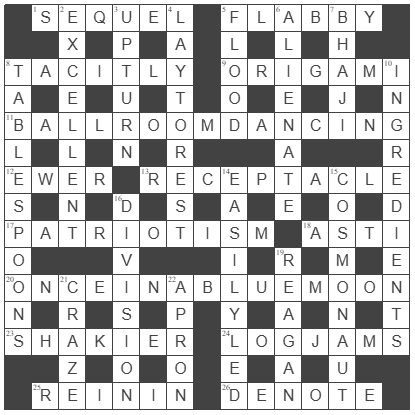
| ACROSS | ||
| 1 | SEQUEL |
Picture covering Queen’s long continuing story (6)
|
| insertion – SEE (picture) around (covering) QU (queen) + L (long – as in dimensions) | ||
| 5 | FLABBY |
Fine scientific establishment busy cutting American slack (6)
|
| charade of F (fine) + LAB (scientific establishment) + BY ( BusY cutting US – American) | ||
| 8 | TACITLY |
Silently cheers Leicester perhaps securing lead in League (7)
|
| charade of TA (cheers) + CITY (Leicester perhaps) around (securing) L (lead in League) | ||
| 9 | ORIGAMI |
Paper craft has old sails etc, one master recalled (7)
|
| charade of O (old) RIG (sails, etc) + reversal (recalled) of I (one) MA (master – masters degree) < | ||
| 11 | BALLROOM DANCING |
Strictly’s content to condemn canoodling and mostly blame Romeo (8,7)
|
| anagram of (to condemn) (CANOODLING BLAMe R)* where BLAM is mostly blame and R is Romeo from the NATO phonetic alphabet –
and sorry, I should have added this, Strictly in the UK is shorthand for Strictly Come Dancing – which has just celebrated 25 years. It is franchised out across the world, but is called Dancing with the Stars in the US. |
||
| 12 | EWER |
Pitcher Webb, initially retained by phone company, gets sponsor in the end (4)
|
| insertion of W (Webb initially) into (retained by) EE (phone company) + R (sponsoR in the end) | ||
| 13 | RECEPTACLE |
Engineers dubiously accept abridged permit for vessel (10)
|
| RE (engineers – Royal Engineers) + anagram (dubiously) of (ACCEPT) + LE (abridged permit – LEt) | ||
| 17 | PATRIOTISM |
Some fellowship at riot is misrepresented as love for one’s country (10)
|
| hidden (some) in fellowshiP AT RIOT IS Mispresented | ||
| 18 | ASTI |
It’s a revolution in sparkling wine (4)
|
| hidden reversal (revolution in) of IT’S A < | ||
| 20 | ONCE IN A BLUE MOON |
On rare occasions previously writer worked, unable to be idle (4,2,1,4,4)
|
| charade of ONCE (previously) + I (writer) + anagram of (worked) (UNABLE)* + MOON (idle) –
adding later, the Chambers definition of MOON includes (vt) to wander about listlessly or to gaze vacantly at anything – I know it from reading about “mooning youth”s – in P G Wodehouse, the lovestruck protagonists often moon. . |
||
| 23 | SHAKIER |
Increasingly tentative, I ask her out (7)
|
| anagram (out) of (I ASK HER)* | ||
| 24 | LOGJAMS |
Preserve records admitting gridlocks (7)
|
| insertion (admitting) of JAM (preserve) into LOGS (records) | ||
| 25 | REIN IN |
Check information held by inner assembly (4,2)
|
| anagram (assembly) of (INNER)* – insertion (held by) of I (information – from the tourist information signs on maps and street signs) | ||
| 26 | DENOTE |
Typify reactionary public school education (6)
|
| reversal (reactionary) of ETON (public school) + ED (education) and all reversed < | ||
| DOWN | ||
| 2 | EXCELLENT |
Select spreadsheet program and occasionally alter books (9)
|
| charade of EXCEL (spreadsheet program) + LE (occasionally aLtEr) + NT (books – New Testatment, books in the Bible) | ||
| 3 | UPTURN |
At university, go for advancement (6)
|
| charade of UP (at university – he was up at Oxford) + TURN (go) | ||
| 4 | LAY TO REST |
Bury put ultimate market on street behind Rock (3,2,4)
|
| charade of LAY (put) + T (ultimate – so last letter of – markeT) + ORE (rock) + ST (street – which comes after the ORE because it’s behind) | ||
| 5 | FLOOD |
Fare well, finally plugging major leak (5)
|
| insertion (plugging) of L (welL finally) in FOOD (fare) | ||
| 6 | ALIENATE |
Repel extra-terrestrial assault that’s drained earth (8)
|
| charade of ALIEN (extra-terrestial) + AT (AssaulT that’s drained) + E (earth – from electrical plug labels) | ||
| 7 | BHAJI |
Starters in Bengal have additional jhalmuri in side dish (5)
|
| acrostic (starters) from Bengal Have Additional Jhalmuri In | ||
| 8 | TABLESPOONS |
Cutlery with carved apostles on captivating bishop (11)
|
| anagram (carved) of (APOSTLES ON)* + insertion of B (bishop from chess notation)
Adding later Apostle Spoons are a thing – I did know about them, didn’t realise they weren’t better known – and far more likely to be used on the table than TABLESPOONS which are now a measure and too big to eat with, but too small for serving. |
||
| 10 | INGREDIENTS |
Stuff for recipe needs vigorous tenderising (11)
|
| anagram (vigorous) of (TENDERISING)* | ||
| 14 | EASILY LED |
Trusting a silly order to enter rising river (6,3)
|
| insertion (to enter) of anagram (order) of (A SILLY) in DEE< (rising, so reversed in a down clue, river – the name of several UK rivers, including one in Scotland, where Aberdeen is found.) | ||
| 15 | COSMONAUT |
Company mounts scheme engaging a space traveller (9)
|
| charade of CO (company) + anagram (scheme) of (MOUNTS) + A (from clue) inserted (engaging) | ||
| 16 | DIVISION |
Conflict with detective on plan for future (8)
|
| charade of DI (detective – detective inspector in police) + VISION (plan for future) | ||
| 19 | REAGAN |
Former president managed to hide confusion of age (6)
|
| insertion (to hide) of RAN (managed) around (to hide) anagram (confusion) of (AGE)* | ||
| 21 | CRAZE |
Rage about variable care organised (5)
|
| insertion (about) of Z (variable – one of the letters used in algebra to signify variables) into anagram (organised) of (CARE)* – and this would have been quicker if I’d remembered Hectence produces pangrams earlier. | ||
| 22 | APRON |
Put up partial screen or partition that protects clothing (5)
|
| hidden reversal (put up partial) of screeN OR PArtition < |
Lovely Quiptic, possibly at the high end of difficulty for the slot but remembering that Hectence usually has a pangram helped (in my case for 16d).
Thanks Hectence and Shanne
I too thought this was a lovely quiptic.
Thanks Hectence and Shanne.
A rather pleasant solve for the Quiptic slot. Momentarily stumped by 25a but got there in the end. Now for some crumpets and oolong 🙂
Many thanks to Hectence and Shanne!
Very enjoyable. Someone had told me that EE was a UK phone company but alas I’d forgotten. Didn’t really matter.
Took me longer than a regular quiptic; couldn’t easily see LOGJAMS (a weird word order threw me off) and couldn’t parse UPTURN. Still not sure what Strictly refers to in 11a, – just guessed the anagram. Liked the one-word anagram of INGREDIENTS, ONCE IN A BLUE MOON and FLABBY. Thanks Hectence and Shanne!
Layman@6 Strictly refers to Strictly Come Dancing, a popular ballroom dancing show on UK TV.
I thought it might have been a reference to the 1992 Australian film Strictly Ballroom — but I guess your explanation is more likely correct in an English puzzle.
Layman @6: Firstly, I agree with your favourites plus the nicely hidden PATRIOTISM and secondly, Strictly refers to Strictly Come Dancing, a BBC dancing competition involving Z list celebrities. Any Leicester City fans will be wincing at the irony of TACITLY, having recently had 6 points docked under the fair play rules, pushing them into the relegation zone.
A lovely Quiptic indeed.
Ta Hectence & Shanne.
Could the clue for REAGAN be an &lit – or didn’t he hide it so well?
Lovely quiptic.
Thanks Hectence and Shanne.
Wikipedia says that Strictly Come Dancing was named as an amalgamation of the abovementioned Strictly Ballroom and the long-running series Come Dancing.
Interesting to see commenters writing both Quiptic and quiptic. Which is grammatically correct, I wonder?
Layman@6: For me, “Strictly” is a reference to the film Strictly Ballroom. Enjoyable crossie, though I was held up trying to complete LoI FRA_BY, having assumed the scientific establishment was the Royal Academy. When the penny dropped…!!! Thanks, Hectence and Shane.
Sorry, I’ve added some information on Strictly – it’s such a huge part of the entertainment world in the UK, that we all think Strictly Come Dancing. It’s all over the headlines when I Googled to get the Wiki page, because new hosts, one of the dancers is starring in Kinky Boots, another celebrity who was on the show has withrdrawn from a West End Show, and scandals various. I’m listening to Sunday on Radio 4, and Arlene Phillips, one of the first judges on the show has been introduced as being a part of Strictly. (And I only had to Google “Strictly”)
AlanC @12 – I suspect Quiptic as probably a registered trademark, so a proper noun.
PATRIOTISM is a great find and makes an apt surface. I liked TABLESPOONS because Apostle spoons are a thing.
You may be right SueM # 10, that Hectence could have been alluding to REAGAN’S cognitive decline while in office, which was observed, although he wasn’t diagnosed with Alzheimer’s disease until after he left at the age of 77, but then he and his wife went very public about it to raise awareness.
Similarities with Biden and Trump in whom others have observed signs, but none of the White House’s physicians have assessed that, on the public record anyway. I’m heading for that age group. I hold on to the expression that if you can remember that you’ve forgotten, you haven’t got it. Or as the lama said to me, remember to remember to remember. I just keep doing cryptics, with my fingers crossed.
Thanks Petert #15. The clue for TABLESPOONS is so much more clever now that you’ve pointed it out. I didn’t know about Apostle spoons. Very interesting on looking them up and why they were in groups of 13.
Thanks Shanne.
Loose (5a, 2d, 6d) and convoluted (4d, 11a, 20a) in too many places. On this kind of sketchy ground, I don’t see why 21d couldn’t be CRAVE. Quite a few headscratchers within clues to boot: ‘Up’ means at university? Moon means to idle? If I were to drop either into conversation I would expect people to think I’d gone mad.
One day Hectence might even 25a the stunted syntax in her clues.
Yes Tachi, I was stumped by the ‘up’ and ‘moon’ references too. Where I live one goes ‘down’ to Oxford and Cambridge.
As far as mooning is concerned ….. well let’s not go there.
An excellent Quiptic from Hectence with some great clues – happy to see my football club in 8a – although this week’s points deduction is going to make it a tough couple of months to see if they can survive. Thanks to Shanne for the excellent blog.
Tachi @19 and Percybass @20 – you obviously don’t read the right books – MOON as to wander aimlessly is in my idiolect, mostly from Jeeves and Wooster, but I’ve come across it in other writings. I’ve added that and Apostle spoons to the blogs.
I don’t think this was an ultra-easy Quiptic, but I don’t find Hectence the quickest of Quiptic setters to solve. I solved it in the sort of time some of the weekday Cryptics take me, but it wasn’t outside the time I expect a Quiptic to take (I have rough times in my head for puzzles). I wrote in about half to two-thirds of the puzzle on first read through, which feels right for my solving of a Quiptic, and then took longer solving the clues I’d missed. I find puzzles I write in less interesting as they are less challenging and I don’t learn anything. But I also reckoned there was enough here for people to get a foothold and then have crossing letters to work out the rest.
“Loose (5a, 2d, 6d) and ”
5a FLABBY – I wrote that one in on first read through, and there’s Chambers justification for FLABBY – the final words in the definition are: hanging, loose – it’s a metaphoric use, but when has that stopped the English language?
I can’t see what is loose about 2D (EXCELLENT) or 6D (ALIENATE) – the word play got me there and the definitions have Chambers justification. Excellent means surpassing others in some qualities, as does the select (few).
“convoluted (4d, 11a, 20a) in too many places”:
4D (LAY TO REST), 11A (BALLROOM DANCING), 20A (ONCE IN A BLUE MOON) –
11A is a pretty straightforward anagram, which I wrote in on first pass. 4D and 20A are charades, slightly more complicated, but not impossible. I had to come back to 20A, but had enough crossers to write in 4D. I did have to back parse 4D and 20A from the answers, but I’m blogging and I have to parse everything to explain it. I don’t when I’m solving for fun, enough to get the gist can be enough.
The other way of looking at these sorts of clues is that they are stepping stones to the more challenging setters. I’ve blogged some quite complicated clues when I’ve covered puzzles, and really had to think how to make the blog make sense. I didn’t have to expend much thought here.
“On this kind of sketchy ground, I don’t see why 21d couldn’t be CRAVE.”
CRAVE means to beg for, to long for and etc
CRAZE means to become deranged
Which seems more likely for “rage” as a definition? Also it’s Hectence, she sets pangrams, and we haven’t used the Z unless it’s here.
“Quite a few headscratchers within clues to boot: ‘Up’ means at university?”
Yes, UP means at university, or at a school or college – it’s in Chambers. It’s also a piece of crosswordese that it’s worth learning because it’s used a lot. UP trains also go to London (if not going to London they go up to the next most major location) – it’s technical train use to know which is the UP rail and which the down that has drifted into general language, so technically you go UP to London from Manchester.
“Moon means to idle?”
Yes, it’s in Chambers.
I do wonder about about this irritation with puzzles not being immediately accessible. It reads like the irritation on the blogs after a difficult puzzle from Paul, Io/Enigmatist or Vlad – where quite often the bile can be boiled down to “I can’t do it so it’s a stupid puzzle” said partly in irritation as I remove various rude comments from people, basically saying “terrible puzzle” in various languages. I can use Google translate too.
The English language is an entertaining delight full of quirks and interesting diversions, and I enjoy digging into the byways I discover when solving crossword puzzles. If I wanted a puzzle that required slotting characters into squares where they fit under certain rules, I’d play Sudoku, rather than word games. I don’t like Sudoku because it doesn’t twist my brain into the same knots.
Quite superb. I loved the sly humour of the surface in many of them. But the play between the text and PATRIOTISM was out of this world!
Thanks Hectence and Shanne
R. Srivatsan @24 – I really enjoyed the clue for PATRIOTISM too. (Two demos planned for the Bell Hotel today, one at 2pm from the locals, the second at 4pm being advertised widely on social media, with a photo showing illegal flares.)
Look Shanne, it’s not about things not being immediately accessible (although that is a virtue in a quiptic crossword). Same with the pangram thing; it’s a hallmark of cryptics just being a snobbish inside-joke where those that know know rather than a fun language puzzle that you can reasonably engage with and improve at.
English is a beautiful language, and when the definitions are stretched most people can tell, and to me, if it happens enough it compromises the quality of the puzzle. Maybe you prefer a rigid by-the-numbers puzzle, where you can point to a manual like Chambers to say that something is technically correct; but English is a live language, and if your refuge is ‘well actually Chambers…’ even though people have never heard these terms in decades of life, I would say the clues are missing the mark. But hey, as you said yourself, I obviously don’t read the right books.
Tachi@26 – sure, things like pangrams are to some extent “in-jokes”, as are the themes that I so very seldom see even if in retrospect (and/or through reading the blogs here), but they’re not necessary to solve the puzzles, and I appreciate them as extra little wrinkles to enjoy.; “snobbish”… I don’t think so. Yes, English is a living language, but it’s also got its dusty attics and intriguing junk rooms, and if a few clues in these puzzles rummage into those bits of the territory, for me that’s all part of the game. I view references to Chambers and the OED as being cited to reassure us that a usage is (or was) legitimate.
My personal blind spots are: most forms of sport, any TV show since about 1970, most films; and I’m pretty shaky on classical music and art. But if these things come up in a puzzle, then fair enough. (I did get GRIMSBY TOWN recently, though: go me!)
[Shanne@25: stay safe! This too, I hope, will pass. ]
Good puzzle, more exacting than the usual Quiptic, but none the worse for that. Favourites already flagged up – and I missed the pangram (the first challenge for a compiler is simply to fill a grid with words, and aiming for a pangram may sometimes just be a way of focusing the task).
Tachi @26: In defence of Shanne, those usages of ‘up’ and ‘moon’ were very familiar to me, without recourse to the dictionaries, though they are a bit old-fashioned and I never use them myself. Perhaps it’s an age thing: most setters are at least middle aged (as I am), which may make them prone to using terms that, although not exactly archaic, have rather dropped out of current use. I sometimes raise an eyebrow at some of the more bizarre listings in Chambers, but without a confirmation in a reference work it would certainly be unfair to use words or meanings which might be unfamiliar to some.
Thanks to H & S
I will add, I checked the railway usage of UP with my daughter (in her 30s) who trained as a railway engineer. And if she knew that use of MOON and she named some other authors who use it
I have no problem with UP for going to university. It’s never been something I would say – I think of it as being something those in upper middle or upper class would say – but have heard it or seen it written many times.
As for moon – I think of it as being the same as mope – to moon around is to mope – so definitely being idle.
And by the way I loved LOGJAMS
About 8D TABLESPOONS /apostle spoons. We collected a few apostle spoons when the children were small. St Andrew was always referred to by them as “the one with the skis”.
I found this brutal. Got about half of the clues in half an hour (most of which I hadn’t fully parsed), then just sat and stared at the grid for another hour. Got maybe 2 more words in before I gave up and had to reveal the 12 clues I missed. I really don’t know what else I can even do to improve further at this point, this all just feels like smacking my thick skull against a brick wall.
Also, I still don’t fully understand 3D: how does TURN = GO?
I think this was a really lovely Quiptic but I often think that of Hectence’s Quiptics. Perhaps it’s a wavelength thing and of course knowing that it’s always a pangram helps in part. I did have a bit of trouble with a couple in the lower half of the grid but not enough to dent the enjoyment. Thanks Shanne and to Hectence.
C @33. Typically, in playing board games TURN and GO are the same, i.e. it’s my turn / it’s my go
c @33 – have you found the Quick Cryptics? Also from the Guardian, but on a Saturday. They are a step down from here, but lots of tricks used there, just not altogether, like this. I don’t recognise you from posting on those puzzles (and I blog those too).
As a newer solver, I found that hard but quite satisfying. Whilst I didn’t parse everything, I found with several clues I could parse bits, which alongside some crossing latters gave me the hints needed to find a solution. That said, I didn’t parse BALLROOM DANCING, although I could see the letters were in the clue. As a UK person that one was a write in for me from “Strictly’s content” although I haven’t watched the show in years.
[c@33: I find that when I get stuck, the best thing to do is just to go and do something else for a bit. A second or third viewing, with the mind refreshed by going for a walk, polishing the Chateau LeMouton antique silverware, or doing my bl***y piano practice, often means what before was obscure is now clear.]
Lovely surfaces. I had to check twice for the proper definition.
This was definitely on the chewier side for a Quiptic, so I do sympathize with those who eventually got tired of chewing and had to spit it out. But there was also lots to like.
About the “not reading the right books” comment–that’s just it, though. To fully grok it all, you have to read all the books. The entire language–from words that have been archaic since the time of Shakespeare to words coined five years ago, from sources English, Scottish, American, Australian, or Jamaican–is fair game in these puzzles! But of course no one can have read all the books. So you will encounter words you didn’t know, and meanings you hadn’t seen before.
“Up” for “in college” (intentionally using the American phrase for “at university” there) is something I learned from Evelyn Waugh, but no one expects you to have read Waugh. So what is expected? Two things: that you have a good dictionary handy, and that you learn and remember these things from one puzzle to the next. “Strictly” as short for “Strictly Come Dancing” is something that I first encountered in one of these puzzles, perhaps a decade ago. Now I’ve learned it.
By the way, Chambers may be the standard reference for UK crosswords, but the American equivalent, Merriam-Webster, is excellent and completely free online. http://www.m-w.com
[As an aside, Noah Webster failed to trademark his own name during his lifetime, and IP law was kind of the wild west back then anyway. For a while there were several competing “Webster’s” dictionaries; Merriam eventually won the battle, but it’s not exactly clear how closely they’re truly tied to old Noah. (Who, as a digression to my digression, single-handedly created many of the spelling differences between American and British English, in his zealous quest to simplify the language.)]
Shanne @39 I do play those sometimes. They are a lot easier, with the exception of ones where the clue types are types I struggle with (eg. homophones, pure charades). I usually get within 1 or 2 clues of finishing unaided. My problem is that most clues in something like the quiptic are either solveable on my first or second read through, or not at all – even if I give myself a couple days before giving up, after a certain point there’s nothing more that I can do, even if the clue is something I could theoretically solve (ie. the techniques, synonyms, and answer are all things I’m familiar with). As I said, I’m not really sure where to go from here in order to get past that block.
In the clue for EWER I knew I didn’t need to know who Webb is/was to solve the clue, but I found Logan Webb, a Major League Baseball Pitcher of repute.
Thanks for your longer dissertation Shanne. I expect British terms in a British crossword and they just add to the learning aspect of doing them.
I discovered EE as a phone company when my phone defaulted to them on one of my visits – I looked them up at the time.
I consider myself a “gentleman solver” who enjoys the exercise and doesn’t get too worried about odd usages. They just add to thrill of the chase. A head shake or a sideways glance maybe, or even one of Roz’s Paddington stares.
Thanks also to Hectence for this one which did take me longer than usual.
[mrpenney@43; ” you will encounter words you didn’t know, and meanings you hadn’t seen before.”. Back in the late ’60s or maybe early ’70s, there used to be a TV quiz show called “Call my Bluff”. Two teams, each of I think three people. A word, real but obscure, was presented. One team had a set of cue cards: on had the real definition, the other two simply said “bluff”. Each one then provided (real or fake) definition, etymology, citations, etc. The other team had to guess which was the real definition. One team was always chaired by the vaguely caddish but urbane Frank Muir, the other by the equally urbane and impish Patrick Campbell. Great fun all round for the budding wordsmith. Eeeh, they don’t make ’em like that any more.]
I thought there was some tough wordplay in this one but that was balanced out by some kinder literal definitions.
Apostle Spoons were learnt from crosswords. I eat with a TABLESPOON (my favourite today) so must have a big mouth.
Thanks Shanne and Hectance
I have been busy on other matters today, so this is a late anecdote that few will see, but hey-ho. In the early 70s I arrived in Oxford from Glasgow and not long afterwards attended a high table dinner to which my scholarship gave me admission. In conversation with a neighbouring don, I said something about having ‘come down’ from Scotland to Oxford. ”One generally comes UP to Oxford,’ said my fellow-diner with a condescending glance, thus putting me well and truly in my place.
I thoroughly enjoyed Shanne’s spirited defence of Hectence’s puzzle (@20), and the subsequent comments in support of Shanne and Hectence from, inter alia, DerekTheSheep, Protase, and mrpenny.
I also thought that Hectence’s puzzle was excellent (superb surfaces and witty wordplay), and Shanne’s blog complemented it (comprehensive without condescension). Thank you both (and the commenters )for the delightful diversion.
I’ve only skimmed through the above, but here’s my two bob’s worth. There are dozens of equivalences in Cryptic Crossword Land which I wouldn’t in my wildest dreams encounter in real life. Which is why I get looks of disbelief on the rare occasions that I try to explain cryptic clues to a beginner. Only a small number of these might be due to differences in dialect between UK and Australia. I get used to it, knowing that if I raise any matters here, more often than not it will be met with “It’s in Chambers”, and no further correspondence will be entered into. (I have previously opined that I often regard Chambers as a work of fiction.)
GDU@47, I’ll see your two bobs and raise you two toonies.
You are correct that “It’s in Chambers” is sufficient justification for the setter’s use of a word. It’s like Scrabble disputes; if it’s in the official Scrabble Dictionary it is allowed, and if not it’s not – never mind whether it should or shouldn’t be acceptable.* “It is allowed” and “it should be allowed” are two different things, and this forum is a good place to raise the latter opinion. Muffin, for example, is proof that “further correspondence will be entered into”.
There are “rules” that say that indirect anagrams are not allowed, and I have used this site to argue that some should be allowed but others are not OK. There is a rule that says false upper case is OK but false lower case is not – or vice-versa, I can never remember which – and I have questioned the reasonableness of this rule on this site. That is one of the beauties of fifteensquared. It is a safe place for differences of opinion, if supported by argument and expressed with civility. Long may it remain so.
* In our house we allow “ni”, which is what some knights say in Monty Python’s Holy Grail. I’d like to see a setter use that someday instead of Northern Ireland.
c – if you’re still reading, there does exist a Chambers Crossword Dictionary, which gives synonyms of words by word length and other information about solving crossword puzzles. I used it a lot more originally, but it till comes out for some of the prize puzzles.
Very late to the party, but will pop something in anyway.
I thought, first and foremost, that it was an excellent crossword and totally informative blog – fortunately I didn’t need any of it, but I always like the extra titbits a great blogger like Shanne will pop in. Probably a bit harder than most Quiptics, but that always will happen through one’s own background knowledge. Also, like others, I literally never look for quirks like pangrams or themes – it’s just not how I grew up (Times).
I have a couple of things for the likes of “c”, which might help. There is a website called crosswordsolver.org which will allow you to type in the letters of the clue that you already have and gives you suggestions. Not fully cheating at all, just reminding you of all the words you know but which you haven’t been able to bring to mind within your timeframe for a particular crossword. You still have to justify to yourself why the answer you pick out has to be be correct through parsing. Secondly, to check if needed, I don’t refer to particular dictionaries, I just type in, e.g., “moon meaning” to google and it churns out loads of possible synonyms. Not perfect, but quick and easy.
I see various people defining CRAZE=rage as a verb. When I was at school, we had periodic playground crazes (hula hoops were the big one) where certain toys, sweets or accessories were all the rage for a few weeks, and then disappeared. So for me both were nouns.
Nice quiptic. Thanks for explaining 11A. Though I got the answer, I had no clue on what “Strictly” meant!
mrpenny @37: As someone who studied at Oxford, one goes UP to the university for terms, and DOWN to go back home (wherever that is) for summers etc. One can also be “sent down” i.e. expelled. So you have to be physically present AT the university (and enrolled in classes) to be UP. So not an Americanism – an Oxfordism.
That said – I missed that clue for ages, as it’s been a long time since I was there! Didn’t help that I had SERIAL for 1ac (with ER for Queen), though I could not picture how SIA was picture…
Also took me a minute to convince myself CRAZE (21d) was correct. My final parsing was along the lines of “all the rage”/”a new craze” for some new fad.
Overall, a good puzzle with some tricky bits – perfect for a learner like myself! Ta Hectence and Shanne.
Excellent though tricky Quiptic and brilliant blog and comments. Thanks Hectence, Shanne et al.
Richard @52
You have reminded me of one the longest sayings attributed to Dr. Spooner. Addressing a failing student:
You have hissed all my mystery lectures. You have tasted a whole worm. Leave by the next town drain!
Really enjoyed this. Did take me a bit longer to finish than the previous weeks, but pretty fair clues I thought. My favourite was LAY TO REST, mainly because Bury is my hometown and it actually is famous for its market, which is situated behind the shopping center called the Rock. When I was a kid, I never used to enjoy being dragged around the market on a Saturday but now I look back at these memories quite fondly. Whether this was intentional wordplay, I don’t know and if not, a funny coincidence. Anyway, I wonder if Hectence is also from that area.
Thank you Shanne and Hectence.