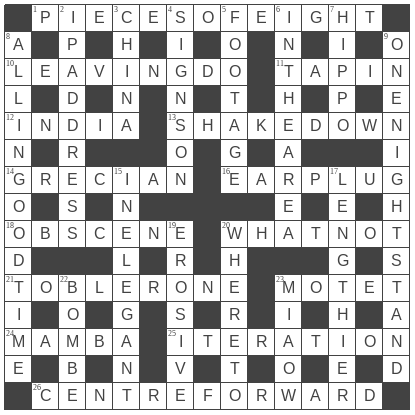
The puzzle may be found at https://www.theguardian.com/crosswords/cryptic/29925.
My aplolgies for the late posting, which seems to be the main topic of the Guardian comments. Anto mostly in good form, but let down, I think, by 20A WHATNOT.
| ACROSS | ||
| 1 | PIECES OF EIGHT |
2/6 in old money? (6,2,5)
|
| 2 + 6 = 8. | ||
| 10 | LEAVING DO |
It celebrates departure of an evil god destroyed (7,2)
|
| An anagram (‘destroyed’) of ‘an evil god’. | ||
| 11 | TAP-IN |
On occasions, tramp didn’t get an easy score (3-2)
|
| Alternate letters (‘on occasions’) of ‘TrAmP dIdNt’. | ||
| 12 | INDIA |
Country information I included in confidentiality contract (5)
|
| A charade of I (‘information’) plus NDIA, an envelope (‘included in’) of ‘I’ in NDA (non-disclosure agreement, ‘confidentiality contract’) | ||
| 13 | SHAKEDOWN |
Attempt at extortion that will ruffle feathers? (9)
|
| A charade of SHAKE (‘ruffle’) plus DOWN (‘feathers’ close enough). | ||
| 14 | GRECIAN |
Such characters provide the beginnings of Picasso’s nuanced mural? (7)
|
| PI, NU and MU (‘the beginnings of PIcasso NUanced MUral’) are all Greek characters. | ||
| 16 | EARPLUG |
Change page URL – it helps filter out rackets (7)
|
| An anagram (‘change’) of ‘page URL’. | ||
| 18 | OBSCENE |
Fuss by former pupil is disgusting (7)
|
| A charade of OB (Old Boy, ‘former pupil’) plus (‘by’) SCENE (‘fuss’). | ||
| 20 | WHATNOT |
Display stand for similar types of things (7)
|
| I can only dismiss this as a weak cryptic definition. It hardly counts as a double definition: a WHATNOT is a miscellaneous item, or a stand for displaying them, but the two meanings are intimately related, and the second part of the clue , ‘similar types of things’ would seem to require a plural. Not, I feel, Anto’s happiest clue. | ||
| 21 | TOBLERONE |
Ferment noble rot and add energy for something sweet (9)
|
| An anagram (‘ferment’) of ‘noble rot’, for the chocolate brand. The surface refers to wines: ‘noble rot’, Botrytis cinerea (pourriture noble or edelfäule) is a mould which renders grapeskins porous, and the juice thus more concentrated, so that its sweetness may be used to make wines such as Chateau d’Yquem and other sweet Sauternes, and German sweet wines culminating in trockenbeerenauslese. | ||
| 23 | MOTET |
Composition of famous auteur writing from the heart (5)
|
| Middle letters (‘from the heart’) of ‘faMOus auTEur wriTing’. | ||
| 24 | MAMBA |
Degrees to which this creature is venomous? (5)
|
| MA and MBA are academic ‘degrees’. | ||
| 25 | ITERATION |
Short article helping to create another version (9)
|
| A charade of ITE[m] (‘article’) minus its last letter (‘short’) plus RATION (‘helping’). | ||
| 26 | CENTRE FORWARD |
Footballer to send on after midpoint (6,7)
|
| A charade of CENTRE (‘midpoint’) plus FORWARD (‘send on’). | ||
| DOWN | ||
| 2 | IP ADDRESS |
Tablet cover shows internet identification (2,7)
|
| A charade of IPAD (‘Apple ‘tablet’) plus DRESS (‘cover’). | ||
| 3 | CHINA |
Check in with a friend (5)
|
| A charade of CH (‘check’, chess) plus ‘in’ plus (‘with’) ‘a’. | ||
| 4 | SIGNS ON |
Indication family member is unemployed (5,2)
|
| A charade of SIGN (‘indication’) plus SON (‘family member’). To sign on could be to start a new job, but here is intended to indicate applying for unemployment benefits. | ||
| 5 | FOOTAGE |
Settle for period film (7)
|
| A charade of FOOT (‘settle’ a bill) plus AGE (‘period’). | ||
| 6 | IN THE AREA |
At home, try partaking in drink that’s close by (2,3,4)
|
| A charade of IN (‘at home’) plus THEAREA, an envelope (‘in’) of HEAR (‘try’ judicially) in TEA (‘drink’). | ||
| 7 | HIPPO |
One wallowing in directorship position (5)
|
| A hidden answer ‘in’ ‘directorsHIP POsition’. | ||
| 8 | ALL IN GOOD TIME |
Eventually exhausted having fun (3,2,4,4)
|
| A charade of ALL IN (‘exhausted’) plus (‘having’) GOOD TIME (‘fun’). | ||
| 9 | ONE NIGHT STAND |
Individual bedroom fitting you may be embarrassed about (3,5,5)
|
| A charade of ONE (‘individual’) plus NIGHTSTAND (‘bedroom fixture’, a bedside table or cabinet). | ||
| 15 | INELEGANT |
Popular English stage worker is a bit ungainly (9)
|
| A charade of IN (‘popular’) plus E (‘English’) plus LEG (‘stage’) plus ANT (‘worker’). | ||
| 17 | LENGTHIER |
Ringlet he adjusted making it more extended (9)
|
| An anagram (‘adjusted’) of ‘ringlet he’. | ||
| 19 | EROSIVE |
Desire setter has is damaging (7)
|
| A charade of EROS (‘desire’) plus I’VE (‘setter has’). | ||
| 20 | WHERE TO |
In attendance, contributing to WTO that’s questioning direction of travel (5,2)
|
| An envelope (‘contributing to’) of HERE (‘in attendance’) in ‘WTO’. | ||
| 22 | BOMBE |
Stink over honour – it may come as a surprise? (5)
|
| A charade of BO (body odour, ‘stink’) plus (‘over’ – not an envelope indicator, but a suitable usage in a down light) MBE (‘honour’). A BOMBE is a dessert, generally of ice cream, in a (hemi)spherical mould, and thus likened to a cannonball. It may well contain an unexpected filling. | ||
| 23 | MIAOW |
Queen’s speech perhaps initially made its appearance on wireless (5)
|
| First letters (‘initially’) of ‘Made Its Appearance On Wireless’. THe ‘queen’ is a cat. |
Quite tough.
I solved/guessed couldn’t parse 1ac, 14ac.
In 23A, I don’t understand why the queen is a cat?
For 1ac to work you have to read “2/6” as “two and six” which was a common spoken shorthand for “two shillings and sixpence” but a bit of an extra step. Could be a challenge for overseas or younger solvers. I missed the parsing of 14ac as well, so thanks for that, and was pleased I had not missed anything clever in “whatnot”.
thanks Anto and PeterO
Ace@2 A queen is an unspayed female cat.
Ace@2: A tom is a male cat, a queen a female (though some will argue that it should only be used for a breeding i.e. unspayed cat). A not uncommon crossword trick so worth remembering.
[crossed with polyphone]
Thanks Anto and PeterO
Thanks for the parsing of GRECIAN – I had no idea.
I thought 2/6 in old money was an eighth of a pound, but was confused that the pound wasn’t indicated, and how that then related to “pieces”.
Also didn’t see how “similar types of things” contributed to WHATNOT. I suppose it is also used for “thingummy” etc.
Favourites the nice hidden for HIPPO, and MOTET.
Ace@2 An unspayed female cat is known as a queen
I really enjoyed this and thought it was rather more challenging than usual for a Monday. I couldn’t parse GRECIAN (I was just looking at the very beginnings ie P, N and U) but in retrospect it’s good. My favourites were PIECES OF EIGHT and LEAVING DO, great surfaces for both.
I think WHATNOT is fine as a double definition — firstly a piece of furniture for displaying items, and secondly “similar types of things” as in “x, y, and whatnot”.
Many thanks Anto and PeterO.
Thanks both,
I think ‘Whatnot’ can be a plural noun meaning etcetera as in ‘ornaments and whatnot’.
WHATNOT can imply a plural: “I left my tools and whatnot at work,” meaning my tools and similar things.
I was led astray by 14 as it’s nearly an anagram of ‘Guernica’, so missed the actual and more subtle parsing. No doubt the misdirection was intended, so kudos to Anto. Otherwise a good Monday challenge requiring some thought. Liked ‘PIECES OF EIGHT’ but agree that knowing how half a crown (the other name for two shillings and sixpence and a much-used coin) was normally written will be lost on younger and overseas solvers. Thanks to Anto and PeterO.
I couldn’t parse 14ac fully, but thought it had to be connected to Picasso’s famous “mural” Guernica since it is an anagram other than one letter. Perhaps Anto was thinking that way but couldn’t make a clue they liked out of it?
Sorry tomsdad @11, our posts crossed.
Having a branded chocolate product in 23A didn’t strike me as being how things are done around here, even if I did get it straight away. I also failed to see what would be surprising about a BOMBE outside of the clangingly politically incorrect denouement to Diamonds are Forever, which features a Bombe Surprise dessert with (spoiler alert) a bomb in it. I didn’t parse 14A, although on reflection I should have.
I liked all the long clues around the perimeter.
Thanks all.
Completed with quite a few guesses from the crossers. Even as a beginner it is rare I have no idea at all how a clue works but that was the case with 14ac. Very clever – I suppose. Thanks Anton for a solvable challenge and PeterO for the clarifications.
When I was young (b.1954), older people would often refer to halfcrown as ‘half-a-dollar’. That was in south London, I don’t know if it was common elsewhere.
There were, of course eight halfcrowns in a pound.
I have read somewhere that the dollar sign derived from the number 8.
Martin @13
Yes about TOBLERONE, but the name has got in to more general usage. For instance, the triangular cross-section foam pads on boundaries of cricket fields are now aften referred to as “toblerones”.
I too thought that two and six somehow were equal to some ancient coin. I never have been able to remember what a florin is equal to.
Otherwise, it was a nice puzzle, I enjoyed it. Thanks Anto and PeterO. Hope that all is well with you in this cold., Peter I don’t know how it’s affecting Long Island — here in Connecticut it’s pretty brutal, the coldest winter I can recall in years.
Oops! 21A not 23A. While I’m back, I had the same Guernica thoughts as Tomsdad and Ravenrider.
Yes indeed, Muffin @16, that’s a fair point. I couldn’t find them in any dictionaries, but I guess that may happen soon.
I must have been on wavelength as it went in smoothly.
Liked the quirky GRECIAN and PIECES OF EIGHT.
I am another one who is fine with WHATNOT for reasons given @#8
Thanks PeterO and Anto
Saying 2/6 as two-and-six (half a crown, but that doesn’t fit) comes so automatically to somebody of my age that you don’t remember that for younger people the past is another country where British money is concerned. But two and six as PIECES OF EIGHT is a splendid, if dated, clue.
Much being made in the Guardian comments about GRECIAN being non-Ximenean – can anyone explain why? Took me a long time, and I was looking for Guernica too, but it doesn’t seem unfair.
I liked the racket-filter and the queen’s speech. Isn’t there actually a French dessert called a bombe surprise?
Thanks PeterO for the parsing of GRECIAN: I looked at it from various directions, and like Lord Jim @8 and Ravenrider@12, thought it must be something to do with Guernica, but couldn’t quite close the deal. Several other parsings were also cleared up by the blog (IN THE AREA, for one).
I was made to chortle by ONE NIGHT STAND; well, those were the days, eh? I wasn’t troubled by WHATNOT; in fact, like Lord Jim @8 (again!, we must form a club…), I thought it quite clever.
A pleasant-enough occupation over breakfast: thanks, Anton.
Good Monday fare, except that I couldn’t parse GRECIAN or MOTET, which I see thanks to PeterO used pretty much the same device. Last one in today was IP ADDRESS. But HIPPO did make me smile, huge but hidden, or trying to remain concealed…
The wallowing hippo of course reminds me of this.
me@21 “Anto”! … and I can’t even blame autocorrect, as I’m on a PC.
More ‘midweek’ than Monday fare for me, took a while to get going. Thanks to Anto, and to PeterO (no apology called for – a volunteer’s prerogative, surely!)
Gladys #20 – I’m pretty sure that they referred to this being an (incorrect) indirect anagram (“nuanced”) of GUERNICA. I must admit I thought so, too, remembering that Anto has a history of misspelling cultural references – sorry Anto 🙁 Looks like it was a clever misdirection on his part playing around the above; I for one fell for it…
I enjoyed the puzzle (now, all of it) and liked the witty wordplay in a lot of clues. On WHATNOT, I fully agree with Lord Jim #8. Thanks Anto for the fun and PeterO for the explanations!
Felt this was slightly too hard for a Monday cryptic, but not impossible. The Picasso clue is brilliant.
Was going to say that the China seemed completely baffling to me, but from googling it seems like it’s related to cockney rhyming slang (China plate = mate). Another one along with pieces of eight that I imagine people outside the UK might struggle with parsing.
Thanks Anto for an enjoyable crossword. My top picks were SHAKEDOWN, MAMBA, IP ADDRESS, CHINA, ALL IN GOOD TIME, and MIAOW. I couldn’t fully parse GRECIAN and WHATNOT and I couldn’t figure out what the word ‘for’ was doing in FOOTAGE but none of this ruined the fun. Thanks PeterO for the blog.
Many thanks to Anto, and to PeterO for the blog, in particular for explaining 14A – like many I was led down the Guernica-anagram-minus U path, surely deliberate and very clever on the part of the setter. And I even reached PNM but failed to add the vowels …
[Thank you muffin@23. Pity that version is missing the verse with my favourite rhyme ever – inamorata & garter 🙂 ]
PIECES OF EIGHT has absolutely nothing to do with pre-decimal British currency. It was the anglicised pronunciation of the Spanish silver dollar (peso duro) which was widely used for international trade from the 16th century onwards, and has been described as the first global currency. It was widely used by pirates in the Caribbean and often appears in literature/films describing that period. The parrot in Treasure Island had a habit of endlessly repeating ‘pieces of eight, pieces of eight’.
I thought 1a referred to there being 2/6 x 8 in a pound!
Couldn’t parse 14a – thought it must somehow refer to “Guernica” minus U
I can’t say I was tempted to go down the Guernica route at 14a. It isn’t a mural, ‘nuanced’ it ain’t, and there was no possible parsing that could lead to it. I saw it in the MOMA in New York just a year or so before it was handed back to Spain (try handing back a mural), and bloody hell, it is awesome in the flesh, as it were.
Also, quite right, Andy @32 – I think some folks seem to have been conjuring with there having been EIGHT half-crowns in the pre-decimal pound. I think Long John Silver’s parrot was called Captain Flint, if memory serves.
I’m another Guernica person, thanks to Petero for explaining it, and to Anto for the brilliant misdirection.
I did wonder if PeterO’s perjorative dismissal of Anton’s whatnot clue was edging towards a breach of the site policy. Either way, the tone felt off to me.
I thought it was fine as a double definition clue, with “similar types of things” being a perfectly good definition for whatnot. As people have already said usages such as “the van was full of spanners and whatnot” are common.
Fine puzzle from Anto, pitched perfectly for a Monday, with consistently good surfaces. 14a GRECIAN was original. 15d INELEGANT was a nice construction. I was curious about the definitions for 4d SIGNS ON and 22d BOMBE, but PeterO has clarified them — thank you
NHO the “Display stand” for 20a. As for the second part of the clue, Chambers has WHATNOT = “a nondescript article” (singular), but it also has WHAT NOT (with space) = “and other such things” (plural). Perhaps the second part works as wordplay (rather than DD) if you assume the space — “There were plates, bowls, and what not” = “…and similar types of things”
Nice one, Anto. My favourites were 1a PIECES OF EIGHT for combining old English and Spanish currencies, 14a GRECIAN for the excellent use of “beginnings”, and 15d INELEGANT, for an elaborate charade with a good surface. I didn’t encounter any dud clues, so this was great fun.
Thanks also to PeterO for the excellent blog, and I concur with Steppie&25 – no apology needed. (Complainers on the other site should be ashamed of themselves.)
Yes, a fine puzzle. I liked MIAOW and PIECES OF EIGHT very much. Is a CENTRE FORWARD still a thing? It was when I was a kid (long time ago!).
On the first pass through, I tried out MESSIAH (me + anagram of has is) for 19 and wondered how it could possibly mean desire. Some crossers sorted it out.
Thanks, Anto and PeterO
Anna@15
Thanks to Anto and PeterO
[As someone born sarf of the river half a dollar was a common expression in 50s & 60s My father said it went back to the war when the $/£ exchange rate was fixed at $4 to £1 so half a crown was equal to US 50 cents and was the common exchange rate between UK and US troops. There were a lot around south east London
The dollar sign existed before the US$, it was used by the Spanish for the peso which maybe is the origin of pieces of eight, there were 8 pesos to the reale. I like Ayn Rand’s theory in Atlas Shrugged, relevant today in understanding some of that happening in US, it derives from overlaying U and S, losing the bottom the U
https://www.britannica.com/topic/Atlas-Shrugged%5D
Good fun. Also a Guernica person. For me Grecian reminds me irresistibly of the “What’s a Grecian urn? Thirty a bob a week” joke. The letters are Greek not Grecian.
Max @36 – a little harsh, methinks. Bloggers are surely allowed to apply their critical faculties to the clues they’re explaining.
FWIW, I agree with the many commenters who have defended the WHATNOT clue, but I know from experience that none of us bloggers are infallible. And I certainly wouldn’t want bloggers to feel they can’t exercise their critical judgment. But, that being said, of course you’re equally entitled to express your sense that the tone was off. OK, I’m straddling the fence here – better get me coat!
Some lovely clues.
Couldn’t parse the fantastic GRECIAN, didn’t understand MIAOW (other than it obviously being right) and wasn’t totally sure why a BOMBE was surprising, but PIECES OF EIGHT and ONE NIGHT STAND were good fun!
I was another Guernica doesn’t quite work puzzler. I liked PIECES OF EIGHT, ONE NIGHT STAND, and MIAOW.
Thanks Anto and PeterO.
Rely to Anna #15. As a kid in Liverpool in the 1950s you felt rich when you got a half crown. Crowns go back to Henry VIII and they were eventually equal to five shillings and hence a half crown was 2/6 or two shillings and six (old) pence, and, in common parlance ‘half a dollar’. This was because in the 1940s the US dollar was pegged at just over four to the pound, so it was worth about 5 shillings or a crown. Thus, half a crown was just about equal to half a dollar. I wonder if this came from Americans here during the war! Does anyone know?
Anna @15: here in Cornwall too. And through my entire childhood (b 1961) – maybe exchange rates didn’t fluctuate much then?
Valentine @17: there was a coin – half a crown – worth two shillings and sixpence. (A crown was five bob, they used to issue commemorative crown coins, I think I have a silver jubilee one my Mum bought me upstairs still.
#32 Andy it was also called peso de a ocho in Spanish.
Alan@45
According to my father and my uncles who were in the forces in ww2 it was the exchange rate used between the Yanks and the British Army, 50 cents for 2/6. However I suspect it predates then.
[I am now proudly the custodian of the family half sovereign. No idea how much it is worth, but it’s Edward VII, dated 1906.]
Historic pieces of eight were Spanish silver coins worth 8 reales (why 8?), which were a common trading currency in the Caribbean and South America for many years. Although there are 8 half-crowns to the pound, this has nothing to do with the answer to the clue except as a happy coincidence: they never had a name that referred to it.
This one filled in quicker than yesterday’s (unfinished) Quiptic.
Thanks to PeterO for explaining the way 14A worked, and thanks to Anto for a puzzle I could finish.
Muffin
If it is in very good condition then £250 but if scratched, dulled or chipped then not much. I had a collection of all the special crown coins from the 1960s through to 1980s, cost me more to buy new than were worth now. Big rip off by the Gov’t as they got millions in that will never be spent. Official Crypto coins?
[Thanks Clive
It’s in good condition, but I’m not thinking of selling it. I’m just looking after it for the family!]
Gladys
In days long gone coin cutting was quite common into halves, quarters, eighths but smaller than that was difficult. In some countries coin cutting was a capital offence.
Clive @55
On a related point, milled edges on coins were introduced to make it obvious that bits of the edges had been filed off.
Muffin
My school days economic history!
The US dollar originated from the Spanish milled dollar which was the peso, forgotten about milling. The original 1794 US dollar was exactly the same weight and value in silver as the Peso and had milled edges to prevent cutting.
With all this talk of pieces of eight, and this morning’s SMBC comic, I wondered briefly whether today was International Talk Like a Pirate Day.
But it’s not. That’s September 19th. Look out for some wag doing a themed crossword then: Arrr!
Thanks for the hints.
Had to reveal WHATNOT and having read the hint, I’m still none the wiser! Pootclue, IMHO.
HIYD@59: Whatnot (OED)
1.a. 1540–
Usually and preferably as two words /ˈhwɒtˈnɒt/ : Anything whatever; everything; ‘anything and everything’; ‘all sorts of things’: mostly, now only, as final item of an enumeration: = anything else, various things besides; ‘whatever you like to call it’. (Also occasionally of persons.)
2. 1808–
An article of furniture consisting of an open stand with shelves one above another, for keeping or displaying various objects, as ornaments, curiosities, books, papers, etc.
Enjoyed this and made good progress from the top down plus 26a but then a couple of problems and guesses in the lower half. This seemed gentle for an Anto compared to what I’ve seen of their Quiptic grids (my normal stomping grounds with the QCs), but glad to get through and continue my run of Mondays. Like other commenters I thought Guernica was involved in 14a but couldn’t see how the U would come out so thanks PeterO for explaining that and some other wordplays I didn’t see. And thanks Anto for the grid.
[PS tried posting this last night but kept getting permission denied errors!]
We were puzzled by SIGNS ON (I don’t think we have the unemployment-benefit usage of this in Australia) and also by the queen’s MIAOW, as nho queen as cat. Tricked like many others by GRECIAN—very clever, but agree with PhilB @41 that the characters are Greek. No problem with that use of whatnot, nor with 2/6 as two-and-six (true here in my early childhood) or CHINA (we read a lot of older English fiction). A fun puzzle. Thanks Anto and PeterO.
Shouldn’t 2d be listed as 1,1,7 rather than 2,7? IP is not a word, but an abbreviation (Internet Provider).
There’s a nice reference to WHATNOTs in this piece here.
Not on wavelength at all! Got a third, missed the rest by a mile.
Thanks both
I believe the “/” in 2/6 should be read as “or”, because 2 or 6 are individually pieces (as in parts) of 8.
Historically, Pieces of Eight were literally a larger coin divided into 8 pieces (see below):
——-
A “piece of eight” is the popular name for the Spanish silver dollar, or 8 Reales, a highly influential coin used globally from the 16th to 19th centuries, known for being cut into eight “bits” for smaller change, inspiring the term “two bits” for a quarter, and famous in pirate lore due to its silver content and use in colonial trade. Its milled edge prevented silver shaving, making it trustworthy.
Bombe Surprise is a dessert