Anto in the Quiptic slot for us this week.
Abbreviations
cd cryptic definition
dd double definition
cad clue as definition
(xxxx)* anagram
anagrind = anagram indicator
[x] letter(s) removed
definitions are underlined
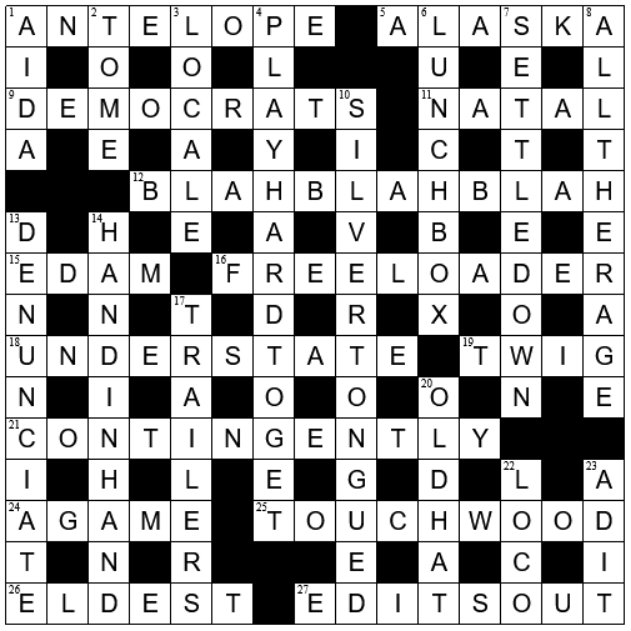
Across
1 Animal bound on stake
ANTELOPE
A charade of ANTE and LOPE.
5 Unfortunately, Kenya borders very cold terrain
ALASKA
A charade of ALAS and KA for the outside letters of ‘Kenya’.
9 Politicians cared most after reshuffle
DEMOCRATS
(CARED MOST)* with ‘after reshuffle’ as the anagrind.
11 Manage intake files at centre dealing with birth
NATAL
The central letters of maNAge inTAke and fiLes.
12 Boring language about heritage leaders keep repeating claptrap
BLAH BLAH BLAH
A triple repeat of the initial letters of the first four words of the clue.
15 Cheese made from 50% of used spam
EDAM
A charade of [US]ED [SP]AM.
16 One taking advantage of available heavy machinery
FREELOADER
A charade of FREE and LOADER.
18 Don’t go overboard when reporting to nation
UNDERSTATE
A charade of UNDER and STATE. ‘Mark reports to/is under Susan in the accounts department.’
19 Get a bit of stick
TWIG
A dd.
21 Military group extremely lively – depending on conditions
CONTINGENTLY
A charade of CONTINGENT and LY for the outside letters of ‘lively’.
24 Regular characters in gang war meet to exhibit best performance
A-GAME
The even letters in gAnG wAr MeEt.
25 Seek money from club – and hope for good fortune
TOUCH WOOD
A charade of TOUCH and WOOD for the golf ‘club’. ‘Susan touched/sought money from Mark for her new project.’
26 Part of Sheffield estate that’s been around the longest
ELDEST
Hidden in SheffiELD ESTate.
27 Removes text suited to getting misspelt
EDITS OUT
(SUITED TO)* with ‘misspelt’ as the anagrind.
Down
1 Opera is a concept lacking energy
AIDA
A charade of A and ID[E]A.
2 Book is closed up as far as I’m concerned
TOME
If you add UP to TO ME, you get UP TO ME. I’m not sure what ‘closed’ is doing here.
3 Position that sounds more healthy?
LOCALE
Aural wordplay (‘that sounds) of LO-CAL.
4 Rare drama showing approach to attracting lover
PLAY HARD TO GET
‘Rare drama’ is a whimsical definition of the solution.
6 Food fight shows one’s masculine quality perhaps
LUNCHBOX
A charade of LUNCH and BOX. LUNCHBOX is a slang word for the collection of organs that make up the male genitalia. Such a container usually contains a sausage and two boiled eggs. Linford Christie and the judge come to mind.
7 Pay low? Try to be calm about it
SETTLE DOWN
A charade of SETTLE and DOWN.
8 Sensible to acquire silver – it’s quite fashionable
ALL THE RAGE
An insertion of AG in ALL THERE. The insertion indicator is ‘to acquire’.
10 Posh cutlery licked? That’s charming!
SILVER-TONGUED
A charade of SILVER and TONGUED.
13 Condemn deceit a nun disseminated
DENUNCIATE
(DECEIT A NUN)* with ‘disseminated’ as the anagrind.
14 Two workers around home being co-operative
HAND IN HAND
An insertion of IN in HAND and HAND. The insertion indicator is ‘around’.
17 Do they get dragged into showing what’s in store?
TRAILERS
A dd.
20 Hot lad running amok – it’s somewhat passé
OLD HAT
(HOT LAD)* with ‘running amok’ as the anagrind.
22 Strange facilities storing carbon
LOCO
An insertion of C in LOO. The insertion indicator is ‘storing’.
23 Passage in financial review union dismissed
ADIT
A[U]DIT.
Many thanks to Anto for this Sunday’s Quiptic.
Thanks Pierre & Anto.
I couldn’t parse the UNDER in UNDERSTATE, but now it’s obvious. Wasn’t familiar with that use of TOUCH either.
In TOME does ‘closed up’ just mean removing the gap between TO and ME…?
This was really a tough one for a quiptic,imo.But seeing the solutions makes it seem so easy.Thanks Guardian for the titular mislead i.e “for beginners or those in a hurry”.
I’ll start the “homophone” discussion. I’ve only ever heard LOCALE pronounced as low-carl, never lo-cal. Over to you.
PS can somebody delete comment 3
I used the check button more often than usual at first because I lacked confidence in my solutions, but once I had some crossers in, I romped home. The parsing of UNDER threw me but otherwise all fine. Now on the Everyman…
Crispy@4 I would always pronounce it lo-cal so no problem for me. I enjoy Anto’s Quiptics and had fun with this one. I didn’t know ADIT but it was easy enough to work out.
CLOSED = TO as in “Push the door closed … push the door to”
But even knowing that I can’t get the exact parsing. It seems rather messy. Might even be a triple def of sorts.
(Incidentally similar clue came up in The Times QC yesterday “Closed one large book”)
I found this a very accessible Anto other than I couldn’t parse LOCALE either as I pronounce it lo-carl too.
[Crispy – only ken and Pierre can delete posts from this blog]
Thank you to Pierre and Anto.
Maybe I just wasn’t on the right wavelength, but this seemed a bit harder than yer average Quiptic. So a steady solve, progressively filling in bits and pieces all over the grid, with crossers giving useful hints, rather than a top-to-bottom romp. But all good stuff.
I especially liked ALL THE RAGE, a neat use of that old friend Ag for silver, the picture induced by SILVER TONGUED, and the jokey PLAY HARD TO GET.
Thanks Anto for my breakfast entertainment, and Pierre for the blog.
[Shanne @13 – It looks like Ken and Pierre are having a busy morning. Seem to remember you had the same issue last Sunday?]
Is it the number of charades that made starting off a bit trickier than usual, especially for a quiptic? I kept looking for anagrams which weren’t there.
I agree with the quibble about the pronunciation of locale. A bit unfortunate for a soundalike! However, it was easy enough to get and didn’t detract from a very enjoyable puzzle.
So that’s why I had so much trouble parsing LUNCHEON… Thanks, Anto and Pierre.
@HG at #8. I read 2d TOME as being “To me…” (“As far as I’m concerned…”) being closed up, i.e. having the space removed. That would explain the inclusion of ‘closed’.
If you close up – ie. remove the space from – the expression “to me” you get TOME
MrsS @20 and others – I’m not getting this quibble about LOCALE. Are people pronouncing it with the stress on the first syllable, as in ‘local’ without the final-e? For me, the stress has to be on the second syllable, so I had no problem with the clue.
Many deletions recently. Is our previously safe word playground becoming a trollfield?
In 2d, does “closed up” mean you take “up” from “up to me” and end up with “tome”??
I thought this was a robust, harder-level Quiptic, with some nice artistry. Lots of clues acting as good examples of standard cryptic concepts, and I felt there were several which were Quiptic-accessible but daily-cryptic-elegance, such as UNDERSTATE.
I think Holypeanut@1 has nailed TOME (which I didn’t fully parse). I assumed it was a triple def with “closed up” being the def which I failed to figure out, but now it seems clear that it’s TOME (book) and also a “closed up” TO ME (i.e. the space is deleted). Good clue!
I really wanted ANTELOPE to be anteater, and TOUCH WOOD to be tough love, so it was a nice exercise in being forced to discard my initial ideas based on partial checkers.
I thought the surface for EDAM was a bit weak, but at least it was a change from the MADE-backwards trope.
Balfour@24, my dictionary has LOCALE as lo-KARL, i.e. long A, and that’s how I’ve always pronounced it, so I needed to give a moment’s thought to the parsing.
BLAH BLAH BLAH looks like an honest attempt at extended definition (wannabe &lit), but I don’t think it quite works because the surface isn’t fully grammatical (“keep”?). Which is a pity because the idea was nice. If we want to keep the “boring language” bit, which would be nice, I’d drop “claptrap” altogether and go with something like “Boring language Arts & Humanities leaders keep repeating?”
Thanks Anto for the enjoyment and Pierre for the blog.
AP@27 Thank for responding. I think that my ‘long A’ is slightly higher in pitch than yours and others’. That may be down to the remnants of Scots pronunciation lurking around in my accent.
I thought this was a quite typical Anto; a bit loose in places and slightly obscure in others. I struggled initially until I spotted and solved some of the anagram based clues but then made good progress with crossers coming in handy. I’m in the long second syllable camp for locale so this was very weak as a sound-alike IMO. Thanks Anto and Pierre for the wordplay explanations.
I believe Anto’s got the hang of it. Favourites BLAH BLAH BLAH, ALASKA, ALL THE RAGE. Stella Heath #23 – thanks, this makes perfect sense! Not sure about UNDERSTATE – it’s not the same as “don’t overstate”. Thanks Anto and Pierre!
This felt tougher than usual. “Rare drama” for play hard to get is nice is amusing in hindsight I suppose…
“Touch” for “seek money” I don’t get even with the explanation. Can’t say I’ve ever heard that used before.
Blah Blah Blah was nice I thought.
Re the long-A pronunciation of locale, I’ve tracked down this bit of the Fawlty Towers The Hotel Inspector episode, which may well be the only place where I’ve heard the word said out loud!
Balfour @28 – I’d already mentioned the low-Carl pronunciation @4
I too found this tougher than usual, at least in places, which may have been a wavelength thing for me this morning. I got there though, and had fun along the way.
Are you miffed that I didn’t name check you specifically, Crispy @34? I had read your and indeed all comments about this, which is why I included the phrase ‘and others’ both in my initial reply @22 and again @28.. My suspicion is that the lowered longer-A with the implicit ‘r’ as in ‘carl’ is characteristic of southern English speech or RP (I know the two do not always coincide), and I would be interested to know how LOCALE is pronounced in Yorkshire, Lancashire or Tyne & Wear. I have Scotland covered, I think.
I thought “closed up” in TOME just meant that the space between TO and ME should be closed up – though it’s rare for a setter to tell us this so explicitly.
Lo-cale didn’t quite work for me, and I spent a while trying to make the ANTELOPE be an anteater. Silly me.
JT@31: People in P G Wodehouse are always getting “touched for a fiver” by friends in temporary financial embarrassment. Rather dated.
As a relatively new solver, I found that hard, particularly the top left corner. Even having read the blog, I didn’t understand the parsing of ANTELOPE, until I looked up the definition of ANTE and discovered it can mean the stake placed as a bet. Then I belatedly realised that BOUND in the clue meant something like jumped or skipped, rather than tied to. Very tricksy!
I also struggled with LOCALE as a soundalike (as I would also pronounce it lo-CARL like others) and am similarly joining others in puzzlement over TOME, where I was extra confused as a I had been assuming UP was a reversal indicator. I got all the solutions from guessing definitions and relying on crossers, but it’s the first one where I’ve really struggled with the parsing even after reading the blog!!
Balfour @36. If you’d read my comment @4, you’d have known what the issue was without needing AP to repeat it for you.
I won’t bother commenting on anything specific in case I upset someone who’s already said something. Another enjoyable Guardian offering for the weekend.
@various: about accents and LOCALE / lo-cal. Being originally from Nottingham but living for the last 50-odd years in Oxford, my accent is (1) a bit of a mish-mash and (2) tends to vary with who I’m talking with. I’ve been muttering “Locale, Locale..” in multitudinous variations most of the morning, and find that, for me at least, it can span a range from something like locál to something like locaal; the former being close enough, again, for me anyway, to being a homophone for lo-cal to pass muster. Opinions will vary, and indeed already have…
Nice puzzle. I liked the closed up TO ME and the clues for ANTELOPE, PLAY HARD TO GET and ALL THE RAGE.
I’m another who pronounces LOCALE as lo-CAHL (note spelling to avoid annoying the rhotics 🙂 ). Lo-cal sounds like an American pronunciation to me.
Thanks to P&A
Fairly nice quiptic challenge.
NHO ‘touch’ in the sense of seeking money (the Chambers merchants will be pleased to know it’s in), or ‘adit’ but the clues were clear enough that they came out in the wash. Not impressed with LUNCHBOX but enough good material that I’m not hung up on it. 8d, 11a (Anto seems fond of these middle letter clues), 12a, 24a are my highlights.
On the locale debate, I (a Lancastrian) think low-carl sounds laboured, Anto’s clue flies fine to me at least.
I was confused seeing the kerfuffle about LOCALE. I thought it might be a US/British disconnect, but Chambers only shows the pronunciation this American uses.
A perfect Quiptic for me. For TOME I first thought of closed=to (as in a door) because of a very similar clue in yesterday’s Times QC, but I couldn’t make sense of the rest of it. So thanks to Pierre and other commenters for resolving that for me. Thanks Anto.
Protase@34 – from reading Alan Connor’s “Meet the Setter” interview with Anto, it would suggest that he’s from Ireland which might explain the pronunciation difference.
AP@27 fI the A in Karl is a long A, what you call the A in kale? To me, that one’s a long A, and Karl’s is a broad A.
Thanks, Anto and Pierre.
@various, in various LOCALES… The OED online has:
LOCALE : {definition omitted to save space}: A borrowing from French. Etymon: French local (1731), use as noun of local adj.; in later use with respelling of the ending to indicate stress, probably after French locale, feminine singular of the adjective local .
British English: /lə(ʊ)ˈkɑːl/ loh-KAHL
U.S. English: /ˌloʊˈkæl/ loh-KAL
Early usages in English spell it without the final “e”:: e.g.
1783: Unless they attend..to the nature of the soil of the local where those accidents happened, their reports will generally meet with little credit.;
Philosophical Transactions (Royal Society) vol. 73 189
Later ones with the “e”:
1908: A concert was given..in the hall of the Liverpool Institute, not an ideal locale.
Musical News 11 July 48/1
So – take your pick!
Which of course reminds me of the apocryphal story about the mis-carved tombstone for the sadly missed devout Lancastrian woman.
Great puzzle thank you all, I couldn’t do four, which is great progress for me
As I have said before I class myself as a beginner/improver so I am a little surprised that some much more experienced solvers found this harder than usual as I believe that this the first Anto I’ve ever fully solved and parsed. May be a wavelength thing or I’m more improved than I give myself credit for.
Either way, a fun puzzle and thanks to A and P for the entertainment and blog.
The middle-letters clue is an Anto trademark: there’s nearly always one in his puzzles.
Bexlreyed@43 yes I had the same experience. I actually found this one easier than the previous day’s QC! Think it must just be a wavelength thing.
As a rhotic (? – whichever one Americans are) speaker, “locale” came easier than some of the soundalikes. Pronounced exactly the same where I come (albeit with slightly more stress on the second syllable in locale versus lo-cal).
As a relatively new solver I thought this was just right. It’s actually the first time I’ve completed on the day of setting. Thanks to all the bloggers and contributors here for keeping me going to this point.
One question, I had to look up “what fits” on a solving site for TRAILERS even once I had the crossers. Is this deeply frowned upon?
I am another solver who found this a mix of nice and unsatisfactory clues. I liked LOCO, OLD HAT, ALASKA, ALL THE RAGE, and TOUCH WOOD
I could not parse LOCALE either
Thanks Anto and Pierre
Well I enjoyed the Quiptic and I’m bemused and mildly amused at its ability to spark such strong emotions. I’m a short ‘a’ person in speech, recognising that the long ‘a’ is correct but it would feel affected to change how I speak now. Perhaps that’s why I pronounce locale both ways.
Valentine@39, I may well have got the two terms the wrong way around! Fortunately I don’t think it affects anything at all in the discussion.
Steyning @47 It’s your puzzle to enjoy however you see fit. If you’re coming here to learn, you will need tools less as time goes by. Some people here have much more time than others. Some operate in self imposed competition conditions. Each to their own!
I can never fail to crack any clue with Kenya 🇰🇪, COD BLAH BLAH BLAH.
Once again many people complain because two words (low-cal and LOCALE) don’t sound exactly the same in every imaginable dialect. But the clue works just fine if you realize that it is a pun, and not a homophone. It surprises me that so many of us, who do these puzzles because we enjoy wordPLAY, lack the imagination to think of pronunciations other than their own.
I also noticed from the comments that some more experienced solvers found this puzzle more difficult than the beginners did. Could this be because the veterans look for more complicated wordplay than the setters use for Quyptics, and so they misdirect themselves? Just a thought.
Re 2d TOME, I agree with those who saw “closed up” as an instruction to combine TO and ME. While it was unnecessary for the wordplay, it greatly enhanced the surface, and I quite liked this clue for that reason.
Thanks, A & P for the amusement and parsings.
Got 13/28. Didn’t know half of the substitutions and answers even once revealed. Even now I don’t understand how you’re supposed to know to switch the order of LOPE and ANTE in 1A. Feel like I’m about ready to give up.
I really can’t imagine how anyone would pronounce LOCALE as “locarle” – there’s no R there (though lots of people here ignore the presence of Rs in their pronunciation, of course!). It sounds exaclty like LO-CAL to me.
Muffin#55 I think it’s more that many people pronounce locale with a long-a (ahhh) but are writing that as Arl in their comments. I don’t think they are really representing that as a rolling-r pronunciation at least not in my opinion (although maybe I’m wrong on that 🙂).
Great stuff from Anto.
Not heard LUNCHBOX in that context since Linford Christie and probably only referring to him.
Liked TRAILER and PLAY HARD TO GET
Thanks Anto and Pierre
Cellomaniac@53, did many people complain? I think there was only one, who described it as a quibble – and it seemed like a passing comment at that; I certainly wouldn’t like to surmise about their imagination.
c@54, if you’re getting half done then you’ve obviously got a grip on how the things work! Keep at it. The ANTELOPE one involves the tricksy “on”, which can mean “by” in things like Clacton-on-Sea; and of course “by” doesn’t specify which order things go, so there’s simply no way of knowing whether your LOPE goes before or after your ANTE. You have to be open to both possibilities!
AP@55, I was surprised that you only saw one quibble about LOCALE, so I looked again and counted seven.
In addition, there were many who said they had no problem with the clue because they pronounce locale in the same way as low-cal. My comment applies to them as well – the critical point is not how you pronounce it, but whether you can see how others pronounce it, and use that to solve/parse the clue.
And more to the point, can a setter make a pun and not be criticised because it is not a homophone to the ears of some solvers?
Cellomaniac@57, well, plenty of people discussed it, but I only saw one comment that was along the lines of “it’s a quibble, clue doesn’t work”. Several others (myself included) said that the parsing required more thought because of a mismatch between the required pronunciation and the commenter’s pronunciation, and that’s perfectly fair enough. My own thought process was “lo-CARL diet, huh? LO-carl? LO-cal? LO-CAL ahh low-calorie, I get you, nho calorie abbreviated like that.” And the ones who said the parsing was easy because their pronunciation matched didn’t say that they thought the clue would be bad if it hadn’t: they merely noted that they were able to parse the clue quickly.
Don’t get me wrong; I agree with you that there are plenty of silly discussions on this site about soundalikes. But I don’t think this particular exchange was one of them. In fact it was interesting, because several of us said that we’ve never heard the word pronounced another way (and in my case I don’t think I’ve ever heard it pronounced at all, except in that Fawlty Towers episode I linked to – which I remember vividly as the place I learned the word in the first place, as a teenager; funny what sticks in one’s mind!) – but that’s also likely a result of it being an uncommon word.
I thought that was easy going for an Anto, although I was looking at a largely empty grid until I got to the bottom on my first pass.
I had PICKLE in for situation/sounds more healthy. My southern English accent and my wife’s northern accent both can’t make locale (/ləʊˈkɑːl/) a satisfying soundalike for lo-cal.
I had always assumed LOCALE to be of French origin, so I’ve always pronounced it as a Frenchman would (to rhyme with sale = dirty). Not that it’s a word I’ve had to pronounce much in my life!
Thanks to setter and blogger, as always.
Late to the party as always! I found this fairly straightforward for a Quiptic, with just a few harder clues thrown in.
I was thrown by the “closed up” in 2d, but as many of you have said, it makes sense to remove the space from TO and ME.
Never heard of men’s genitalia described as a lunchbox! I had to look up the Linford Christie reference Pierre made.
LOI was 25ac. Not familiar with the term touch for to seek money.
Liked 4d and 10d, 12a etc.
Thanks Pierre and Anto.
I’m another who was troubled by “closed up”, but Prospector @13 (and others)’s explanation resolves it for me.
I didn’t know about this meaning of LUNCHBOX or about Linford Christie. I thought it was just a weak definition suggesting that manly men are those who carry lunchboxes (like the stereotypical construction worker). I’m much happier now — it’s quite amusing now that I know.
I don’t like the construction of 11ac: the cryptic reading requires “centres” rather than “centre”. But no doubt that’s just an eccentricity of mine. I do like 8dn (ALL THE RAGE), though.
A pleasant solve, as usual for Anto. BLAH BLAH BLAH was rather well clued. Now for some starbursts and rooibos 🙂
My sincere regards to Anto and Pierre!
New for me: ADIT; LUNCHBOX = a man’s genitals. I have never heard about Linford Christie (and don’t want to know about him in this context anyway).
I couldn’t parse 1ac.
We seem to have more unmarked deletions, since “c@54” mentioned by AP@55 is now @51. Can we go back to keeping the numbering consistent please? And would somebody please delete the trollery @56?