I blogged Paul’s last Alphabetical puzzle and began my preamble with, ‘It’s always good to see an alphabetical puzzle in the Prize slot…and this proved to be a satisfying challenge.’ I can say that again.
I went on to say, ‘Rather different from the traditional, in that there were not two answers beginning with the same letter, to give a help with the first placing, nor any initial letters round the perimeter’. Same again – but, this time, having two fifteen-letter answers was a great help and gave a good start to filling in the grid, which proceeded at a steady and satisfying pace, with no obscurities, apart from, for me, the X word, providing an enjoyable solving experience.
Many thanks to Paul – and yet another repetition: ‘I am once more indebted to Gaufrid for the production of the completed grid’ : many thanks to him.
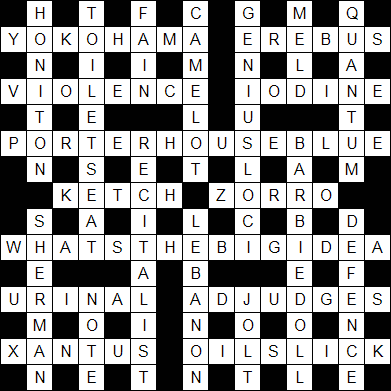
Definitions are underlined in the clues.
A Rules on book applied to promotion (8)
ADJUDGES
AD [promotion] + JUDGES [book of the Old Testament]
B Journalist has nothing to contribute to final cost of drinks? A pretty stupid figure (6,4)
BARBIE DOLL
ED [journalist] + O [nothing] in BAR BILL [final cost of drinks] – often, punctuation in the cryptic reading needs to be ignored: here we need to supply a comma between ‘pretty’ and ‘stupid’
C Ideal location where queen, perhaps, keeps endless fruit (7)
CAMELOT
CAT [queen, perhaps] round MELO[n] [endless fruit]
D Argument in case of desperate criminal (7)
DEFENCE
D[esperat]E [‘case’ of desperate] + FENCE [criminal] – nice allusive surface
E Darkness in ultimately dire puzzle (9)
EREBUS
[dir]E ultimately dire] + REBUS [puzzle]
F Heartless Dickensian compelled by circumstances (4)
FAIN
FA[g]IN [heartless Dickensian] – I’m not happy with the definition here: the quotation ringing in my ears from Primary / Sunday School is from the story of the prodigal son in the Authorised Version:
“And he would fain have filled his belly with the husks that the swine did eat”, which ties in with Chambers’ ‘content for lack of anything better’, which is how I’ve always understood it; however, both Chambers and Collins give ‘compelled’ as a secondary definition, which, to me, seems almost the opposite and I can’t see how to fit it into a sentence – any ideas?
G Cryptic clues go in, one showing Guardian spirit (6,4)
GENIUS LOCI
Anagram [cryptic] of CLUES GO IN + I [one]
H Fine fabric fool held by man once at D(7)
HONITON
NIT [fool] in HOON [man once at D – Geoff HOON was Labour DEFENCE Secretary at the time of the Iraq war: I didn’t know that the lace made in Honiton, Devon was a term in its own right but it’s in Chambers
I 53 on the table, 10 eat (6)
IODINE
IO [ten] DINE [eat] – IODINE is 53 on the Periodic Table
J Scrap metal finally has filled jar (4)
JOLT
[meta]L in JOT [scrap]
K Did he have basic plan to execute?
KETCH
[s]KETCH [basic plan] beheaded [executed] – and Jack Ketch was the executioner under Charles II – not sure if it’s quite an &lit but very clever clue anyway!
L Tyre here heading for blowout, given external force (7)
LEBANON
B[lowout] in LEAN ON [force] – time again [no apology] to delve into my little book of favourite classic clues, as I’m reminded of Rufus’ ‘Gluttons may have one; Alexander the Great didn’t (5,4)’
M Mix in a possible extra Spice Girl (4)
MELD
After Spice Girls Mel B and Mel C could possibly come MEL D – not sure whether to include ‘in’ in the definition but it doesn’t really matter, does it?
N Do say when radio broadcast, with certitude, ends (4)
NOTE
Last letters [ends] of wheN radiO broadcasT [with] certitude – nicely hidden definition: again, we have to add commas – after Do and say
O Film noir a work of art, polished but superficial (3,5)
OIL SLICK
OIL [a work of art] + SLICK [polished but superficial] – simple charade but great definition
P Doorman put up with erotic novel (11,4)
PORTERHOUSE BLUE
PORTER [doorman] + HOUSE [put up] + BLUE [erotic]
Q Required amount in turn from government-funded body and corporation (7)
QUANTUM
QUAN[go] [government-funded body minus GO, turn] + TUM [corporation]
R Performer performing realistic stunt for the finale? (10)
RECITALIST
Anagram [performing] of REALISTIC + [stun]T
S At the front, spineless German general (7)
SHERMAN
S[pineless] + HERMAN [German]
T Authoress’s flipping sad state a downer for women? (6,4)
TOILET SEAT
A reversal [flipping] of [George] ELIOT [authoress] + an anagram [sad] of STATE
U Where water’s passed in river banks (6)
URINAL
URAL [river] round [banks] IN – two nicely juxtaposed clues for Ladies and Gents
V Fighting failing to impress Labour leader, one struggling to contain it?
VIOLENCE
VICE [failing] round L[abour] contained in an anagram [struggling] of ONE
W I need to know why French author is in the bath – I saw splashing about (5,3,3,4)
WHAT’S THE BIG IDEA?
[André] GIDE [French author] in an anagram [splashing about] of THE BATH I SAW
X Try to recall outstanding name, American zoologist with a hummingbird (6)
XANTUS
A reversal [to recall] of TAX [try] round [outstanding] N [name] + US [American] for this very pretty humming bird [pardon me, Pierre-at-the-Indy 😉 named after a [Hungarian] zoologist]
Y Port, liquid okay to cover duck meat (8)
YOKOHAMA
Anagram [liquid] of OKAY round O [duck] HAM [meat]
Z Fox has rights when in captivity? (5)
ZORRO
RR [rights] in ZOO [in captivity?] – Spanish for fox, as in various films =
Fabulous fun, and unlike with the larger holiday alphabeticals it was possible to start filling the grid with not so many of the clues solved, and use the crossers to help.
Re F: e.g. “and wast though fain, poor father, to hovel thee with swine” (King Lear).
Thanks Eileen. My way in was the two five letter words which by happenstance I got in the right order and which gave me a place for RECITALIST and hence the SW corner. The 15 letter clues didn’t emerge until quite a bit later. I finished with a rare sense of achievement and satisfaction even if I did have to seek Google assistance with HONITON, XANTHUS and GIDE. I agree it doesn’t matter but I think MELD is MIX IN; I see the etymology is probably a blend of ‘melt’ and ‘weld’.
Can’t help with FAIN, I just put it in without giving it much thought.
I’ve just checked the OED for ‘fain’ and was surprised to find the only connotation is one of gladness or joy which certainly doesn’t reflect compulsion or even preference. The quotations it offers are mostly from over 500 years ago.
Thanks Eileen. For the F word my Shorter has a quote about a famine when “men were fain to eat horseflesh” – that exactly fits the bill. Like you I found this a pleasant ride, beginning as always in jigsaws with the longest ones first – and the humming bird was the only one to need outside help. The silly doll was lovely. Thanks Paul.
Thanks to Paul and Eileen. Too tough for me. I started off with the two 15-letter answers that then helped me make some progress, especially with the four 10-letter items, but I had to come here to get ADJUDGES, XANTUS, HONITON, LEBANON, and OIL SLICK.
Yes I am with you, ACD@6. Too tough for me.
I solved some and got to smile at the cleverness of such gems as T for TOILET SEAT and U for URINAL (sorry – both toilet humour!). But with less than half completed, it was all too hard for this muddle-headed wombat, and I started googling and cheating so much that I felt cross with myself and gave up. Still it was worth having a go, and then being able to enjoy the many “Ah ha!” moments today when I came here to read your delightful blog, Eileen.
Congratulations to the clever solvers who succeeded, thanks to Paul, and additional thanks to Eileen for the enjoyment of the “spare” clue in LEBANON.
Excellent.
Thank you, Eileen, jolly tough I found.
Is there a missing I in the GENIUS LOCI anagram?
I started this one later in the week than usual, and thought I wouldn’t get it finished in time, but just squeaked in. Generally, alphabetical puzzles seem to have slightly easier clues, but I didn’t think that was the case here, and the grid didn’t seem a lot of help, as Eileen said. I think if I hadn’t read Porterhouse Blue many years ago I’d never have got going at all filling in the grid, and as it was had to start with only about seven other answers I was confident of. Fortunately, the letter counts showed which of the two possible 15-slots the Tom Sharpe novel filled, and I worked on from there. (I could see Paul as a Tom Sharpe fan, by the way.) LOI was KETCH, which I couldn’t parse, but it was the only word that worked, and I hoped it wasn’t just a random name. Then I Googled Ketch, and in among the sailing boats there was the executioner. So, satisfying in the end, but quite a challenge.
William @ 9 – I have the clue as “Cryptic clues go in, one showing Guardian spirit”, so that one is the missing I.
Thanks Paul and Eileen.
William @9 and Eileen. The clue in my printed version reads : Cryptic clues go in, ONE showing Guardian spirit. That ONE gives the additional I.
Great puzzle. I’m still working through some Araucaria alphabetical puzzles and variants.
Thanks to Paul and Eileen.
Sorry KeithS, my comment crossed with yours.
Thank you, Flavia @2 and molonglo@5 for the additional ‘fain’ quotations, which correspond to my biblical one, I think. I had meant to say that, for me, ‘fain’ equates to ‘faute de mieux’ and only remembered when my friend used the expression yesterday evening. Such is life.
My apologies for the missing I in the G clue: because of the format of the puzzle, I had to type out the clues, rather than the usual cut-and-paste and the ‘one’ went AWOL between the solve and post. I’ll amend the blog now. I’m going out shortly until late afternoon, so I hope no one finds any more serious errors in the meantime.
Thanks both, great stuff.
Famous FAINs part 3: “for all that, to my thinking, he would fain have had it” – Casca, in Julius Caesar
I couldn’t get the two 15-letter clues at first, but got all four 4s, a couple of 6s and an 8. This allowed me to slot them in by a process of elimination and after that things went pretty smoothly. I agree that the clues seemed to be harder than is often the case for alphabeticals, so I was pleased to finish. Groan out loud moment: IODINE. It seemed impossible for a long time, but “53 on the table” was obvious in retrospect, so I gave myself a good kicking (metaphorically only)>
Possible Nina – ‘Sail’ just under KETCH. Maybe just coincidence, but as right hand column reads – ‘See…Ask’ I thought I’d mention it…
My legal team is constantly on the lookout for infringements of the Pierre copyright on obligatory bird links, so my attention has been drawn to Eileen’s blog, although I did not solve the puzzle.
My attention was also drawn to the discussion about ‘fain’. If pushed, I would have gone with Paul’s definition of ‘compelled’, mainly because of a two centuries old traditional song, The Snows they Melt the Soonest. It reflects on the fickleness of the seasons and the fickleness of love. Verse one is:
The snows they melt the soonest when the winds begin to sing
And the corn it ripens fastest when the frost is settling in
And when a woman tells me that my face she’ll soon forget
Before we part I’ll wage a croun she’s fain to follow it yet
There is a classic version by Dick Gaughan on his 1981 album Handful of Earth. Mrs Google will take you there if you’re interested.
I will crawl back under my Indy stone now and instruct my team to invoice Eileen for royalties. She’s much better than me at this blogging stuff, you know.
My interest in ‘fain’ having been aroused I find the Modern English version of Luke 15, 16 is:
He would gladly have filled his stomach with the husks that the swine were eating, but no one gave him any.
So it doesn’t look as if either ‘compelled by circumstances’ or, forgive me Eileen, even ‘faute de mieux’ really fits.
On the subject of the prodigal son I can recommend the Kipling version.
Thanks Eileen and Paul.
I found it toughish towards the end, but started quite easily (as others) with PORTERHOUSE BLUE.
The one I struggled with, and my LOI, was XANTUS. Googling hummingbird and several other stabs didn’t reveal anything. I had the XA, of course, and I discovered typing just XA into google brings up xantus number one on the list! Doh!
I enjoyed this but I didn’t find the individual clues that easy and it took a while to get both of the long answers. T his meant that I was left with a blank grid for longer than usual. Once W went in I was away. PORTERHOUSE BLUE took longer – and I was a Tom Sharpe fan! I very much liked HONITON but I wasn’t sure it could stand alone. However, in the event it couldn’t have been anything else. Couldn’t get XANTUS without Mr Google though.
Thanks Paul.
I used to love Araucaria’s alphabeticals (particularly where the clues were rhyming couplets!), but since then I often haven’t got on with those by other setters. But I thought this one was great.
Last weekend we were staying at a remote cottage in Devon (in fact we passed Honiton on the way there) with no dictionary or internet access, so I was unable to check on meanings I was unsure of. This certainly made it more of a challenge, but a very entertaining one.
My understanding of FAIN has always been that it indicates wishes or preference, as in Polonius: “I would fain prove so” (Hamlet II, 2, 131), but it clearly had to be the answer. Very interesting to see the discussion of its meaning here.
I was slightly surprised to see “authoress” (rather than “author”) for George Eliot as I’m sure this is not approved Guardian usage!
Thank you Paul and Eileen.
I did not manage to finish this puzzle, but all the discussion of ‘fain’ made me wonder where I had heard it before – now I remember, Lord Randal
O where ha’ you been, Lord Randal, my son?
And where ha’ you been, my handsome young man?’
‘I ha’ been at the greenwood; mother, mak my bed soon,
For I’m wearied wi’ hunting, and fain wad lie down.
The last line of each verse ends with “fain wad lie down.”
He is dying, and is certainly compelled by circumstances to lie down.
This was rough; I didn’t finish until Sunday night.
There were a number that I’d never heard of, including HONITON [my last in], Jack KETCH, PORTERHOUSE BLUE, and XANTUS.
I was stymied entirely, in terms of filling in the grid, until I figured out WHAT’S THE BIG IDEA, which had to go in the lower of the two long slots, and several of the others I’d solved went in right away as a result. From there, there was *just* enough to keep it going.
This all seems a long time ago now. I’m not very fond of alphabeticals, but managed to work things out in the end. At least it was enlivened by Paul’s customary wit!
Many thanks for the comments on ‘fain’. I did hesitate about instigating discussion about a word that has not been used for a century or two but I’m glad I did – it has been very interesting.
As the dictionary entries indicate, there are two different interpretations – straightforward ‘gladly’ or ‘compelled by circumstances’.
Biggles @18 reflects both – the prodigal son would surely not have eaten the swine food unless he had to – so Chambers’ ‘content for lack of anything better’ fits – and Pierre-at-the-Indy’s contribution is delightfully ambiguous, being about the fickleness of love: “she’s fain to follow it yet” – she gladly follows it, or ‘she follows it compelled by circumstances’.
I was going to say that I couldn’t see myself ever using the word but – ‘compelled by circumstances’ [my last word] – I would fain accept Paul’s definition. 😉
Hi JimS @21 – I think Paul may be ironically pointing up [in the context of the clue] the number of times TS ELIOT [author] has been used as an anagram of TOILETS. 😉
Nowadays, I hardly comment on Paul’s crosswords anymore.
I think there’s not much to say other than that his clueing is generally very sound.
And that I find it quite special that he, after so many years in the business, can still come up with something that hasn’t been done before or something that tickles the brain.
In that respect, today’s prize puzzle (which we shouldn’t discuss here) was another example of his no mean skills.
Last week’s alphabetical was very enjoyable, not the easiest of this kind, though.
Our last entry was KETCH, purely from construction as we were too lazy to find out who Mr Ketch was.
My only quibble is SHERMAN.
‘Herman’ is surely not a familiar German first name.
That should be ‘Hermann’ – with double-N.
‘Herman’ is Dutch, Belgian (Flemish) or even American but not German.
If I did this in one of my own puzzles, I would accept people calling it a mistake.
Because it really is.
Nonetheless, a really good crossword.
Thanks Eileen (& Paul).
Eileen, I have no wish to prolong the issue and, again, it doesn’t really matter but the prodigal son did not eat the husks; he would gladly (not content for lack of anything better) have done so but nobody gave him the opportunity. The parable goes on to tell how, perishing with resultant hunger, he then decided to return home.
Hello Biggles A @28 – I think we’re at unnecessary odds here: this parable is one of my favourite bible passages, for several reasons – don’t get me started! I didn’t intend to say that he actually did eat the husks, but that, if he did so, it would not be from choice.
[Just between you and me: I nearly mentioned that, throughout my childhood years, this story led me to believe that ‘prodigal’ meant ‘repentant / favoured’ – and I found, through discussion with my daughter, that she’d had the same mistaken idea. 😉 ]
Great puzzle. I enjoyed the challenging gridfilling. Solving the 4-letter lights and then locating EREBUS was my way in.
Some very nice clues. I particularly liked BARBIE DOLL and IODINE.
Thanks, Paul and Eileen. P.S. I think the definition in XANTUS is just “zoologist with a hummingbird”, as American is part of the wordplay and Wiki suggests he was Hungarian.
Sil@27. I think Paul’s on pretty safe ground with HERMAN. He, I think, is referring to the phrase “Herman the German”, which has been around for a long time. I Googled it and came up with a number of images showing that spelling, including, I see, one of a new chain of restaurants in England (or is it London only) called Herman ze German.
Eileen. We Sunday School alumni could never really be at odds I’m sure.
My childhood assumption was that ‘prodigal’ had to mean ‘homecoming”!
Sil van de Hoek
Herman I (archbishop of Cologne) (d. 924)
Herman I, Duke of Swabia (d. 949)
Hermann Billung Duke of Saxony (d. 973)
Herman II, Duke of Swabia (d. 1003)
Herman III, Duke of Swabia (d. 1012)
Herman IV, Duke of Swabia (d. 1038)
Herman II (archbishop of Cologne) (d. 1056)
Hermann of Reichenau (1013–1064)
Herman (bishop), bishop of Ramsbury, Sherborne and Salisbury (d. 1078)
Herman of Salm (d. 1088)
Herman II, Margrave of Baden (d. 1130)
Herman van Horne, bishop of Utrecht (d. 1156)
Herman of Carinthia (ca. 1100–ca. 1160), Benedictine scholar
Herman Joseph of Cologne (1150–1243)
Hermannus Alemannus, Herman the German, 13th century translator
Hermann von Münster (d. 1392), master glassmaker
?????
Hi phitonelly @30 – another lapsus digiti, I’m afraid and I could really kick myself. I’ve amended the underlining now but, as you can see, I actually made a point of saying that the zoologist was Hungarian!
Well researched, lurkio @ 32! You win (and so does Paul).
Thanks Eileen. I was like you, lucky to get both fifteen-letter words/phrases fairly quickly- David Jason’s porter in Porterhouse Blue is one of his best roles, and the meal with swans on the menu an abiding image. Which went where was obvious from the I being only six letters and the rest was good fun.
It was a nice coincidence that Azed’s Sunday No 2369 wonder-work was also an alphabetical albeit not one of each. A bumper weekend!
Lurkio may have won and Paul too.
But I’m afraid I’ll stick to my view that Herman is not a typical German first name.
Despite ‘Herman the German’ and ‘Herman ze German’ and the examples in post 32 (which are not all German, by the way).
It is like Jeff being called Jef (by a German, for example 🙂 ).
I’m so stubborn because I lived near the German border until I left home for university, saw German TV from an early age (never ever subtitles!) and enjoyed 6 years of German at secondary school.
I can make a list too, if I want: Hermann Hesse, Hermann von Siemens, Hermann Prey, Hermann Maier etc.
Lurkio’s list is coming from this Wikipedia page.
https://en.wikipedia.org/wiki/Herman_(name)
I think it’s important to read the first paragraph and have a re-think.
I’m totally fine with those disagreeing with me.
And it doesn’t change my verdict of this crossword which was excellent.
Enjoyed this and found it more challenging than I expected, despite the simplicity of the jigsaw element. TOILET TEST was last in. Sil is right about Herman(n) but that didn’t make the crossword any harder to solve (we can all find examples of non-standard spellings from the middle ages – most of the contemporary documentation probably used the Latin forms anyway).
Thanks to Paul and Eileen
Like others, I got in via Porterhouse Blue (which I read a long time ago) and progressed fairly well till I got stuck on X and K and put it aside. When I finally came back to it, a little googling explained KETCH and yielded up XANTUS from the crossers with guessed N, though inexplicably I failed to parse “try”.
Does “execute” mean “cut the head off”? Certainly it has come from “execute [a death warrant]” to stand alone to mean “carry out a judicial killing”, but that by whatever means. Knew what he meant though.
IODINE was a big pdm, of course — thought I’d never get it. Till I did.
MELD raised a smile. (Which one’s Old Spice? All of them — now) and “film noir” for OIL SLICK was superb.
All this talk of the prodigal son reminds me of a cartoon of two calves munching happily from a manger, with one, looking well “fatted”, saying “I see the prodigal son’s back”. You had to see their faces for full effect. A Gary Larson, maybe?
@Sil, I think you’re missing the point that, however Germans spell the name, “Herman the German” is a well-known English phrase.
@Cookie,
Thanks for Lord Randall (sic). Great poem. It’s reminiscent in a way of Dylan’s Hard Rain. I wonder if it was an influence in his composition?
Full text: http://www.poetrybyheart.org.uk/poems/lord-randall/
Recital (partial): https://www.poetryarchive.org/poem/lord-randall
Tony, I did not miss that point.
I do see it and I accept HERMAN from that perspective but you Brits should also know that it’s not really a German name.
Or is that too patronising now?
Or am I bullying the British?
[other Europeans seem to do so (I’ve read in The Daily Mail)]
🙂
Tony @39: A Hard Rain’s A Gonna Fall is definitely based on Lord Randall.
I was going to add that Dylan famously wrote his song during the Cuban Missile Crisis, and that part of its inspiration probably came from his formative trip to England in 1962 when he was immersed in British folk songs performed by people like Martin Carthy. However, having checked, I see that Dylan first performed Hard Rain in September 1962, the Cuban Missile Crisis was in October 1962, and he went to England in December 1962.
It just goes to show that history is much neater in your imagination than in reality.
Sil, “am I bullying the British?”. We can handle it.
Jim,
Thanks for that. After I wrote my comment I thought “in a way” was a bit hesitant. Did Dylan acknowledge his debt somewhere, then? North Country Fair is a borrowing from Scarborough Fair, of course (which latter I believe Paul Simon once claimed to have written).
Er … Girl From the North Country
Late again to comment, but had to say how much we enjoyed the puzzle. It took us a bit of time to get started, but after that it moved on nicely. Fun way to spend Sunday morning. (Why not Saturday, but that’s a long story).
The comments here are, as always, enlightening. Charles also thought Dylan wrote Hard Rain during the Cuban missile crisis and remembers reading an article in which Dylan said he thought the world was coming to an end, so he put parts of half written songs together. False memory syndrome. Did Paul Simon really claim to have written Scarborough Fair? Shame on him.
Thank you Paul and Eileen both deserve a pat on the back.
Just to qualify my comments @41. Dylan did indeed say on at least one occasion that he’d written Hard Rain at the time of the Cuban crisis. And although the specific stand-off about the missiles happened in October 1962, tension was building before then, and, according to Wikipedia: “On August 31, Senator Kenneth Keating… warned on the Senate floor that the Soviet Union may be constructing a missile base in Cuba.”
As to the song being based on Lord Randall, I’m not aware of Dylan himself saying this, but several sources do, and I think it’s fairly clear from the question and answer structure of both (“Oh where have you been”, “And who did you meet” etc).
[Gaufrid – I’m sorry if we’ve strayed a bit off-topic, but the conversation did arise from a discussion of the word FAIN, so I hope we may be forgiven.]
Jenny and Charles,
“Did Paul Simon really claim to have written Scarborough Fair?”
“Paul Simon learned the song in London in 1965 from Martin Carthy, who had picked up the tune from the songbook by Ewan MacColl and Peggy Seeger[9] and included it on his eponymous 1965 album. Simon & Garfunkel […] The copyright credited only Simon and Garfunkel as the authors, causing ill-feeling on the part of Carthy, who felt the “traditional” source should have been credited.”
https://en.m.wikipedia.org/wiki/Scarborough_Fair_(ballad)#Simon_.26_Garfunkel
“Why not Saturday, but that’s a long story”
You mean you were too busy doing this one, right? (Sorry, Gaufrid, could no longer resist plugging it.)
Thanks for that Tony.
And of course you are correct about the Saturday morning.
And thanks JimS too.
New to all this . But Proud to say i completed all but Camelot.Hoon i got as a corean footballer who plays in defence