scchua, the regular blogger is unavailable today, so I am standing in. I don’t venture into Financial Times territory very often, so this is my first encounter with the setter MOO
It took a while to get on to MOO’s wavelength and I only started to get a foothold in the Downs having gone through the Acrosses without any success. The grid built up fairly steadily after that.
I am defeated by the wordplay for SOFTHEAD at 1 down, so look forward to having it explained to me. It’s probably something very simple that I just can’t see.
MOO seems to favour cryptic definition clues as there were a few in this puzzle.
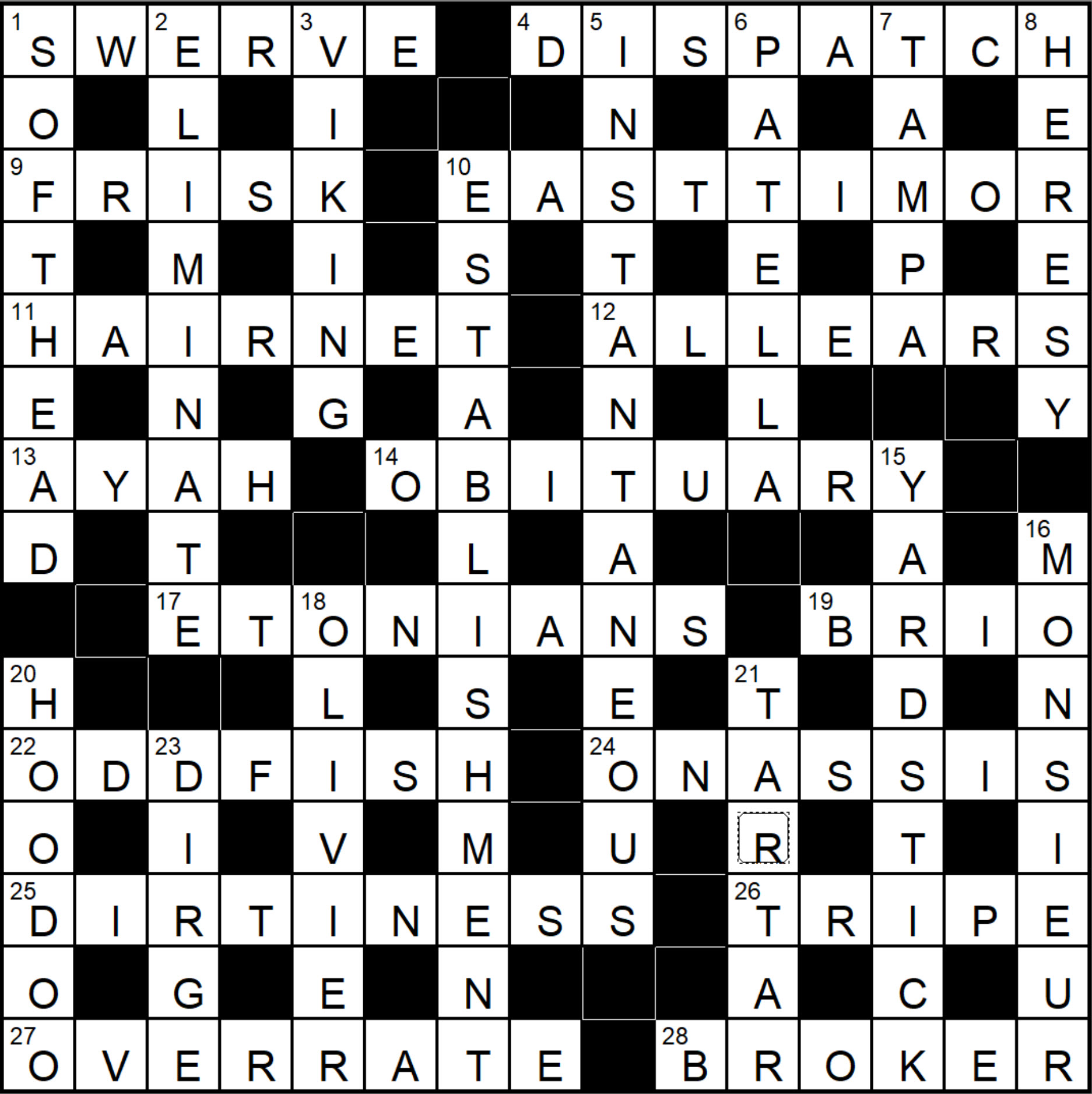
| No | Detail |
| Across | |
| 1 | Avoid wife opening present (6)
SWERVE (change direction suddenly; to sidestep or avoid) W (wife) contained in (opening) SERVE (give; present) S (W) ERVE |
| 4 | Coppers joining plot put to death (8)
DISPATCH (kill or put to death) DIS (Detective Inspectors; policemen; coppers) + PATCH (plot of land) DIS PATCH |
| 9 | Search female on the game (5)
FRISK (search) F (female) + RISK (example of a board game) F RISK |
| 10 | Drunkenly toast Emir in island state (4,5)
EAST TIMOR (Southeast Asian nation occupying half the island of TIMOR) Anagram of (drunkenly) TOAST EMIR EAST TIMOR* |
| 11 | A means of containing shock? (7)
HAIRNET (a means of keeping HAIR in place) HAIRNET (cryptic definition based on ‘shock’ meaning a mass of thick, shaggy HAIR and ‘keeping’ meaning ‘containing’) HAIRNET |
| 12 | Listening closely, as our new monarch is? (3,4)
ALL EARS (term used to describe someone listening closely) ALL EARS (King Charles III is often portrayed with big ears by cartoonists) cryptic definition ALL EARS |
| 13 | A yes from posh boy’s nanny (4)
AYAH (in India and other former British territories, a waiting-maid or nursemaid [nanny]) A + YAH (often considered to be a posh way of saying ‘yes’) A YAH |
| 14 | Notice that one is late (8)
OBITUARY (announcement of someone’s death) OBITUARY (cryptic definition based on the meaning of ‘late’ as ‘deceased’) OBITUARY |
| 17 | Schoolboys from different European nations (8)
ETONIANS (schoolboys who attend ETON School) Anagram of (from different) E (European) and NATIONS ETONIANS* |
| 19 | Liveliness of writer Faber finally promoted (4)
BRIO (liveliness) BIRO (pent; writer) with R (last letter of [finally] FABER) moved towards the beginning of the word (promoted) to form BRIO BRIO |
| 22 | Eccentric angle on love consuming theologian (3,4)
ODD FISH (a person of eccentric habits) (O [old] + FISH [angle, as in go angling]) containing (consuming) DD (Doctor of Divinity [theologian]) O (DD) FISH |
| 24 | Maybe Aristotle is to follow, riding donkey (7)
ONASSIS (reference Aristotle ONASSIS [1906 – 1975], Greek shipping magnate) ON (riding) + ASS (donkey) + IS ON ASS IS |
| 25 | Sinister duke revelling in filth (9)
DIRTINESS (filth) Anagram of (revelling) SINISTER and D (duke) DIRTINESS* |
| 26 | Ladyboy initially rejecting threesome? Rubbish! (5)
TRIPE (rubbish) TRIPLE (group of three) excluding (rejecting) L (first letter of [initially] LADYBOY TRIPE |
| 27 | Make too much of old judge holding vicar back (8)
OVERRATE (give too high a value to; make too much of) (O [old] + RATE [judge]) containing (holding) REV (REVerend ; vicar) reversed (back) O (VER<) RATE |
| 28 | Middleman increasingly hard up (6)
BROKER (go-between, negotiator or intermediary; middleman) BROKER (more [increasingly] hard up) double definition BROKER |
| Down | |
| 1 | S for simpleton? (8)
SOFTHEAD (simpleton) SOFTHEAD (I’m not sure how the word play works here – I can see S OF THE (S for?), but that leaves AD which I can’t do anything with. The clue is not of the exact same form as the similar ‘M for … at 16 down where M is an abbreviation for the answer MONSIEUR. S isn’t an abbreviation for SOFTHEAD) SOFTHEAD |
| 2 | Get rid of badly brewed ale in time (9)
ELIMINATE (get rid of) Anagram of (badly brewed) ALE IN TIME ELIMINATE* |
| 3 | Sex champion is a Scandinavian (6)
VIKING (any of the Scandinavian adventurers who raided, traded with, and settled in, many parts of Europe between the eighth and eleventh centuries) VI (Roman numeral for six [sex- is a combining form denoting six] + KING (chief; champion)) VI KING |
| 5 | Immediate tension as aunt erupts (13)
INSTANTANEOUS (immediate) Anagram of (erupts) TENSION AS AUNT INSTANTANEOUS* |
| 6 | Kneecap head with everyone’s backing? (7)
PATELLA (kneecap) PATE (head) + ALL (everyone) reversed (backing) PATE LLA< |
| 7 | Loudly muck about in US city (5)
TAMPA (city in Florida; United States city) TAMPA (sounds like [loudly] TAMPER [interfere unwarrantably or damagingly; meddle; muck about]) TAMPA |
| 8 | Dissent at present extremely scary (6)
HERESY (dissent) HERE (present) + SY (outer letters of [extremely] SCARY) HERE SY |
| 10 | Setting up shop perhaps (13)
ESTABLISHMENT (act of setting up) ESTABLISHMENT (a business, such as a shop) double definition ESTABLISHMENT |
| 15 | Measure of the Met’s credit? (9)
YARDSTICK (any standard of measurement) YARD’S (reference New Scotland YARD headquarters of the METropolitan police – YARD’S [of the MET’s) + TICK (credit) YARDS TICK |
| 16 | M for title of Emmanuel Macron (8)
MONSIEUR (Emmanuel Macron is a MONSIEUR [title of courtesy in France) MONSIEUR (M is an abbreviation for [M for] MONSIEUR) MONSIEUR |
| 18 | Actor, one imprisoned by Cromwell? (7)
OLIVIER (reference Laurence OLIVIER [1907 – 1989], English actor) I (Roman numeral for one) contained in (imprisoned by) OLIVER (reference OLIVER Cromwell [1599 – 1658], English statesman, politician and soldier) OLIV (I) ER |
| 20 | Magic party for the doctor, they say (6)
HOODOO (Chambers gives voodoo [magic] as a definition for HOODOO) HOO (sounds like [they say] WHO [reference Doctor WHO, fictional character]) + DOO (sounds like [they say] DO {party]) HOO DOO |
| 21 | Two seamen, one from central Asia (6)
TARTAR (Tatar [loosely, one of the mixed inhabitants of Tartary, Siberia and the Russian steppes, including Kazan; one from Central Asia) TAR (seaman) + TAR (seaman) giving two seamen TAR TAR |
| 23 | Lament return of drug network (5)
DIRGE (funeral song or hymn; a slow and mournful piece of music; lament) (E [ecstasy; drug] + GRID [network]) all reversed (return of) (DIRG E)< |
SOFTHEAD
SOFT HEAD …the head of SOFT=S
I think it must be this.
Seen clues like 1d before, parsed as KVa @1. “Famously”, when Paul had B as a clue for ‘Blockhead’, I initially thought of ‘Knob end’ which didn’t fit.
In 3d, I don’t think there is any need for using sex- as a prefix. Sex is Latin for ‘six’, as is VI.
Thanks for stepping in with such a clear blog, a good set of clues here , I think the SOFTHEAD clue is pretty neat. Similar to the Blockhead that Muffin@2 mentions and also the B clue for Bottle Opener, this one is much more sound.
Also agree with Muffin that sex=VI which is also very neat.
INSTANTANEOUS a very nice anagram .
Very enjoyable and possibly my fastest solve yet. Not that I time myself, just that it seemed to be over before I’d even finished my coffee!
Interestingly, I did the down clues first so if I’d answered them systematically, I may have had a similar experience to our blogger.
I liked SOFTHEAD and I parsed it as KVa did. Also ticked YARDSTICK and HAIRNET.
Thanks to Moo and Duncan for stepping in.
Roz @3. I’m not Muffin.
I’ve never heard of a softhead, nor odd fish, nor a game called Risk, nor an ayah (nor, for that matter, a posh way of saying “yes”!) VI/sex was a bit of a stretch.
Despite all this I managed to finish, and pretty quickly.
Very sorry Hovis , wrong bakery product, I will wake up soon.
Ha ha, very good, Roz.
Geoff, ‘OK yah’ was the affirmation of choice among the Sloan Rangers, Lady Diana’s neighbours in the 1980s.
Thanks Moo and Duncan
Further to Diane@8: Sloane Rangers are named after Sloane Square in London, so it is Sloane with an E, unlike the US jockey Tod Sloan who was mentioned last week with regard to the rhyming slang “on her/his/my/your tod”.
Liked the Latin sex in VIKING
WHO DO — Still waiting for a 60th anniversary Doctor Who theme. His enemies’ second favourite catchphrase appears alibi hodie (qv)
FrankieG @ 10
Inquisitor 1831 blogged a week ago had Doctor Who theme with the shape of the TARDIS containing 12 of the Doctor’s companions since 1963.
Thanks to everyone who explained the simple way to parse SOFTHEAD – I should have spotted that.
I think both sex- as a prefix for six and sex as Latinn for six are both valid for the part parsing of VIKING
The game of RISK (a strategy board game of diplomacy, conflict and conquest for two to six players) first appeared in 1957 and is still around today.
RISK was very popular when I was a student although the rules were slightly amended.
Geoff @6 , Diane mentions the Sloane Rangers but OK YAH spread to Yuppies in general during the 80s and 90s.
duncanshiell@11 – the Inquisitors are only available in the i dead tree edition, aren’t they? Shame I’m paperless. But thanks for the heads-up.
My loi — usually the sign of a good clue — was SOFTHEAD — a repunctuation of a word I’d never come across.
oed.com cites only ‘1851 – “Ha, Softhead! my Pylades—my second self!” – E. Bulwer-Lytton, Not so Bad
Thanks M&d
I am with GDU in not knowing YAH or RISK, but I found the clues easy to solve and backward parse. The only clue I could not parse was VIKING, not really knowing latin (or was that the NZ pronunciation?) and not seeing the sex- parsing. If it is latin (or NZish), shouldn’t there be a foreign language indicator of some sort? At least sex was not IT again.
My favourites were ALL EARS for its schoolboy humour, both long clues in the middle (ESTABLISHMENT was clever and I love a long anagram)and ODD FISH (nice surface).
Thanks to Roz@7 for teaching me that Hovis is a bakery – another new UK term under the belt for me.
Thanks Moo and thanks duncanshiell
I liked the SEX=VI because both are Latin/Roman for six , no need for any conversion to English.
Martyn@6 there is a famous UK advert for Hovis from the 1970s . A baker’s delivery boy on his bike and a very steep hill , with the New World Symphony by Dvorak in the background.
The BRIO BIRO link appears in Jonathan Cole’s “What a Carve Up”, where a phoned in review describing a writer lacking the necessary brio is printed as lacking the necessary brio.
Petert@17: You seem to have reversed the error. Presumably you meant “printed as lacking the necessary biro”.
PB@18 Oh dear. You are right of course. Thanks
Oh, I forgot to ask – since when has “loudly” been a homophone indicator (7d)? It is not in my Chambers crossword dictionary as such – and Chambers is the unquestionable word, right?
And that is before asking whether anyone on earth pronounces TAMPA and tamper the same way….
Martyn@20: I am sure I have seen “loudly” as a homophone indicator before, but I am not sure when it was first used. I can see no justification for it myself, but “loudly” is closer in meaning to “out loud”, which I think does work, than “extremely” is to any meaning that would justify its use as indicating the first and last letters of a word as used in 8dn.
As to who pronounces “Tampa” and tamper the same way, I do for one (except before a vowel of course).
Pelham@21 I think the justification for “extremely” as a selection indicator for the first and last letters is the adverbial form of the first meaning of “extreme” given in Chambers – namely “outermost”.
While we’re on the subject of ends indicators, I cannot find any justification for the use of “endlessly” as a deletion indicator for anything other than a last letter, despite is frequent use as a both ends deleter. “endless”, on the other hand, does at least mean without ends in the context of an endless belt, for example.
I agree with what you say about “loudly” – I don’t think that works as a homophone indicator any better than “noisily”.
Further to 21: Apologies for inconsistent use of quotation marks in the final paragraph. It occurred to see what the dictionaries have to say on the pronunciation issue. The only one of mine that gives pronunciations for both Tampa and tamper is Collins 2023, which indeed gives the same pronunciation for the two words.
Rudolf@22: I take your point about “extremely”. I know Azed has no authority over FT puzzles, but I remember he said he could see no justification for it when it started to be used. I do not think he has relented on that in his own clues: how he reacts in competition entries I am not so sure.
Funnily enough, I was always happy with “endlessly”. I would certainly talk about both ends of a road, at least in the case where they are both junctions. ODE 2010 gives end as a noun with the meaning “either of two places linked by a telephone call, letter, or journey” with the example “‘Hello’, said a voice at the other end.“. SOED 2007 gives “Either of the two extremities of a line, or of the greatest dimension of any object; a part of anything which includes either of its two extremities.” Can we work from any of those?
Rudolf@22 again: actually, does not your own use of the phrase “both ends deleter” give the necessary justification for “endlessly” without my having needed to rummage through the dictionaries?
Thanks PB@21 and@23. I will not argue with Collins on pronunciation.
But I did test it out and my Scandinavian friend Per was rather alarmed that I called him Pa.
Martyn @ 26
The pronunciation of PER and PA as standalones certainly differs
But in TAMPER and TAMPA the pronunciation is shaped by the preceding phoneme, hence to many ears they will/ sound the same
Thanks Moo and ds
Somewhat off topic, but regarding quotation marks, what is the consensus on when single vs. double marks should be used? I always thought that single marks should be used when referring to a specific word or name whereas double (otherwise known as speech marks) should be used when quoting what someone said etc. I find the usage in this blog and elsewhere totally inconsistent. I used to think it was a UK-US difference but now I’m just confused. Please can the grammar experts weigh in? Thanks!
Steve @ 28
I don’t think I would recommend using my blogs as a text book for English grammar. I tend to use single quotes in the blogs I write when referring to individual words. I use double quotes when copying and pasting preambles for barred crosswords, but I rarely use double quotes within a blog unless I am using something from another website or dictionary. I know I’m guilty of grammatical errors at times. For example, I omit quite a few full stops, misuse semicolons and commas and probably I mangle the English language in places as my focus is on trying to explain the parsing of the clues as clearly as possible.
I note that the double quotation marks on this page are all in the comments by different solvers, rather than in the initial blog.
Pelham@24&25. Thanks for your response. I’d agree with you if the word were “endslessly”, but my (probably pedantic) point is that “endlessly” does not readily lend itself to referring to both ends. I think the Clue Clinic takes this line.
Thanks Simon S@27. My mention@26 of my new father Per was an attempt at humour – very possibly an unsuccessful one.
Steve@28: My experience of official style on quotation marks comes from having been an author on papers in academic journals. Standard UK style is single quotation marks outermost, or if there is only one level of quotation, with double quotation marks for the inner quotation when one quotation appears inside another. US style is double quotation marks outermost and single quotation marks next inside. If there are three or more levels of quotations, the pattern is to alternate single and double. I once had a junior colleague who was the lead author of a paper accepted by a US-based journal. The proof copy came back to him with all of his single quotation marks changed to double (and perhaps vice versa). He wanted to put them back to how he had written them, but I explained to him that this was the difference between UK and US style and he then left things as they were.
Although I have never spent more than twelve consecutive nights of my life outside England, my personal preference is to use double quotation marks to avoid possible confusion between an apostrophe and the end of a quotation. Individual commenters will of course do what they please in this and all other matters.
Rudolf@30: The linguistic example I would follow here is “fingerless gloves”. A fingerless glove is a glove missing all of its fingers, not just missing one finger. I actually use one (on my writing hand) during the summer so that I can sit out in the sun and write without burning the back of that hand.
Martyn@26 I did appreciate your comment .
Quotation marks, I can only see the double ones on this keyboard . This site is the only time I ever type, I am fortunate that people will indulge me and type up all the things that I need in print, I think it is actually a specialist task with all the scientific notation.
Duncan@29 please use whatever style you feel like, bloggers are volunteers and doing us all a big favour.
Pelham@32 Part (ii). Chambers defines “fingerless” as “having no, or rudimentary or short, fingers”, and gives the principal meaning of “endless” as “having, or seeming to have, no end”, where “end” is defined as “the last point, or portion” or “termination or close”. I don’t think there is a good argument for linguistic equivalence here. The adverbial form “endlessly” must derive from the meanings of “endless” given in the dictionary.
On 7d TAMPA/tamper – Martyn@20, only for certain people in certain parts of the UK do they sound the same.
Collins online https://www.collinsdictionary.com/dictionary/english/tamper would disagree with Pelham Barton’s Collins 2023
giving different UK (t+æ+mp+schwa) and US (t+æ+mp+schwa+r) pronunciations with clickable speaker icons and embedded youtube videos.
[Also Sotheby’s will try to sell you 19-year-old trainers for $1000 while warning ‘Sneakers and Streetwear manufactured 10 years or more prior to date of sale may display signs of age and should not be worn.’]
I’m all for “aural wordplay” provided it’s fun – this was just annoying, Here’s a good one: “I’m so happy to hear the Waj’s weady! (7)” WHOOPEE
Rudolf@34: I think we will have to agree to differ.
Frankie@35: There are certainly places outside the UK where a reasonable proportion of the population does not sound a final R except before a vowel. Having agreed that “loudly” is not a suitable homophone indicator in any case, I do not think the clue for 7dn could have been faulted for soundness if it had said something like “Some say muck about in US city”.
Pelham Barton@32 et al
If the sunny summer you mention were to be described as ‘endless’, presumably that would mean that it never began?
DRC@37: The short but unhelpful answer would be to say that to describe a summer as “endless” would be factually incorrect whichever meaning was intended. However, I think we can do better than that. The only time I would talk about an “endless summer” would be figuratively, and it would mean not only that I cannot make any prediction for when it will end, but also that it has been going long enough that I cannot without some effort remember when it started. But that is all irrelevant to the discussion about the possible uses of “endlessly” as a text modifier in a crossword clue, a discussion which I think has already gone on long enough.
We’ll certainly have to agree to differ there. Those entering his competitions should note that Azed (a lexicographer by profession) to the best of my knowledge still does not accept ‘extremely’ to indicate the selection of both first and last letters, nor ‘endless’ or ‘endlessly’ to indicate their deletion.