Apologies for a slightly late and rushed blog – this was a tricky and well-clued puzzle and I especially liked 11ac, 26ac, 27ac, and 4dn. Thanks to Pasquale.
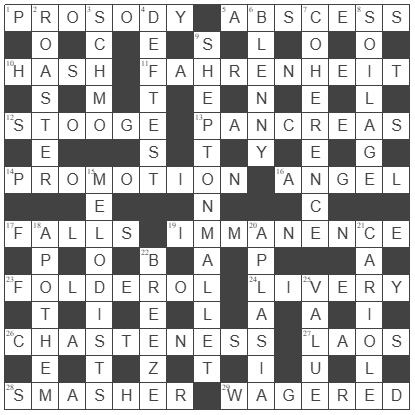
| ACROSS | ||
| 1 | PROSODY |
Party about to get immersed in long-winded study of linguistic elements (7)
|
|
DO="Party" reversed/"about", "immersed" inside PROSY=dull or tedious="long-winded" |
||
| 5 | ABSCESS |
Sailors about to join Eastern ship that contains unhealthy liquid (7)
|
|
definition: an abscess would contain pus ABS (AB is a sailor, with an S to make it plural); C (Circa, "about"); E (Eastern); SS (steam ship) |
||
| 10 | HASH |
Character providing reheated food (4)
|
|
double definition: the character/symbol # ; or a dish of food that has been cooked again |
||
| 11 | FAHRENHEIT |
Scientist producing exceptionally fine earth, hard to begin with (10)
|
|
definition: the physicist Daniel Gabriel Farenheit [wiki] anagram/"exceptionally" of (fine earth h-[ard])* |
||
| 12 | STOOGE |
Victim, say, sent back to be placed on seat interminably (6)
|
|
EG=e.g.=for example="say" reversed/"sent back" and placed after STOO-[L]="seat" without its ending i.e. interminably |
||
| 13 | PANCREAS |
Part of body with short line following knock (8)
|
|
CREAS-[e]="line" cut "short"; after PAN=to criticise="knock" |
||
| 14 | PROMOTION |
What ambitious employee seeks, against standing still (9)
|
|
to be PRO [in favour of] MOTION is to be "against standing still" |
||
| 16, 17 | ANGEL FALLS |
Natural wonder getting all fans excited, set inside (5,5)
|
|
anagram/"excited" of (all fans)*, with GEL="set" inside |
||
| 17 | ANGEL FALLS |
See 16
|
| 19 | IMMANENCE |
Divine quality came in men surprisingly (9)
|
|
definition: the quality of being present [in the context of a God, being present in and throughout the universe] anagram/"surprisingly" of (came in men)* |
||
| 23 | FOLDEROL |
Some stuff – older/oldest nonsense (8)
|
|
hidden in ("Some" of): [stuf]-F OLDER OL-[dest] |
||
| 24 | LIVERY |
End of ordeal with one extremely irritable (6)
|
|
definition: to be liverish or livery can mean "irritable", or suffering from a disordered liver end letter of [ordea]-L plus I="one" plus VERY="extremely" |
||
| 26 | CHASTENESS |
Hurry into church alongside saints, showing purity (10)
|
|
HASTEN="Hurry" inside CE (Church of England); alongside SS (abbreviation for "saints") |
||
| 27 | LAOS |
Country’s capital no longer losing heart (4)
|
|
LA-[g]-OS=former capital city of Nigeria="capital no longer", losing its "heart" or middle letter |
||
| 28 | SMASHER |
Attractive person in two American TV series, second coming first (7)
|
|
definition: a slang term for someone with great charm M*A*S*H [wiki] and ER [wiki] are "two American TV series", with S (second, unit of time) going in front |
||
| 29 | WAGERED |
Bet wife with time will get angry-looking? (7)
|
|
W (wife) + AGE="time" + RED="angry-looking" |
||
| DOWN | ||
| 2 | ROASTER |
Roll containing a piece of hot food? (7)
|
|
ROSTER="Roll" (a list of names, e.g. 'roll call'), around A (taken from surface) |
||
| 3 | SCHMO |
Brief while after school for dunce (5)
|
|
MO (a moment, a "Brief while"); after SCH (school) |
||
| 4 | DEFTEST |
Most skilful match with excellent opener (7)
|
|
TEST (a test "match" e.g. in rugby or cricket); with DEF=slang for 'brilliant'="excellent" placed at the beginning/opening |
||
| 6 | BLENNY |
Fish in lake caught by boy shortly (6)
|
|
definition: a fish of the genus Blennius L (lake) caught inside BENNY=short for a boy's name e.g. Benjamin |
||
| 7 | COHERENCE |
Firm in this place no longer with leader gone? That shows intelligibility (9)
|
|
CO (Company, "Firm"); plus HERE="in this place'; plus [o]-NCE="no longer" with its leading letter gone |
||
| 8 | SOILAGE |
Green fodder and fuel stored by wise person (7)
|
|
definition: green fodder e.g. used to feed livestock OIL="fuel" stored inside SAGE="wise person" |
||
| 9 | SHEPTON MALLET |
English town group embracing trendy fashion on promenade? (7,6)
|
|
SET="group", around all of: HEP (old fashioned way to say 'hip' or "trendy") plus TON ("fashion", from French usage as in e.g. 'bon ton') plus MALL="promenade" |
||
| 15 | MELODISTS |
The writer introducing fifty poets and singers (9)
|
|
ME (from the point of view of "The writer" of this clue); plus L ("fifty" in Roman numerals): plus ODISTS=writers of odes="poets" |
||
| 18 | APOTHEM |
Line in article penned by a Brit (7)
|
|
definition: a term for a certain kind of line in geometry THE (definite "article"); penned inside A POM=Australian term for "a Brit" |
||
| 20 | APLASIA |
Problem with organ in a small place above huge space (7)
|
|
definition: the imperfect development or absence of a body part or organ A (from surface) plus PL (small/abbreviated version of "place") plus ASIA="huge space" |
||
| 21 | CARIOLE |
Old mode of transport? I look up, beset by worry (7)
|
|
definition: aa type of horse-drawn carriage I (from surface), plus LO=exclamation/instruction to "look" reversed/"up"; all inside (beset by) CARE="worry" |
||
| 22 | BREEZE |
Something for making building blocks – it’s not hard to do (6)
|
|
double definition: reference to 'breeze blocks' made from concrete and used for construction; and if something is a breeze, it is easy to do |
||
| 25 | VALUE |
Think highly of university restricted by depression (5)
|
|
U (University) inside VALE=a valley, a geographical "depression" |
Very tough with the usual obscurities, but as ever, the clues can be solved from the wordplay, and therefore the Don makes it a fair contest. I enjoyed teasing out SHEPTON MALLET and had ticks for PANCREAS, STOOGE, PROMOTION, LIVERY, FOLDEROL, SMASHER, SCHMO, COHERENCE and BREEZE.
Ta Pasquale & manehi.
Can’t believe I’m the first one here, but I liked this a lot, though as ever the Don has a number of unfamiliar words or usages (LIVERY, APOTHEM, SOILAGE). My only quibble is the ‘providing’ in 10a, which held me up quite a bit, and I can’t say I’ve ever seen ROASTER with that meaning. Chambers would seem to agree.
24ac is also an archaic form of “delivery” (therefore a cryptic definition in respect of “end of ordeal” as well as the more obvious one re “irritable”). Every single clue fair and do-able. The doing still took me a fairly long time but I just love a struggle and I especially love learning new words. Really fell for the apothegm/APOTHEM trap and scratched my head for a long time before googling APOTHEM and seeing it is a real thing and a different kind of “line” to a “saying”. All glorious. Thanks all round.
Tough, quite a few unheard of words (but was expecting that from Pasquale) but managed to work my way through it.
I’m only a short distance from SHEPTON MALLET which helped with that.
Liked ABSESS and STOOGE
Thanks Pasquale and manehi
I meant to add re 3 d I always thought SCHMO was an ordinary fella and a schmuck was the dunce.
thanks M and P! I found the clues to be consistently sound with sensible surface readings (are you listening, Paul? 🙂 — anyway, wrt SOILAGE, I was only familiar with SILAGE (with basically the same meaning) which had me puzzled until I resigned myself to the wordplay).
Nice one from Don. Loved 23a. Down here on the south coast yonks ago the summer entertainment on the end of the pier were the Folderols. Happy memories. Needed the blog to suss out one or two obscurities though. Ta both .
Yes, these days when a Pasquale puzzle appears I’m now bracing myself for a few obscurities and today was no exception. SCHMO, SOILAGE, APOTHEM, APLASIA and CARIOLE were the unknowns for me. However, I steadily worked around them, playing a kind of waiting game. And the fact that there aren’t too many two-named English place names (is there a word for that sort of thing?) meant I also bided my time until there were enough crossers in place to spot SHEPTON MALLET.
Which is all rather a roundabout way of saying “I got there in the end” which appears to be a common or maybe just an occasional comment on here, I have noticed.
Haven’t heard FOLDEROL for a while, liked PROSODY and PANCREAS and PROMOTION. Many thanks Pasquale for the challenge and Manehi for the clarity this morning…
If the aim of this crossword was to damage my self-esteem by making me feel deficient in the scope of my lexicon, it has succeeded brilliantly. 🙂 IMMANENCE, BREEZE, SCHMO, FOLDEROL, LIVERY, APLASIA, DEF (in DEFTEST), PROSODY, APOTHEM, CARIOLE, BLENNY, along with a town that I doubt whether anyone this side of the Channel would have heard of. I had to reveal ROASTER. I don’t mind — indeed I quite enjoy — discovering one or two new words in each puzzle. All part of life’s rich tapestry! I finished but would have liked to have spent less time with the dictionary.
Thanks Pasquale and manehi
I thought that in places this wasn’t clued as carefully as usual from this setter; some components felt rather “that’ll do”. Examples include “huge space” for ASIA, “depression” for VALE. There are more.
Why is ROASTER “hot food”? If it’s referring to potatoes, for instance, they aren’t hot until they have been roasted.
A very satisfying puzzle to complete – a fine end to the week. Meticulous cluing, as expected from this setter, leading to three jorums (APOTHERM, SCHMO – I was initially held up because I read ‘dunce’ as ‘dance’ and APLASIA (a beautifully precise definition), which is always particularly gratifying.
There isn’t a dud clue in sight – and lovely surfaces throughout – but special mention for PROSODY, ABSCESS, STOOGE, ANGEL FALLS, IMMANENCE, FOLDEROL (a favourite word and yes, Cedric @)7, I remember the shows in Eastbourne in the ’60s), CHASTENESS, SMASHER (a long time since I heard that usage – and a lovely construction), COHERENCE, SHEPTON MALLET and BREEZE, which made me smile.
Many thanks to Pasquale for a most enjoyable puzzle and to manehi for a customarily fine blog.
Is there a difference between SOILAGE and silage or is it just a variant spelling in a rural accent? Before the crossers settled the matter I wondered about “MoilAGE” for a word I knew I didn’t know – it’s Christmas and mages are in season.
Other dnk’s were APOTHEM (not a variant spelling), APLASIA, CARIOLE and those meanings of LIVERY and ROASTER, but all at least fairly clued. Lots more interesting words, but no particular favourites today.
Chambers gives (old) for LIVERY in this sense; if you want to say this now you would use “liverish”.
Bin-worthy!
Tough, took most of the evening (while watching telly).
Curious that HEP, while meaning trendy, is dated, so is also the opposite of trendy.
I tried to make ROASTER (nho) ROTATOR and it almost works, at least for the wordplay. RR for Rolls (that’s where it doesn’t quite work) containing OTATO, which is a piece of potato, a “hot” food, as in hot potato. Now I’m wondering if there is a way to tweak the clue to give both answers, properly.
gladys@12. I wondered about that too, but having consulted the big red book, they are two separate words. Silage is from ‘stored in a silo’ and soilage is from Latin ‘satullus’ (via Old French) and means ‘full’.
I Googled SOILAGE as I thought it might be a mistake, but found that it refers to fresh greens fed to stock; silage has been stored and dried to some extent.
As others have said, very fairly clued, so that I was able to get LIVERY, ROASTER, SCHMO, SOILAGE, APOTHEM and CARIOLE. Didn’t greatly enjoy it, though, it all felt a bit of a slog; a bit reminiscent of Azed’s incessant “Oh, look at how clever I am and how big my vocabulary is!”
Each to his own.
Thanks, both.
Chewy, challenging – thanks to Pasquale and manehi for the blog. LOI was PROSODY, because it’s not a ‘study’ per se – it’s elements of spoken language that can be studied …
I’m not expressing this very clearly, am I!
Several obscurities including BLENNY, which my dictionary tells me is either a family of related fish of highly varied appearance; or a group of unrelated fish of similar appearance. Take your pick.
I stand by my opinion that names of fish that don’t appear regularly on the dinner plate are the last resort of a setter who has written themselves into a corner. (The same for other obscure flora and fauna.)
judygs@19: This is one of those cases where a little ignorance is an advantage 🙂 I knew that prosody had something or other to do with linguistics, but not its proper definition
Muffin@10: I considered potatoes, but I’ve only ever heard them called ROASTIEs, never ROASTERs. Chambers has ‘a pig, etc. suitable for roasting’, so that still doesn’t work.
I do this for fun and to fend off the brain rot. This one had a larger footprint in the second category than in the first, though at times it felt like the plan had already failed. My vocabulary crumbled like a sandcastle under a tsunami.
Oh well, we live and (probably don’t) learn. I’m pleased I finished. No reveals, as ever, but many visits to both dictionary and thesaurus. I guess we were due a genuinely hard one.
Thanks Pasquale and manehi.
In the U.S. a ROASTER can be a chicken or other roasted bird. But it’s not super-common. I was pleased to finish this puzzle, though a “breeze block” is new to me.
George@20: Scientists, sportsmen, actors and singers and mathematical terms are rarely criticised for obscurity, but once we enter the natural world, birds, beasts, bugs and fish we don’t eat are routinely deemed unfairly obscure – not to mention plants of all kinds.
judygs @ 19
I’m not sure what you mean. Chambers has
“prosody /prozˈ or prosˈə-di/
noun
1. The study of versification
2. The study of rhythm, stress and intonation in speech”
The OED has similar.
A slow but satisfying solve.
I found the possessive in 27a distracting as it’s neither part of the definition or the wordplay. I think the clue is clearer and cleaner without it.
Thanks Pasquale and manehi
In 2d, I read “containing a” as doing double duty, with a ROASTER being (when in use) something “containing a piece of hot food” .
Made it in the end, despite
1- trying to organise Xmas presents in between short sessions;
2 – the Guardian app on the tablet suddenly refusing to play, I think because the Android version it’s using is ancient (8.something), which meant is I was erring into the teeny tiny grid on my phone. Has anyone else had this happen?
Some slightly odd words, as others have noted: ROASTER when ROASTIE might be thought more usual, and SOILAGE rather than SILAGE, LIVERY rather than LIVERISH; thanks to manehi & various above for confirming that these are stretched but acceptable usages (well, it is Pasquale) .
Thermal physics seem to be having a bit of a moment, what with RANKINE the other day, now FAHRENHEIT; Stirling stuff.
Lots to like, but I’ll go with IMMANENCE as CotD.
Thanks Pasquale for the puzzle, and manehi for the blog.
The clues make sensible surface reading (unlike Paul), made this an enjoyable romp.
Paul would have found another was of cluing STOOL in 12a, of course.
The usual number of obscurities, but fairly clued.
Thanks both.
This was chewy and it defeated me in places, but I found it very enjoyable despite that. I was pleased to tease out a number of jorums – with the unlikely APOTHEM pencilled in very early on – but failed on words I did know (well, not PROSODY, but that’s too likely-sounding to be a jorum IMO).
I most enjoyed the kick-myself moments, such as falling – again – for verb infections which can be past tense as well as present; I don’t know how long I was looking at WAGER** before twinging what the last two letters needed to be!
I don’t agree with some of the quibbles raised. I’ll just say that after cheating on the aforementioned ***SODY, ROASTER was my LOI and I wasn’t surprised why. I interpreted it as the chicken as per Nakamova@24 (noting the missing American indicator) – but along the lines that others have followed I’d say that that term only applies when the bird is raw; I can’t imagine anyone referring to a cooked roast as a roaster, and certainly it didn’t occur to me until I had all the checkers.
Talking of which, Paul’s also getting quite a roasting today, but unfairly IMO. I’ve found his surfaces much better of late.
Thanks both.
Simon S @26
I understand ‘prosody’ to embrace features of spoken language such as intonation, rhythm and stress – to define it as a *study* of those elements seems to be a conflation of concepts. Whatever some important dictionaries say!
[Re me@ 31: That said, and to Balfour’s point about the lack of comments on yesterday’s puzzle, I just found it a bit of a headache and didn’t have the energy for it. It was interesting to read that some people who often find Paul intractable found yesterday’s easier, and many of those of us who find his work (different but) usually accessible couldn’t get on the wavelength. He really is a marmite setter!]
Well! The six or seven I didn’t get today were all NHOs, so I doubt I’d have got them if I’d spent the rest of the day trying. The rest was enjoyable, if tough going. Oh – and I couldn’t parse Shepton Mallet despite seeing it early on from a couple of crossers. Thanks to setter for the work-out and blogger for the help.
I recall my mother referring to chickens as ‘boilers’ or ‘roasters’ when buying them at the butcher’s. I believe the essential difference was in the age of the birds. This was in Liverpool, so I’d dispute that ‘roaster’ is purely American usage.
It’s the age of the bird tells the difference between the roaster and boiler. If you pick the bird up by the beak and it bends the bird is young enough to roast, if not it needs boiling or casseroling. But unless you’ve handled birds before plucking and drawing, it’s not something you would know.
Shanne@36: is it whether or not the beak itself bends that’s the telltale, rather than some other bit of the bird? (I’m not being sarcastic – I actually don’t know! I didn’t know beaks could be bendy.)
However you identify whether the bird is a roaster or boiler, it won’t be “hot food” until you have actually cooked it!
Yes, a good workout today. A greater list of unknowns for me too, along with a bunch of others I’d have a hard time defining. Interesting that SOILAGE and SILAGE are actually different. Had me wondering too. In 28a, I was trying to work out why Tunn might be a US TV series before the inevitable PDM.
My favorite was ANGEL FALLS, which I was able to construct before being rewarded with beautiful views on Google.
Thanks, Pasquale and manehi. Fine blog, despite the rush.
DerekTheSheep @37- yes, how flexible the beak is indicates the age of the bird, so how tough it’s going to be to cook.
Shanne@40 – thank you : a. veritable TILT.
I agree with Muffin @10. Some of the clueing used very vague synonyms/examples.
Poor Pasquale and poor Paul, too. They can’t please all of the solvers all of the time, no matter how hard they try. (The latter even gets it in the neck when it’s not his turn!) While the other Ps, Puck and Picaroon were universally praised just for getting out of bed and putting their glasses on.
I enjoyed the challenge today, with some new words, some that are not used very much if at all, and some that were half or even only a quarter known to my decrepit memory. LIVERY used to be a uniform for servants, or a service provided to horses; the meaning here was always called liverish, in my experience. CARIOLE was only a shimmer on the horizon when I looked at the word play, but gradually came nearer. I almost had APLASIA on the tip of my tongue, but it vanished into the air. And I spent ages saying confidently to myself that SOILAGE couldn’t possibly be a thing despite what the word play was telling me – but of course it was.
Pasquale certainly uses obscure words, or obscure meanings or synonyms for words that are better known in other guises, but why are we complaining about it – isn’t that part of the crossword setter’s art? Accept the challenge, enjoy the tussle, learn something new and try not to have mislaid it next time it comes up.
Thanks to the Don and to Manehi for the blog, which may have been a little late but didn’t seem rushed.
SheffieldHatter@43: well said!
I did a little better than yesterday — three unsolved, after working on and off through the day. The bottom went in more readily than the top. Clues were well constructed, but unlike Eileen@11 and others I generally wasn’t taken with the surfaces. They read like real phrases, but don’t have real-world meaning. Best probably 2d ROASTER
Thanks both!
Thanks Pasquale for a great puzzle, which – as expected – prompted a bit of searching to confirm deduced solutions as right.
As for SCHMO etc., I often wonder what the disparaging exclamation of New York’s supporters of the Israel national football side was when Peter Schmeichel saved one of their shots?
Cheers all.
I understand Soilage is quite distinct from Silage.
Silage is fermented grasses whereas soilage is just freshly cut grasses. (I didnt know this before)
Fortunately I also wasnt distracted by the knowledge of APOTHEGM, but also didnt know APOTHEM
Lots of new words for me. Too many to finish without disclosing quite a few, but nothing unfair and thanks for the very clear blog.
Breeze is also another word for cinders which are mixed with concrete to make a (relatively) light weight building blocks known in the states strangely enough as under blocks.
Mixed with cement sorry
Tony@48. Your spellchecker seems to have decided that cinder blocks should be called “under” blocks!