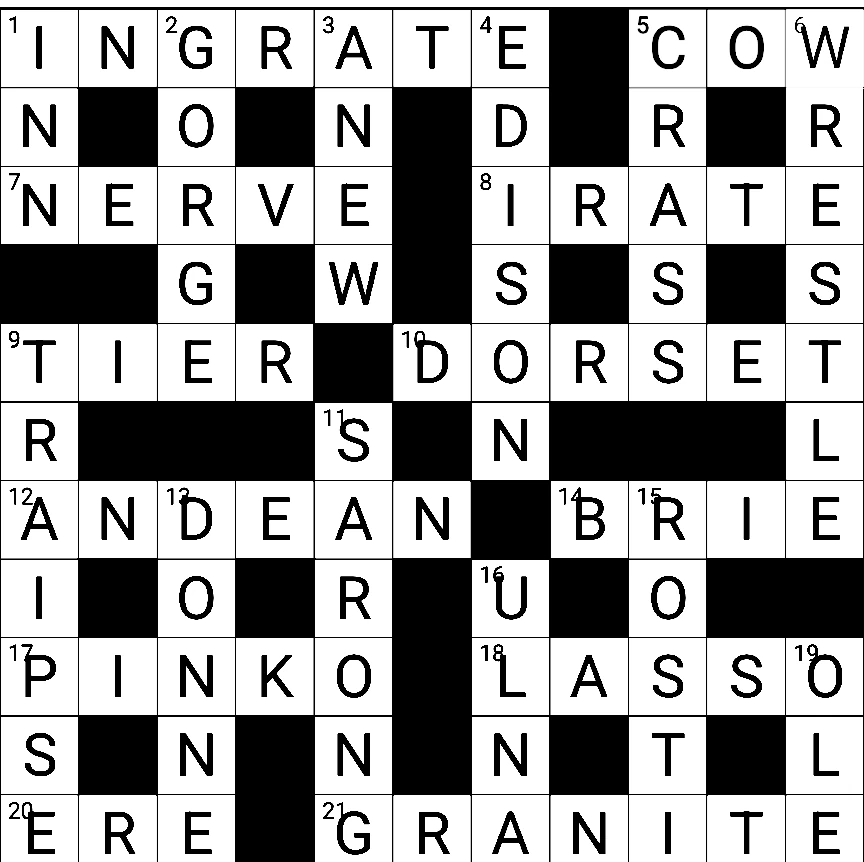
This week’s 11 x 11 crossword from the Guardian intended to teach cryptic crosswords, found here
This week’s puzzle is the 12th from Ludwig, who sets occasional Cryptic and special puzzles for the Guardian. The first puzzles from Ludwig were published with the first series of the Ludwig detective series, and at that time was said to be a team of the Observer’s Everyman, Alan Connor, and Enigmatist, but since then Alan Connor, the Guardian crossword editor, has blogged that other setters have been involved. Today we have anagrams, acrostics, hidden words and alternate letters clues with all the letters present in the clue, which makes for a good puzzle for beginners.
The whole point of these crosswords is support and encouragement of new solvers, so special rules for these crosswords apply – see here – those rules include not posting solving times.
This blog continues to develop in response to suggestions. We hide the answers and the wordplay descriptions (parsing) too. To find the solution click on “Answer” and to find how the word play works, click on “Parsing” which will reveal the hidden information. You can choose to reveal everything using the “Expand All” button. If you have partially revealed the page, refreshing it will clear that, and allow you to expand all. The definition is in bold and underlined, the indicator is in red.
For additional help click here
There is a summary of the tricks used in the first six months here and a Guardian Crossword blog called the ultimate beginner’s guide has tips which may be useful for some solvers
For abbreviations and clue tips click here
Fifteen Squared uses several abbreviations and jargon tricks, there’s a full list here, of which I’ve used the following in this blog:
- underlining the definition in the clue – this is either at the beginning or end of the clue
- indicators are in red.
- CAPITALS to indicate which bits are part of the answer, e.g. haVE ALtered for the example.
- anagram – letters being used shown in brackets (SENATOR)* for the clue below to give TREASON.
- anagrind – anagram indicator – in the case below it is “arranged”
- soundalike – is indicated by “Wilde” – so in the example, Oscar “Wilde”, the playwright and author, is indicating the soundalike WILD.
- charades – the description below only gives the example of words being added together, but charades can be more complicated, adding abbreviations or single letters to another word. Examples previously used in this series are: Son ridicules loose overgarments (6) S (son) + MOCKS (ridicules), Get rid of dead pine (5) D(dead) + ITCH (pine) – D ITCH, and early on DR (doctor) + IVE (I have) to give DRIVE.
- reversals – the reversal element of a clue is indicated by < – so in the example clue below, VieTNAm <.
- CAD or clue as definition– where the whole clue gives the definition, sometimes called an &lit. These are rare.
- DBE or definition by example – e.g. where a dog might be clued as a setter – often using a question mark, maybe, possibly or e.g. to show that this is an example rather than a definition.
- surface – the meaning from reading the clue – so often cryptic clues use an English that could only be found in a cryptic crossword, but a smooth surface is a clue that has a meaning in English, which can be pointed or misleading.
TODAY’S TRICKS – from the crossword site – because the clues have moved on from the clue descriptions below, I am now adding more to the descriptions hidden above. Clues begin or end with a definition of the answer. The rest is one of these:
- Anagram Anagram of answer and hint that there’s an anagram
‘Senator arranged crime (7)’ gives TREASON - Hidden word(s) Answer hidden in clue’s words
‘Some haVE ALtered meat (4)’ gives VEAL - Acrostic First letters of answer
‘Initially Get A Good joke (3)’ gives GAG - Alternate letters Choose every other letter for answer
‘Oddly EnViEd First Lady? (3)’ gives EVE
| ACROSS | Click on “Answer” to see the solutions | |
| 1 |
Thankless type tearing around (7)
|
AnswerINGRATE |
Parsinganagram of (TEARING)* with an anagrind of “around” for a word derived from the Latin for someone who is ungrateful. Checking to see how common it is, the cited usages are all in books, ranging from Great Expectations and more recent books. |
||
| 5 |
Bully chases off wimp, to begin with (3)
|
AnswerCOW |
Parsingacrostic (to begin with) in Chases Off Wimp. |
||
| 7 |
Audacity under review now and again (5)
|
AnswerNERVE |
Parsingalternate letters (now and again) of uNdEr ReViEw. |
||
| 8 |
Pirate’s not entirely mad (5)
|
AnswerIRATE |
Parsinghidden word(s) (not entirely) in pIRATE‘s |
||
| 9 |
Toiletry, every so often, is rank (4)
|
AnswerTIER |
Parsingalternate letters (every so often) in ToIlEtRy – think of ranks of seating in a stadium. |
||
| 10 |
Sorted out where to see Jurassic Coast (6)
|
AnswerDORSET |
Parsinganagram of (SORTED)* with an anagrind of “out” for one of the counties where the Jurassic coast is found. Having just looked it up, more of that area is defined as being part of the Jurassic coast than I thought. I used to know the eastern end reasonably well – when we lived in this area, we used to drive down to the coast in the evenings after school and spend the evening on the beach, arriving as the grockles (tourists) went home, driving home as it got dark. |
||
| 12 |
Somewhat wan deaneries in the mountains (6)
|
AnswerANDEAN |
Parsinghidden word(s) (somewhat) in wAN DEAN, for an adjective which refers to specific South American mountains, so the definition does need “in the mountains”. |
||
| 14 |
Debriefs, including cheese (4)
|
AnswerBRIE |
Parsinghidden word(s) (including) in deBRIEfs – for one of two cheeses regularly found in cryptic crosswords. The other is EDAM – when I read cheese in a clue, I start looking for one or the other. |
||
| 17 |
Left-winger providing some Agitprop in Kosovo (5)
|
AnswerPINKO |
Parsinghidden word(s) (providing some) in agitproP IN KOsovo – for a term for left-winger. Checking Wikipedia, this term was coined in Time in 1920, with the most recent usages being recorded during apartheid in South Africa. |
||
| 18 |
Rope ladder aboard ship seafarers observed at first (5)
|
AnswerLASSO |
Parsingacrostic (at first) of Ladder Aboard Ship Seafarers Observed. There are a couple of cryptic tricks to note. Firstly, there’s use of a phrase that needs splitting into component parts to decode the clue. “Rope ladder” needs dividing (sometimes described as to “lift & separate”) into the two words: the definition is “rope”; “ladder” is part of the wordplay. Secondly, the surface, how the clue reads as a sentence without looking at the wordplay, attempts to suggest boats and sailing (or would without the slightly clunky “observed”) with rope ladders up the rigging. Second caveat on that image – I’d refer to ratlines, the correct sailing terminology, so use of “rope ladders” also prevents the clue from creating the intended image for me. |
||
| 20 |
Regularly wearied, before, before (3)
|
AnswerERE |
Parsingalternate letters (regularly) of wEaRiEd. The solution is a poetic version of “before”, and the doubling up of the same word in a clue is a trick much used by Everyman (in the Observer). I suspect the intention here is to make the clue more poetic. |
||
| 21 |
Bananas gratiné, very hard (7)
|
AnswerGRANITE |
Parsinganagram of (GRATINÉ)* with an anagrind of “bananas”. The term comes from a type of rock, relatively harder because of igneous formation – but there’s a metaphorical cliche of describing the strong silent man as having a jaw made of this rock. |
||
|
DOWN
|
||
| 1 |
Sinning, oddly not in alehouse (3)
|
AnswerINN |
Parsingalternate letters (oddly not) of sInNiNg – the instructions tell us to take the even letters, as “oddly not” means removing the odd letters. |
||
| 2 |
Eat too much egg; okra, ghee oddly ignored (5)
|
AnswerGORGE |
Parsingalternate letters (oddly ignored) of eGg OkRa GhEe – the rubric says to only take the even letters here too, but to do that you have to read the three words as one block of letters. It’s an odd surface, I can’t think of a recipe where I’d use eggs, okra and ghee together, not without a lot of other ingredients. |
||
| 3 |
Starters of artichokes not eaten, wasted again (4)
|
AnswerANEW |
Parsingacrostic (starters of) of Artichokes Not Eaten Wasted. |
||
| 4 |
Inventor is done wrong (6)
|
AnswerEDISON |
Parsinganagram of (IS DONE)* with an anagrind of “wrong” for this inventor. This is another crossword trope – when I read inventor in a clue, this is the one I think of first. |
||
| 5 |
Oafish, crude, rude and stupidly swinish, principally (5)
|
AnswerCRASS |
Parsingacrostic (principally) of Crude Rude And Stupidly Swinish – the surface suggests Ludwig doesn’t like oafs. |
||
| 6 |
Swelter unpleasantly in scuffle (7)
|
AnswerWRESTLE |
Parsinganagram of (SWELTER)* with an anagrind of “unpleasantly” – with a nice surface summoning up the image of fighters sweating with effort. |
||
| 9 |
Drunken pirates move nonchalantly (7)
|
AnswerTRAIPSE |
Parsinganagram of (PIRATES)* with an anagrind of “drunken” – and I am going to quibble about the definition here – checking the dictionary definition, I’m not sure where “nonchanantly” is coming from. |
||
| 11 |
A little antimacassar on Gainsborough (piece of cloth) (6)
|
AnswerSARONG |
Parsinghidden word(s) (a little) in antimacasSAR ON Gainsborough – for this piece of fabric. And another surface that doesn’t work for me – an antimacassar is a very Victorian solution for interiors, those little bits of cloth over the backs of chair upholstery to save it from the oil used on hair. Gainsborough is either a town in Lincolnshire or an famous artist of the 18th century who painted portraits often set in landscapes. He’s known for portraiture and the landscapes he painted in his later career, not domestic settings. |
||
| 13 |
Poet doesn’t offer nemesis nice elegy in introductions (5)
|
AnswerDONNE |
Parsingacrostic (in introductions) of Doesn’t Offer Nemesis Nice Elegy referring to this poet, known for epigrams and elegies, sermons and poems. He coined “no man is an island”. I suspect Ludwig meant to use “epigram” not “elegy” because it was in the epigrams that nemesis appeared. One of his most famous elegies is “To His Mistress Going to Bed”. |
||
| 15 |
Fried dish covered in frosting (5)
|
AnswerROSTI |
Parsinghidden word(s) (covered in) in fROSTIng for this fried dish, I think of a side dish, but apparently, according to the Wiki link, this was originally a complete breakfast, not the side dish I thought it was. The surface works for doughnuts, which are fried goods that can get covered in frosting. |
||
| 16 |
Bone periodically found in Dublin Bay (4)
|
AnswerULNA |
Parsingalternate letters (periodically found in) dUbLiN bAy for one of the bones of the forearm – having broken one of mine, those two forearm bones working together allow us to rotate our wrists. |
||
| 19 |
Principal characters in old Léon express Spanish appreciation (3)
|
AnswerOLE |
Parsingacrostic (principal characters) of Old Léon Express with a meaningful surface, Léon being a Spanish city. |
Thanks Shanne. I was puzzled by the clue for ERE, but simply assumed that the second “before” was added to indicate that it is an archaic term for “before”.
Thanks Ludwig for a relaxing start to the day.
Humble Tim @1 – but the Chambers definition of ERE just marks it as literary, not archaic – I’ve just known it as a poetic.
I think more than one clue is a bit sloppily drawn here – nonchalantly for traipsing for example – Chambers describes traipse as: to trail, to trudge, to gad, to go in a slatternly manner. And it gives nonchalance as unconcern, coolness, indifference.
I enjoy Donne’s language and ideas enough to own a book of his works (it’s not just poetry), so wince at that clue too.
Popped in to see how this excellent initiative works, and the answer is……excellently.
Shanne, I concur a few clues are a tad loose, but if one is learning the game, it’s fair preparation for the full-fat versions, which often have iffy clues themselves!
Great stuff.
Thanks for the blog, Shanne. I also wondered about the double before, and thought it may be archaic, as HumbleTim@1 suggests. But Shanne is probably right, and it is supposed to be poetic.
I accidentally started off solving the quick crossword instead of the quick cryptic, and was surprised I hardly got any solutions on the first parse through… First one I had was “idle types – footwear” (loafers), which is somewhat cryptic, but onceI got to the “you, once” (thou) I realised it was a straight crossword… I must say, I find cryptic crosswords easier
Thanks Shanne and thanks Ludwig. Today’s QC went by far too quickly and so I’ve decided I need to challenge myself more by NOT looking at the clue type hints unless I’m completely stumped. I did find some of today’s clues a bit clunky sounding/reading – like ‘wan deaneries’ and ‘antimacassar on Gainsborough’, but still fun to do.
That was an interesting one – the wordplay was relatively straightforward with no charades, soundalikes etc, but the definitions were sometimes a bit stretchy and I reckon some people may find some of the solutions (pinko, ere, ingrate etc) a little obscure. I guess it’s teaching different skills to other quick cryptics!
Merriam-Webster tags ERE as “old-fashioned, literary”; Collins online labels it as “poetic, old”. Both of which support the extra “before.”
If I were to make fried okra, my batter might include eggs (but in many/most (but by no means all–I just looked online) recipes the okra’s own goo is sufficient binder for the breading, which is the whole point to the dish); and I could imagine pan-frying it in ghee, but no self-respecting Southerner would do it that way. Even if you did that, though, you’d call the result okra, not “eggs, okra and ghee”. (In other words, I agree with the blog.)
Dutch girl#4
Unlike you I did this first and read the comments before trying the Quick. Solving 5d was hindered for a while by having read and accepted your solution for 11a!
Thanks go to Shanne and the setters for all the hard work.
I had 1 down as a hidden word.
This is only the second of these that I’ve completed in one short sitting. A huge boost! I find Ludwig to be on my wavelength.
Thank you, setter and Shanne.
Thanks for this; I’ve been very glad to have discovered this site as I foray into the twisted world of cryptic crosswords. I would agree that some of the clues seemed a little dubious, however, for 11D, “Gainsborough” I believe would be referring to a Gainsborough chair, which is an armchair of a specific style, presumably originally produced in Gainsborough (or something along those lines).